Oxford Twenty-First Century Approaches to Literature – serie
Visar alla böcker i serien Oxford Twenty-First Century Approaches to Literature. Handla med fri frakt och snabb leverans.
10 produkter
10 produkter
2 728 kr
Skickas inom 3-6 vardagar
This is an open access title available under the terms of a CC BY-NC-ND 4.0 International licence. It is free to read at Oxford Academic and offered as a free PDF download from OUP and selected open access locations.Literature and the Senses critically probes the role of literature in capturing and scrutinizing sensory perception. Organized around the five traditional senses, followed by a section on multisensoriality, the collection facilitates a dialogue between scholars working on literature written from the Middle Ages to the present day. The contributors engage with a variety of theorists from Maurice Merleau-Ponty to Michel Serres to Jean-Luc Nancy to foreground the distinctive means by which literary texts engage with, open up, or make uncertain dominant views of the nature of perception. Considering the ways in which literary texts intersect with and diverge from scientific, epistemological, and philosophical perspectives, these essays explore a wide variety of literary moments of sensation including: the interspecies exchange of a look between a swan and a young Indigenous Australian girl; the sound of bees as captured in an early modern poem; the noxious smell of the 'Great Stink' that recurs in the Victorian novel; the taste of an eggplant registered in a poetic performance; tactile gestures in medieval romance; and the representation of a world in which the interdependence of human beings with the purple hibiscus plant is experienced through all five senses. The collection builds upon and breaks new ground in the field of sensory studies, focusing on what makes literature especially suitable to engaging with, contributing to, and challenging our perennial understandings of, the senses.
686 kr
Skickas inom 7-10 vardagar
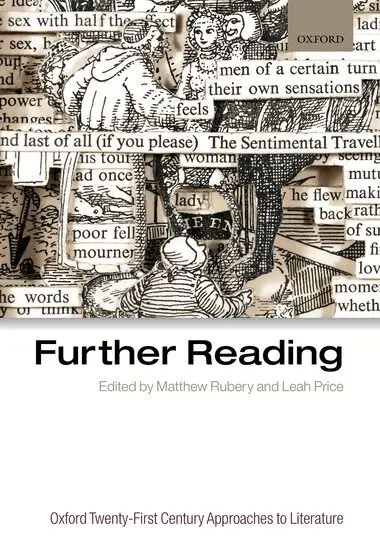
What does reading mean in the twenty-first century? As other disciplines challenge literary criticism's authority to answer this question, English professors are defining new alternatives to close reading and to interpretation more generally. Further Reading brings together thirty essays drawing on approaches as different as formalism, historicism, neuroscience, disability, and computation. Contributors take up the following questions: What do we mean when we talk about 'reading' today? How are reading techniques evolving in the digital era? What is the future of reading?This book foregrounds reading as a topic worthy of investigation in its own right rather than as a sub-section of histories of the book, sociologies of literacy, or theories of literature. As our knowledge of reading changes in step with the media and the scholarly tools used to apprehend it, a more precise understanding of this topic is crucial to the discipline's future. This collection introduces new ways of conceptualizing the term's forms, boundaries, and uses. Its contributors bring varied vocabularies to bear on the contested nature and continued importance of reading, within the academy and beyond.
2 858 kr
Skickas inom 7-10 vardagar
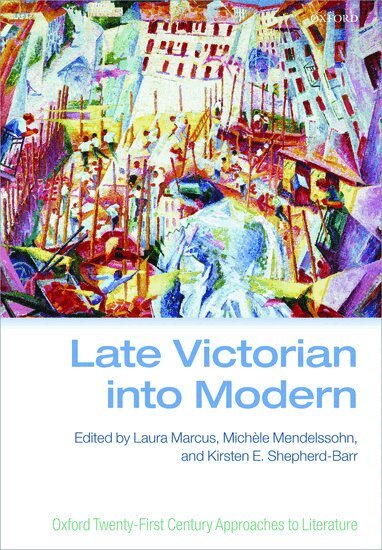
The original essays in Oxford Twenty-First Century Approaches to Literature mean to provoke rather than reassure, to challenge rather than codify. Instead of summarizing existing knowledge scholars working in the field aim at opening fresh discussion; instead of emphasizing settled consensus they direct their readers to areas of enlivened and unresolved debate.This volume opens up, in new and innovative ways, a range of dimensions, some familiar and some more obscure, of late Victorian and modern literature and culture, primarily in British contexts. Late Victorian into Modern emphasises the in-between: the gradual changeover from one period to the next. The volume examines shared developments, points out continuities rather than ruptures, and explores and exploits an understanding of the late nineteenth to the early twentieth centuries as a cultural moment in which new knowledges were forming with particular speed and intensity. The organising principle of this book is to retain a key focus on literary texts, broadly understood to include familiar categories of genre as well as extra-textual elements such as press and publishing history, performance events and visual culture, while remaining keenly attentive to the inter-relations between text and context in the period. Individual chapters explore such topics as Celticism, the New Woman, popular fictions, literatures of empire, aestheticism, periodical culture, political formations, avant-garde poetics, and theatricality.
2 057 kr
Skickas inom 5-8 vardagar
Futures examines the relevance of futures studies to literary studies. It demonstrates how the growing interest in futures thinking is opening up multidisciplinary conversations and initiatives, examining historical and contemporary forms of futures knowledge, the methodologies and technologies of futures expertise, and the role played by different institutions on legitimising, deploying, and controlling anticipatory practices.Bringing together emerging perspectives on the future from diverse disciplinary perspectives including critical theory, design, anthropology, sociology, politics, and history, this book places the provocation of power at the heart of the book through an investigation of futures as both objects of science and objects of the human imagination, creativity, and will. A multidisciplinary team of contributors challenge and debate the varied ways in which futures are conjured and constructed, exploring issues as diverse as the utopian imagination, history and philosophy, literary and political manifestos, artefacts and design fictions, and forms of technological and financial forecasting, big data, climate modelling, and scenarios. The book positions the future as a question of power, of representations and counter-representations, and forms of struggle over future imaginaries. Forms of futures-making depend on complex processes of envisioning and embodiment. Each chapter investigates the critical vocabularies, genres, and representational methods - narrative, quantitative, visual, and material - of futures-making as deeply contested fields in cultural and social life.
2 021 kr
Skickas inom 5-8 vardagar
What does reading mean in the twenty-first century? As other disciplines challenge literary criticism's authority to answer this question, English professors are defining new alternatives to close reading and to interpretation more generally. Further Reading brings together thirty essays drawing on approaches as different as formalism, historicism, neuroscience, disability, and computation. Contributors take up the following questions: What do we mean when we talk about 'reading' today? How are reading techniques evolving in the digital era? What is the future of reading? This book foregrounds reading as a topic worthy of investigation in its own right rather than as a sub-section of histories of the book, sociologies of literacy, or theories of literature. As our knowledge of reading changes in step with the media and the scholarly tools used to apprehend it, a more precise understanding of this topic is crucial to the discipline's future. This collection introduces new ways of conceptualizing the term's forms, boundaries, and uses. Its contributors bring varied vocabularies to bear on the contested nature and continued importance of reading, within the academy and beyond.
1 084 kr
Skickas inom 5-8 vardagar
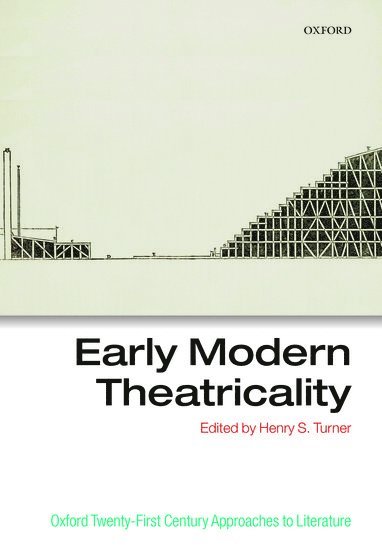
The original essays in Oxford Twenty-First Century Approaches to Literature mean to provoke rather than reassure, to challenge rather than codify. Instead of summarizing existing knowledge, scholars working in the field aim at opening fresh discussion; instead of emphasizing settled consensus, they direct their readers to areas of enlivened and unresolved debate.Following the models established by previous volumes in the Oxford Twenty-First Century Approaches to Literature series, Early Modern Theatricality launches a new generation of scholarship on early modern drama by focusing on the rich formal capacities of theatrical performance. The collection gathers some of the most innovative critics in the field to examine the techniques, objects, bodies, and conventions that characterized early modern theatricality, from the Tudor period to the Restoration. Taking their cues from a series of guiding keywords, the contributors identify the fundamental features of theatricality in the period, using them to launch conceptually adventurous arguments. The volume generates fresh possibilities for criticism by combining historical, formal, and philosophical questions, in order to provoke our rediscovery of early modern drama in all its complexity and inventiveness.
2 368 kr
Skickas inom 5-8 vardagar
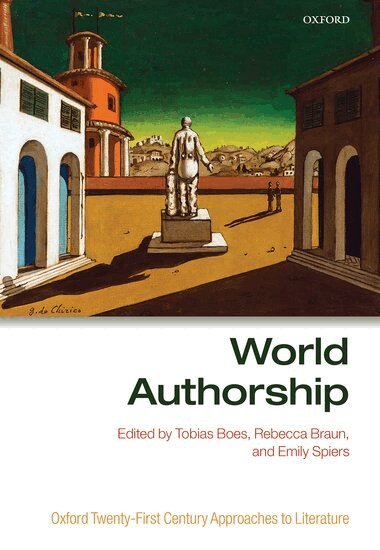
The original essays in Oxford Twenty-First Century Approaches to Literature mean to provoke rather than reassure, to challenge rather than codify. Instead of summarizing existing knowledge, scholars working in the field aim at opening fresh discussion; instead of emphasizing settled consensus they direct their readers to areas of enlivened and unresolved debate.Booksellers, authors, and academics have been talking about world literature since Goethe made the term fashionable in the early nineteenth century. Yet amidst all the talk of books that 'circulate' and literature as a kind of universal property that can function as a 'window on the world', how do we account for the people who live in real places, and who write, translate, market, and read the texts that travel on these global journeys? World Authorship breaks new ground by showing how to bring together the real-world contexts of authorship with the literary worlds of fiction.Written by world-leading academics and creative professionals including authors, translators, publishers, editors, prize jurors, and literary festival organizers, World Authorship updates Michael Foucault's 'author function' by significantly expanding the network of people and practices involved in literature. It covers keyword aspects of world authorship, grounding them in the study of actual literary texts to illuminate how literature is shared and made in different parts of the world and at different times in history. At the heart of all contributions, however, is one key question: where is the human element in world literature? By covering everything from 'Beginnings' to 'Voice', World Authorship provides the answer.
3 340 kr
Skickas
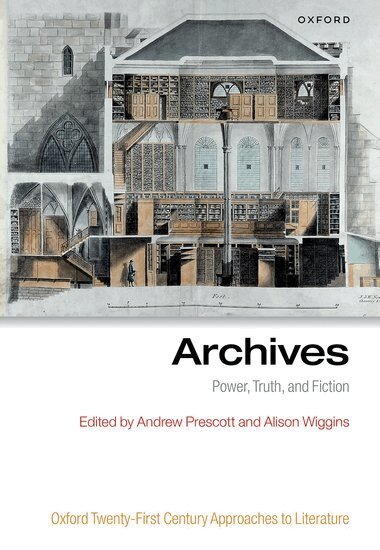
Chapter 23 is published open access under a CC BY-NC-ND 4.0 license and is free to read or download from Oxford Academic.Archives have never been more complex, expansive, or ubiquitous. Gargantuan in scale and conception yet never sufficient or complete, the archive is on the one hand a space for empowerment and expression and on the other an instrument of constraint and repression. The way in which the archive is structured, made available, and developed plays a central role in how societies define their values and ethics. Archives: Power, Truth, and Fiction is a wide-ranging and innovative volume which highlights the vibrancy and urgency of the field by bringing together contributors from many different disciplines and backgrounds, including archivists, historians, literary scholars, digital researchers, and creative practitioners.The archive of the twenty-first century is a fluid and multi-vocal space that challenges at every point the hegemonic and positivistic assumptions which shaped traditional ideas of the archive. The massive growth of digital archives further complicates the picture. Archives: Power, Truth, and Fiction is designed to help the reader draw threads through the rapidly changing and shifting multiverse of archives. The interdisciplinary and international contributors use a wide range of examples, from the Middle Ages to the Windrush scandal, to unsettle preconceptions, encourage debate, and draw out issues generated by the perpetual motion of the archive.
2 271 kr
Skickas inom 5-8 vardagar
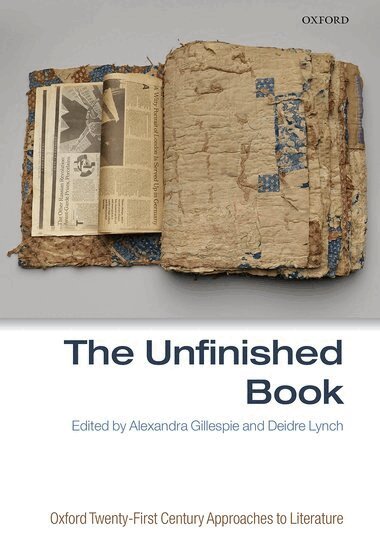
This collection is founded on the premise that the physical book is far from exhausted as informational medium, art object, or conceptual resource. The contributors to The Unfinished Book identify the many ways in which study of books -- of their compounding of matter and meaning, of their global travels and historical transitions, of their shaping of and by new media technologies -- remains unfinished business for humanist scholarship generally, and literary studies in particular. The collection's 32 chapters demonstrate in tandem how much book history has to gain in turn from engaging the most vital and innovative literary-critical modes of the 21st-century. Book studies thus intersects here with scholarship on empire, the environment, disability, and affect, as well as with work in African-American and Indigenous studies. Literary study is uniquely positioned, this collection asserts, to honour books' distinctive ways of both meaning things and being things.The chapters span a terrain that extends from the earliest surviving writings of the Indus Valley to Cicero's 1st-century B.C.E. library to the latest videogames. Some model new ways of thinking about the form, edges, and boundaries of the book as they demonstrate how seldom the book's history as a material object is terminated at the moment of its manufacture. Other chapters highlight the provisionality that makes the book's conceptual boundaries fuzzy, unfinished, and variable; many seek to overturn triumphalist histories that recount the story of the book as though it were Western and white. Overall, this collection launches a new generation of scholarship as it introduces provocative new approaches about the nature, place, and time of books.
919 kr
Skickas inom 5-8 vardagar
The original essays in Oxford Twenty-First Century Approaches to Literature mean to provoke rather than reassure, to challenge rather than codify. Instead of summarizing existing knowledge scholars working in the field aim at opening fresh discussion; instead of emphasizing settled consensus they direct their readers to areas of enlivened and unresolved debate. This volume opens up, in new and innovative ways, a range of dimensions, some familiar and some more obscure, of late Victorian and modern literature and culture, primarily in British contexts. Late Victorian into Modern emphasises the in-between: the gradual changeover from one period to the next. The volume examines shared developments, points out continuities rather than ruptures, and explores and exploits an understanding of the late nineteenth to the early twentieth centuries as a cultural moment in which new knowledges were forming with particular speed and intensity. The organising principle of this book is to retain a key focus on literary texts, broadly understood to include familiar categories of genre as well as extra-textual elements such as press and publishing history, performance events and visual culture, while remaining keenly attentive to the inter-relations between text and context in the period. Individual chapters explore such topics as Celticism, the New Woman, popular fictions, literatures of empire, aestheticism, periodical culture, political formations, avant-garde poetics, and theatricality.