Psychoanalysis and Social Theory - Böcker
Visar alla böcker i serien Psychoanalysis and Social Theory. Handla med fri frakt och snabb leverans.
8 produkter
8 produkter
844 kr
Skickas inom 10-15 vardagar
Friedrich Nietzsche is both subject and interlocutor in this innovative study. The book mirrors the psychoanalytic situation, mediating between the philosophical world that Nietzsche created for himself and the external world challenged by his philosophy.Eugene Victor Wolfenstein, a distinguished social theorist and practicing psychoanalyst, focuses on the opposition between the principles of psychoanalytic theory and Nietzsche's concepts of the will to power and perspectivism. Through critical engagement with these Nietzschean concepts, Wolfenstein brings them into the purview of psychoanalytic theory and practice.Using this revised version of psychoanalytic theory, Wolfenstein then conducts a psychobiography of Nietzsche's life. He contends that Nietzsche philosophized from within a transitional space between the maternal and paternal extremes of the male imaginary, a space in which gender identity is notably unstable, and sublimity consorts with the most abject misery. This psychic location is the impetus for Nietzsche's conceptions of eternal return and the feminine.Finally, Wolfenstein explores Nietzsche's genealogy of morals from a psychoanalytic perspective and in the light of Nietzsche's psychobiography. He concludes that Nietzsche's revaluation of values leaves us painfully short on both love and compassion. The whole book is also framed by a critical engagement with Michel Foucault's problematics of power/knowledge.
977 kr
Skickas inom 10-15 vardagar
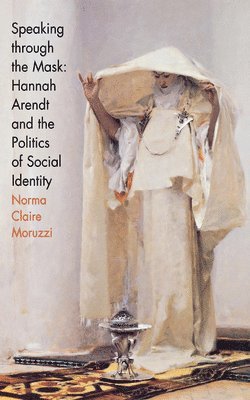
Hannah Arendt was famously resistant to both psychoanalysis and feminism. Nonetheless, psychoanalytic feminist theory can offer a new interpretive strategy for deconstructing her equally famous opposition between the social and the political.Supplementing critical readings of Arendt's most significant texts (including The Human Condition, On Revolution, Rahel Varnhagen, The Origins of Totalitarianism, Eichmann in Jerusalem, and The Life of the Mind) with the insights of contemporary psychoanalytic, feminist, and social theorists, Norma Claire Moruzzi reconstitutes the relationship in Arendt's texts between constructed social identity and political agency. Moruzzi uses Julia Kristeva's writings on abjection to clarify the textual dynamic in Arendt's work that constructs the social as a natural threat; Joan Riviere's and Mary Ann Doane's work on feminine masquerade amplify the theoretical possibilities implicit in Arendt's own discussion of the public, political mask. In a bold interdisciplinary synthesis, Moruzzi develops the social applications of a concept (the mask) Arendt had described as limited to the strictly political realm: a new conception of (political) agency as (social) masquerade, traced through the marginal but emblematic textual figures who themselves enact the politics of social identity.
349 kr
Skickas inom 10-15 vardagar
On 7 April 1944 a Slovakian Jew, Rudolf Vrba (born Walter Rosenberg), and a fellow prisoner, Alfred Wetzler, succeeded in escaping from Auschwitz-Birkenau. As block registrars both men had been allowed relative (though always risky) freedom of movement in the camp and thus had been able to observe the massive preparations underway at Birkenau of the entire killing machine for the eradication of Europe's last remaining Jewish community, the 800,000 Jews of Hungary. The two men somehow made their way back to Slovakia where they sought out the Jewish Council (Judenrat) to warn them of the impending disaster. The Vrba-Wetzler report was the first document about the Auschwitz death camp to reach the free world and to be accepted as credible. Its authenticity broke the barrier of skepticism and apathy that had existed up to that point. However, though their critical and alarming assessment was in the hands of Hungarian Jewish leaders by April 28 or early May 1944, it is doubtful that the information it contained reached more than just a small part of the prospective victims—during May and June 1944, about 437,000 Hungarian Jews boarded, in good faith, the "resettlement" trains that were to carry them off to Auschwitz, where most of them were gassed on arrival. Vrba, who emigrated to Canada at war's end, published his autobiography in England nearly forty years ago. Yet his and Wetzler's story has been carefully kept from Israel's Hebrew-reading public and appears nowhere in any of the history texts that are part of the official curriculum. As Ruth Linn writes, "Israeli Holocaust historiography was to follow the spirit of the court's policy at the Eichmann trial: silencing and removing challenging survivors from the gallery, and muting questions about the role of the Jewish Council in the deportations." In 1998 Linn arranged for publication of the first Hebrew edition of Vrba's memoirs. In Escaping Auschwitz she establishes the chronology of Vrba's disappearance not only from Auschwitz but also from the Israeli Holocaust narrative, skillfully exposing how the official Israeli historiography of the Holocaust has sought to suppress the story.
1 504 kr
Skickas inom 10-15 vardagar
Group identifications famously pose the problem of destructive rhetoric and action against others. Cynthia Burack brings together the theory work of women of color and the tools of psychoanalysis to examine the effects of group collaborations for social justice and progressive politics. This juxtaposition illuminates some assumptions about race and equality encoded in psychoanalysis. Burack's discursive analysis suggests the positive, identity-affirming aspects of group relational life for African American women.One analytic response to groups emphasizes the dangers of these identifications and exhorts people to abandon or transcend them for their own good and for the good of others who may be harmed by group-based forms of cultural or material violence. Another response understands that people feel a need for group identifications and asks how they may be made more resistant to malignant group-based discourse and action.What can black feminist thought teach scholars and democratic citizens about groups? Burack shows how the rhetoric of black feminism models reparative, rather than destructive, forms of group dialogue and action. Although it may be impossible to eliminate group identifications that provide much of the impetus for bias and violence, she argues, we can encourage more progressive forms of leadership, solidarity, and coalition politics.
Leaders and Their Followers in a Dangerous World
The Psychology of Political Behavior
Inbunden, Engelska, 2004
330 kr
Skickas inom 10-15 vardagar
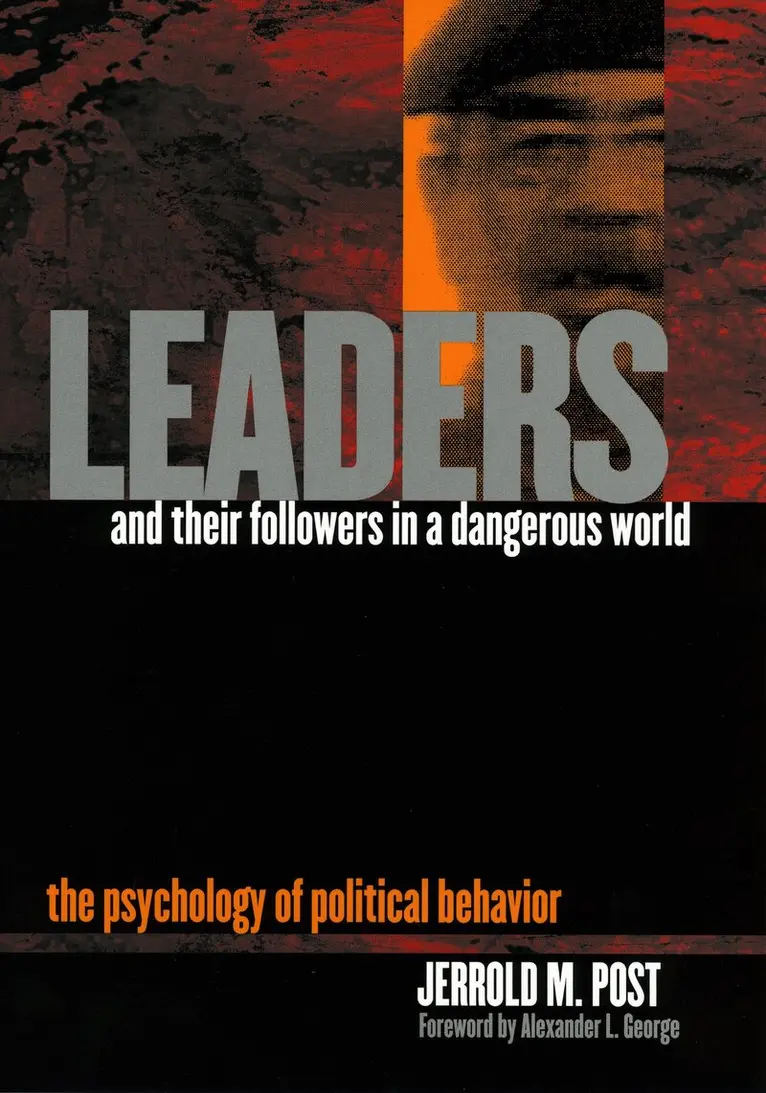
"Post is a pioneer in the field of political-personality profiling. He may be the only psychiatrist who has specialized in the self-esteem problems of both Osama bin Laden and Saddam Hussein."—The New Yorker "Policy specialists and academic scholars have long agreed that for U.S. leaders to deal effectively with other actors in the international arena, they need images of their adversaries. Leaders must try to see events, and, indeed, their own behavior, from the perspective of opponents.... Faulty images are a source of misperceptions and miscalculations that have often led to major errors in policy, avoidable catastrophes, and missed opportunities. History supplies all too many examples."—from the ForewordWhat impels leaders to lead and followers to follow? How did Osama bin Laden, the son of a multibillionaire construction magnate in Saudi Arabia, become the world's number-one terrorist? What are the psychological foundations of man's inhumanity to man, ethnic cleansing, and genocide? Jerrold M. Post contends that such questions can be answered only through an understanding of the psychological foundations of leader personality and political behavior.Post was founding director of the Center for the Analysis of Personality and Political Behavior for the CIA. He developed the political personality profiles of Menachem Begin and Anwar Sadat for President Jimmy Carter's use at the Camp David talks and initiated the U.S. government's research program on the psychology of political terrorism. He was awarded the Intelligence Medal of Merit in 1979 for his leadership of the center.In this book, he draws on psychological and personality theories, as well as interviews with individual terrorists and those who have interacted with particular leaders, to discuss a range of issues: the effects of illness and age on a leader's political behavior; narcissism and the relationship between followers and a charismatic leader; the impact of crisis-induced stress on policymakers; the mind of the terrorist, with a consideration of "killing in the name of God"; and the need for enemies and the rise of ethnic conflict and terrorism in the post-Cold War environment. The leaders he discusses include Fidel Castro, Osama bin Laden, Saddam Hussein, Kim Jong Il, and Slobodan Milosevic.
1 548 kr
Skickas inom 10-15 vardagar
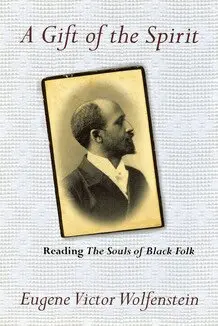
In A Gift of the Spirit, Eugene Victor Wolfenstein offers a reading of W. E. B. Du Bois's The Souls of Black Folk aimed at demonstrating its organic unity and coherence. He takes as his interpretive key the experience of the color line with which Du Bois's narrative begins—the incident from his youth in which a white girl refused his offer of a visiting card. Wolfenstein contends that this instance of misrecognition makes visible an aesthetic and affective configuration involving insult and injury, both racial and personal; anger as the immediate response to the humiliating wound; and, when that anger is suppressed, a melancholy retreat from the site of injury. As Wolfenstein reconstructs it, Souls tells the story of Du Bois's twofold approach to waging the battle for recognition: proud and disciplined resistance to the impositions and injustices of white supremacy; and the development of an intellectual station above the field of battle, where it could be surveyed from on high.With its serious and respectful approach to this canonical work in African American social theory, A Gift of the Spirit is a fitting tribute to the enduring relevance of Du Bois's singular achievement.
286 kr
Skickas inom 10-15 vardagar
In A Gift of the Spirit, Eugene Victor Wolfenstein offers a reading of W. E. B. Du Bois's The Souls of Black Folk aimed at demonstrating its organic unity and coherence. He takes as his interpretive key the experience of the color line with which Du Bois's narrative begins—the incident from his youth in which a white girl refused his offer of a visiting card. Wolfenstein contends that this instance of misrecognition makes visible an aesthetic and affective configuration involving insult and injury, both racial and personal; anger as the immediate response to the humiliating wound; and, when that anger is suppressed, a melancholy retreat from the site of injury. As Wolfenstein reconstructs it, Souls tells the story of Du Bois's twofold approach to waging the battle for recognition: proud and disciplined resistance to the impositions and injustices of white supremacy; and the development of an intellectual station above the field of battle, where it could be surveyed from on high.With its serious and respectful approach to this canonical work in African American social theory, A Gift of the Spirit is a fitting tribute to the enduring relevance of Du Bois's singular achievement.
330 kr
Skickas inom 10-15 vardagar
Group identifications famously pose the problem of destructive rhetoric and action against others. Cynthia Burack brings together the theory work of women of color and the tools of psychoanalysis to examine the effects of group collaborations for social justice and progressive politics. This juxtaposition illuminates some assumptions about race and equality encoded in psychoanalysis. Burack's discursive analysis suggests the positive, identity-affirming aspects of group relational life for African American women.One analytic response to groups emphasizes the dangers of these identifications and exhorts people to abandon or transcend them for their own good and for the good of others who may be harmed by group-based forms of cultural or material violence. Another response understands that people feel a need for group identifications and asks how they may be made more resistant to malignant group-based discourse and action.What can black feminist thought teach scholars and democratic citizens about groups? Burack shows how the rhetoric of black feminism models reparative, rather than destructive, forms of group dialogue and action. Although it may be impossible to eliminate group identifications that provide much of the impetus for bias and violence, she argues, we can encourage more progressive forms of leadership, solidarity, and coalition politics.