Gräv upp, hugg ned, pumpa ut : människan och naturresurserna under 5000 år
Per Högselius
279 kr
Du är på sajten för privatpersoner.
Del i serien Making Europe
348 kr
Beställningsvara. Skickas inom 10-15 vardagar. Fri frakt över 249 kr.
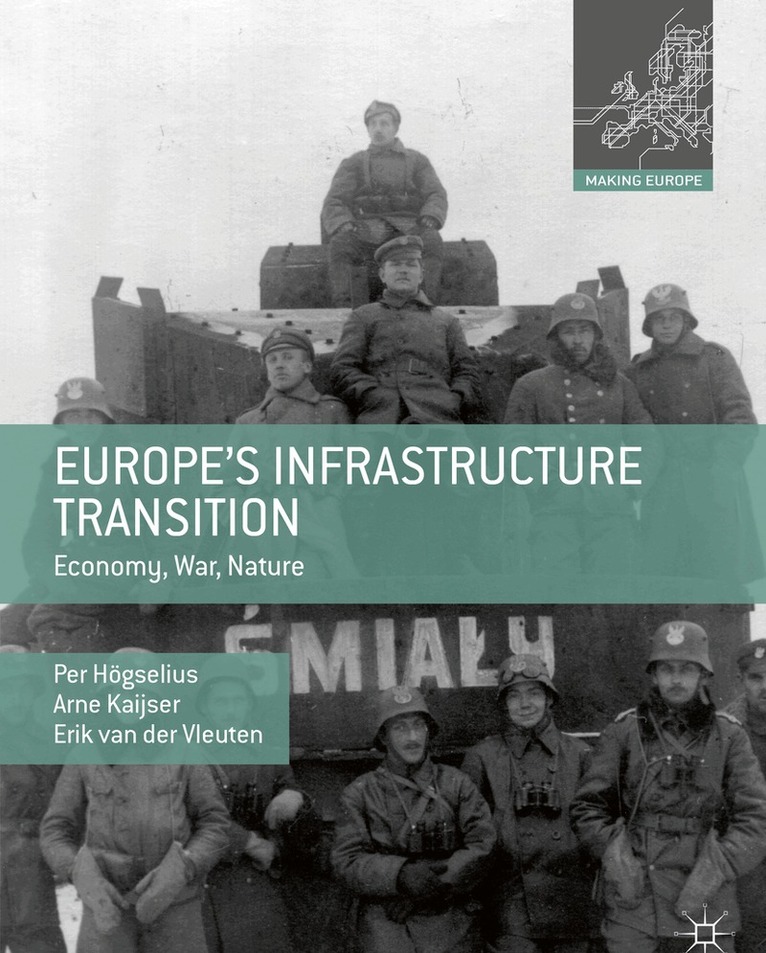
Per Högselius is Associate Professor at the Division of History of Science, Technology and Environment at KTH Royal Institute of Technology, Stockholm, Sweden. His research has focused on international aspects and in particular East-West relations in the history of science, technology, and environment. Most recently he published Red Gas: Russia and the Origins of European Energy Dependence (2013). Arne Kaijser is Professor of History of Technology at KTH Royal Institute of Technology, Stockholm, Sweden. His main research interests concern infrastructure, institutions, and environment in historical perspective. Together with Erik van der Vleuten he edited Networking Europe: Transnational Infrastructures and the shaping of Europe, 1850-2000 (2006). Erik van der Vleuten is Professor of History of Technology at Eindhoven University of Technology, the Netherlands, and scientific director of the Foundation for the History of Technology (SHT). In 2013-2015 he chaired the Pan-European research network Tensions of Europe: Technology and the Making of Europe. With Högselius and Kaijser he authored Europe’s Infrastructure Transition: Economy, War, Nature (2015).
'At once finely detailed and ambitiously synthetic, this work reveals infrastructure as an agent of history. From the first railway tracks of the 1830s to migrants walking those tracks today, changing means of circulation have redefined the meaning of 'Europe.' This brave and persuasive history of infrastructure space will inspire similar studies of other regions.' Rosalind H Williams, Massachusetts Institute of Technology, USA 'A tour de force that marks a new era of Braudelian 'total history.' Probes the material roots of European modernity: the technological systems and networks that undergird today's Europe of integration, circulation, flows, borders, and barriers. Europe's Infrastructure Transition reveals the contradictory human aims that have made these systems powerful agents of historical and environmental change.' Eda Kranakis, University of Ottawa, Canada 'In a richly-textured and original study, Hogselius, van der Vleuten and Kaijser explore how system builders engineers, officials, and others made 19th and 20th century Europe. They built transport, energy, communication and other infrastructures. They believed in progress, in economic growth ending forever war, and in their ability to alter nature for the better. The authors show that, despite their bold utopian intentions, the builders encountered political uncertainties, national technical vulnerabilities, and unexpected and severe environmental costs that still have done little to dampen their enthusiasm. This book should be of interest to broad audiences.' Paul R. Josephson, Colby College, USA 'This indispensable book presents a sophisticated, highly original lens on modern European history. Far more than a study of technical systems, it reveals the profound roles of infrastructural integration in social and political rapprochement as well as how infrastructures were dysfunctionally managed, disconnected, or destroyed for national competition, war, and ideology.' Paul N. Edwards, University of Michigan, USA
Per Högselius
279 kr