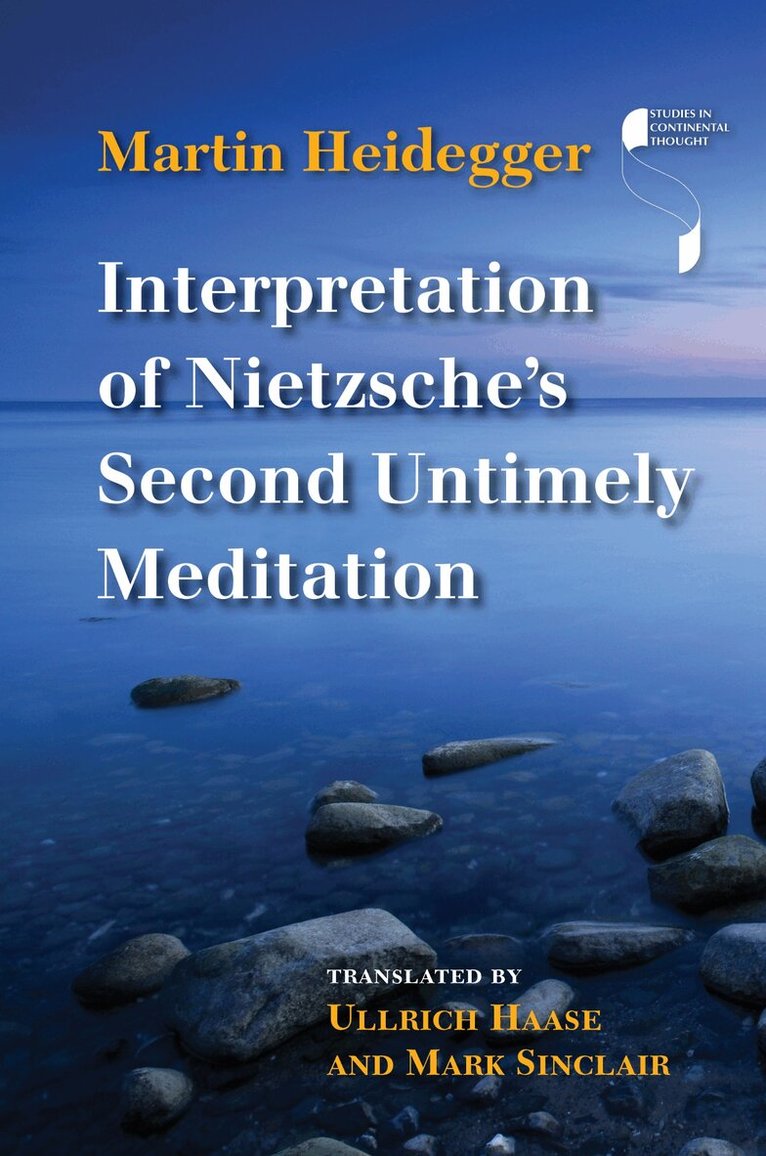
Del i serien Studies in Continental Thought
587 kr
Beställningsvara. Skickas inom 7-10 vardagar. Fri frakt över 249 kr.
Beskrivning
Produktinformation
- Utgivningsdatum:2016-09-12
- Mått:156 x 235 x 32 mm
- Vikt:621 g
- Format:Inbunden
- Språk:Engelska
- Serie:Studies in Continental Thought
- Antal sidor:320
- Förlag:Indiana University Press
- ISBN:9780253022660
- Översättare:Ullrich Haase, Mark Sinclair
Utforska kategorier
Mer om författaren
Ullrich Haase is Head of Philosophy at Manchester Metropolitan University. He is author of Starting with Nietzsche and editor of the Journal of the British Society for Phenomenology.Mark Sinclair is Senior Lecturer in Philosophy at Manchester Metropolitan University and Associate Editor at the British Journal for the History of Philosophy. He is author of Heidegger, Aristotle and the Work of Art.
Recensioner i media
"Haase and Sinclair render the German into a readable and fluent English. They make potentially clunky and jargon laden passages from the original seem natural, and also do a good job of dealing with the specific difficulties thrown up by this text. In particular, they confront well the problem of distinguishing between Historie, the study of the past, and Geschichte, which is the past in general, as it underpins reality."—Phenomenological Reviews"The translators have done an admirable job of striking a balance between eloquence and readability, on the one hand, and fidelity to Heidegger's highly idiosyncratic German, on the other."—Shane Montgomery Ewegen, Trinity College
Innehållsförteckning
- Translators' IntroductionA. Preliminary Remarks1. Remarks Preliminary to the Exercises2. Title3. The Appearance of our EndeavoursB. Section I. Structure. Preparation and Preview of the Guiding Question. Historiology—Life4. Historiology—The HistoricalOn the Unhistorical/Supra-historical and the Relation to Both5. Section I. 16. Section I. 27. Section I8. Comparing9. The Determination of the Essence of the Human Being on the Basis of Animalityand the Dividing Line between Animal and Human Being10. Nietzsche's Procedure. On the Determination of the Historicalfrom the Perspective of Forgetting and Remembering11. 'Forgetting'—'Remembering'. The Question of 'Historiology' as the Question of the 'Human Being'. The Course of our Inquiry. One Path among Others.12. Questions Relating to Section I13. Forgetting14. Nietzsche on Forgetting15. 'Forgetting' and 'Remembering'16. Historiology and 'the' Human Being17. 'The Human Being'. 'Culture'. The 'People' and 'Genius'18. Culture—Non-Culture, Barbarism19. Human Being and Culture and the People20. Nietzsche's Concept of 'Culture'21. The Formally General Notion of 'Culture'. 'Culture' and 'Art'22. 'The' Human Being and a Culture—a 'People'23. 'Art' (and Culture)24. Genius in Schopenhauer25. The People and Great Individuals26. Great Individuals as the Goal of 'Culture', of the People, of Humanity27. 'Worldview' and PhilosophyC. Section II. The Three Modes of Historiology 1. Monumental Historiology28. The Question of the Essence of 'the Historical', i.e. of the Essence of Historiology29. Section II. Structure (7 Paragraphs)D.Section III30. The Essence of Antiquarian Historiology31. Critical HistoriologyE. Nietzsche's Three Modes of Historiology and the Question of Historical Truth 32. 'Life'33. 'Life'. Advocates, Defamers of Life34. Historiology and Worldview35. How is the Historical Determined?36. The Belonging Together of the three Modes of Historiology and Historical Truth37. The Three Modes of Historiology as Modes of the Remembering Relation to the Past 38. Section IIF. The Human Being. Historiology and History. Temporality39. Historiology—the Human Being—History (Temporality)40. The Historical and the UnhistoricalG. 'Historiology'. Historiology and History. Historiology and the Unhistorical41. 'The Unhistorical'42. The Un-historical43. The Un-historical44. History and Historiology45. Nietzsche as 'Historian'46. Historiology and History47. 'Historiology'48. History and HistoriologyH. Section IV49. On Section IV ff., Hints50. Section IV51. Section IV (Paragraphs 1-6)I. Section V52. Section V53. Section V, Divided into Five Parts54. Oversaturation with Historiology and with Knowledge GenerallyJ.Concerning Section V and VI: Truth. 'Justice'. 'Objectivity'. Horizon.55. Life—'Horizon'56. Objectivity and 'Horizon'57. Justice58. Justice—Truth59. Life—and Horizon60. Beings as a Whole—the Human Being61. 'Truth' and the 'True'62. The True and Truth63. Truth and the Human Being64. Will (Drive) to 'Truth'65. Nietzsche on the 'Will to Truth'K. On Sections V and VI. Historiology and Science (Truth). (cf. J. Truth. 'Justice'. 'Objectivity'. Horizon)66. The Human Being—The Gods67. Why the Primacy of 'Science' in Historiology?68. 'Positivism'69. Historiology70. Historiology and Science71. The Impact of Historiology on the Past72. Truth73. Historiology as Science74. 'Historiology' and 'Perspective' and 'Objectivity'L. Section VI (Justice and Truth)75. Section VI76. Section VI (Paras. 1-7)77. 'Objectivity' and 'Justice'78. On the Structure of Section VI as a Whole79. Nietzsche's Question of a 'Higher Justice'80. Morality and Metaphysics81. Justice—Truth—Objectivity—Life82. Justice as 'Virtue'83. Justice—Truth84. Truth and Art (Cognition)85. On Nietzsche's Treatise "On Truth and Lie in an Extra-Moral Sense"86. Truth and 'Intellect'—Justice87. Truth and 'Intellect'88. Nietzsche's Conception of Truth(Determined from the Ground Up by Western Metaphysics)89. Justice and Truth90. Truth, and Science Conditioned by Worldview91. Truth and Science92. Historiology Science Truth—JusticeM. Nietzsche's Metaphysics93. Nietzsche's Metaphysics94. 'Life' in the Two Senses of World and Human BeingN. 'Life'95. Nietzsche's Projection of Beings as a Whole and of the Human Being as 'Life'96. Disposition97. Recapitulation According to the Basic Questions98. Concluding Remark99. Nietzsche's Early Characterisation of his own Thinkingas 'Inversion of Platonism'100. 'Life' (ego vivo)101. The Philosophical Concept102. On the Critical Meditation103. Decisive Questioning104. 'Life'O. The Question of the Human Being: 'Language'. 'Happiness'. Language (cf. 15, 'Forgetting' and 'Remembering')105. Language as Use and Using-Up of Words106. Word and Meaning107. 'Happiness' and Da-Sein108. 'Happiness'P. The Fundamental Stance of the Second Untimely Meditation109. The Guiding Demand of the Meditation110. Guiding Stance111. Concept Formation in Philosophy and the Sciences112. 'Life'113. 'Life'114. 'Life'115. Nietzsche's Fundamental Experience of 'life' and Opposition to 'Darwinism'116. Life117. 'Life'118. 'Life'119. 'Life'120. 'Life'121. 'Life'122. Life and 'adaptation'123. Life—Health and Truth124. Life as 'Dasein'125. 'Life' and 'Death'Q. Animality and Life. Animal—. The 'Living Body'. cf. Lectures of Winter Semester 1929/30126. Milieu and Environment (World)127. Soul—Living Body—Body128. Embodying129. The Animal has Memory130. Animal (Questions)131. Delimitation of the Essence of 'Life' (Animality)132. AnimalityR. The Differentiation of Human Being and Animal133. The Un-historical and the Historical134. The Unhistorical—(of the Human Being)135. Animal and Human BeingS. 'Privation'136. What Happens to us as 'Privation'137. 'Privation'—Inter-ruptionT. Structure and Composition of the Second Untimely Meditation138. On the Advantages and Disadvantages of History for LifeAddendaI. Seminar ReportsII. Summary by Hermann HeideggerIII. Editorial Postscript
Du kanske också är intresserad av
- Nyhet
- Signerad!
- Signerad!
- -30%
- Signerad!
- Nyhet
- Nyhet
Hjärnans akilleshälar : hur din hjärna lurar dig, och vad du kan göra åt det
Anders Hansen
289 kr
- -22%
- Signerad!
- Signerad!