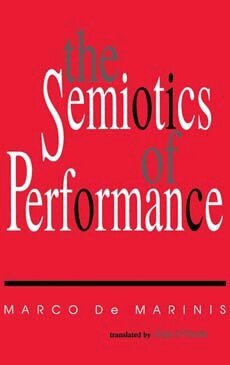
Del i serien Advances in Semiotics
613 kr
Beställningsvara. Skickas inom 10-15 vardagar. Fri frakt över 249 kr.
Beskrivning
"The book . . . succeeds at refining elements in the problem that semiotics and theater represent to and for one another." —Choice"The Semiotics of Performance surprisingly retains its revelatory freshness, and actually opens up areas of reseach that could very well supply new incentives for further probing into what semiotics can offer to the study of theatre." —Theatre Survey
Produktinformation
- Utgivningsdatum:1993-03-22
- Mått:156 x 235 x undefined mm
- Vikt:567 g
- Format:Inbunden
- Språk:Engelska
- Serie:Advances in Semiotics
- Antal sidor:280
- Förlag:Indiana University Press
- ISBN:9780253316868
Utforska kategorier
Mer om författaren
MARCO DE MARINIS is a Professor at the Institute of Communications and Theater at the University of Bologna. He is the author of several books and the editor of Versus. ÁINE O'HEALY is Director of European Studies and Assistant Professor of Italian at Loyola Marymount University. She is author of numerous works on contemporary Italian literature and cinema.
Innehållsförteckning
- Introduction: Theater Or Semiotics0.1. The Textual Analysis of Performance0.2. From Structuralism to the Pragmatics of the Text0.3. Enunciation, Intertextuality, and Reception0.4. Textual Analysis as a Multidisciplinary Approach0.5. Epistemological Limits0.6. Semiotics and TheaterOne. Dramatic Text and Mise-en-Scene1.1. Reasons for a Misunderstanding1.2. A Critique of the Conception of the Dramatic Text as a "Constant" or "Deep Structure" of Performance1.3. Language and Metalanguage, Text and Metatext1.4. Virtual Mise-en-Scene and Real Mise-en-Scene1.4.1. The Residue-Text: A Particular Case?1.5. The Irreversibility of Theatrical Transcoding1.6. Toward a Definition of the Dramatic Genre1.7. Dramatic Discourse1.8. The Dramatic Text as "Instructions for Use"Two. The Performance Text2.1. Performance as Text2.2. Theatrical Performance: A Definition2.2.1. Technical Reproducibility, Repeatability, Duplicatability2.2.2. Theater and Everyday Life2.3. Completeness and Coherence of the Performance Text2.3.1. The Delimitation of the Performance Text2.3.2. Levels of Coherence in the Performance Text2.4 The Performance Text: Between Presence and Absence2.4.1. "Present" Performances and "Absent" Performances2.4.2. Ruffini: Contextual Restoration2.4.3. Description/Transcription2.5. The Double Heterogeneity of the Performance Text2.6. Performance Texts Shorter or Longer than One Performance2.6.1. Partial Texts and Segments of the Performance Text2.6.2 Groups and Classes of Performance Texts2.7. Co-textual and Contextual AspectsThree. The Textual Structure of Performance3.1. Multiple Systems and Single Systems3.2. Degrees of Dynamism in the Textual Structure of Performance3.3. Partial Structures and Macrostructures3.4. Multiple Interpretations, Multiple Structures3.5. Analysis/Reading/CriticismFour. Performance Codes and Theatrical Conventions4.1. The Concept of "Code" in Relation to Theatrical Performance4.2. Decoding, Comprehension, Interpretation4.3. Classification according to Codes and Classification according to Expressive Material4.4. Theatrical and Nontheatrical Meanings4.5. Performance Codes (in the Strict Sense)4.6. Theatrical Conventions4.6.1 General Conventions4.6.2. Particular conventions4.6.3. Distinctive Conventions4.6.4. Notes and Observations on the Proposed Classification4.7. The Performance Text as an Example of Invention4.7.1. Transformation and Institution of the Code4.7.2. The Performance Text as an Aesthetic TextFive. Performance Text, Cultural Context, and Intertextual Practices5.1. The Performance Text in the Genral Test: The Cultural Roots of Codes and Conventions5.2. Aesthetic and Nonaesthetic Codes: From Culture to Art and Back5.3. Francastel: The Aesthetic Text as Montage of Cultural Objects5.3.1. The Example of the Mythological Festival5.4. Types of Theatrical IntertextualitySix. Toward a Pragmatics of Theatrical Communication6.1. The Performance Context6.2. Communication in the Theater6.3. The Kind and Degree of Communication in Performance6.4. Theatrical Manipulation6.5. Action/Fiction: The Performance Test as a Macro-Speech Act6.6. Theater Beyond Simulation and NegationSeven. The Spectator's Task7.1. The Current State of Research on Theatrical Reception7.2. Research on Reception outside of Theater7.2.1. The Konstanz School and "Rezeptionsasthetik"7.2.2 T.A. van Dijk and W. Kintsch: The Cognitive Processes of Discourse Comprehension7.3. The Model Spectator: "Closed" Spectators and "Open" Spectators7.4. Theatrical Competence7.5. Theatrical Genre as a Textual Type7.6. Pragmatic Aspects of Theatrical Genres7.7. Avant-Garde Theater as Metalinguistic Manipulation of the Performance Context7.8. Grammaticality, Acceptability, and Appropriateness of the Performance TextNotesBibliography