• Fri frakt över 249 kr
  • •
  • Snabba leveranser
  • •
  • Billiga böcker
Kundservice

Du är på sajten för privatpersoner.

Företag, bibliotek eller offentlig verksamhet?

Du handlar på classic.bokus.com, där alla dina funktioner finns intakta.
Till classic.bokus.com
Bokus logotyp. Gå till startsidan.
  • Erbjudanden
  • Nyheter
  • Student
  • Topplistor
  • Barn & ungdom
  • Bokus Play
  • E-böcker
  • Pocketböcker
  • Spel & pussel

10% rabatt på allt med kod: NYSTART10 →

Sidfot

Mina sidor

    Hjälp

    • Kundservice
    • Vanliga frågor och svar
    • Frakt och leverans
    • Retur vid ångerrätt
    • Reklamera vara
    • Betalning
    • Köpvillkor
    • Allmänna villkor
    • Information om webbplatsens tillgänglighet

    Om Bokus

    • Om oss
    • Pressrum
    • För studenter
    • För företag
    • För bibliotek och offentlig verksamhet
    • För leverantörer
    • Hållbarhet

    Populärt

    • Aktuella erbjudanden
    • Presentkort
    • Studentlitteratur
    • Nya böcker
    • Topplistor
    • Signerade böcker
    • Engelska böcker

    Inspiration

    • Boktips
    • BookTok
    • Populära bokserier
    • Barnbokskaraktärer
    • Populära författare
    Logotyp för Bokus
    Följ oss på Facebook (extern länk)Följ oss på Instagram (extern länk)Följ oss på YouTube (extern länk)Följ oss på TikTok (extern länk)
    bokus @ CookiesAnpassa cookiesIntegritetspolicyKöpvillkor
    Till Citymail hemsida (extern länk)Till Budbee hemsida (extern länk)Till Postnord hemsida (extern länk)Till Schenker hemsida (extern länk)Till Early Bird hemsida (extern länk)Till Walleys hemsida (extern länk)
    1. Samhälle och politik
    2. Samhälle och kultur
    3. Kultur och medier
    4. Referensverk och tvärvetenskap

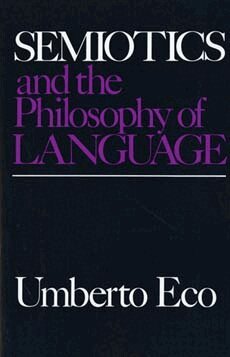
    Semiotics and the Philosophy of Language

    AvUmberto Eco

    Häftad, Engelska, 1986

    Del i serien Advances in Semiotics

    373 kr

    Beställningsvara. Skickas inom 3-6 vardagar. Fri frakt över 249 kr.

    Beskrivning

    "Eco wittily and enchantingly develops themes often touched on in his previous works, but he delves deeper into their complex nature . . . this collection can be read with pleasure by those unversed in semiotic theory." —Times Literary Supplement

    Produktinformation

    • Utgivningsdatum:1986-07-22
    • Mått:154 x 235 x 18 mm
    • Vikt:402 g
    • Format:Häftad
    • Språk:Engelska
    • Serie:Advances in Semiotics
    • Antal sidor:256
    • Förlag:Indiana University Press
    • ISBN:9780253203984

    Utforska kategorier

    • Referensverk och tvärvetenskap inom Samhälle och politik
    • Språkvetenskap och lingvistik inom Språk och ordböcker

    Recensioner i media

    "Eco wittily and enchantingly develops themes often touched on in his previous works, but he delves deeper into their complex nature ... this collection can be read with pleasure by those unversed in semiotic theory." Times Literary Supplement

    Innehållsförteckning

    • Introduction1. Signs1.1. Crisis of a concept1.2. The signs of an obstinacy1.3. Intension and extension1.4. Elusive solutions1.5. The deconstruction of the linguistic sign1.6. Signs vs. words1.7. The stoics1.8. Unification of the theories and the predominance of linguistics1.9. The 'instructional' model1.10. Strong codes and weak codes1.11. Abduction and inferential nature of signs1.12. The criterion of interpretability1.13. Sign and subject2. Dictionary vs. Encyclopedia2.1. Porphyry strikes back2.2 Critique of the Porphyrian tree2.3. Encyclopedias3. Metaphor3.1. The metaphoric nexus3.2. Traditional definitions3.3. Aristotle: synecdoche and Porphyrian tree3.4. Aristotle: metaphors of three terms3.5. Aristotle: the proportional scheme3.6. Proportion and condensation3.7. Dictionary and encyclopedia3.8. The cognitive function3.9. The semiosic background: the system of content3.10. The limits of formalization3.11. Componential representation and the pragmatics of the text3.12. Conclusions4. Symbol4.1. Genus and species4.2. Expressions by ratio facilis4.3. Expressions produced by ratio difficilis4.4. The symbolic mode4.5. Semiotics of the symbolic mode4.6. Conclusions5. Code5.1. The rise of new category5.2. The landslide effect5.3. Codes and communication5.4. Codes as s-codes5.5. Cryptography and natural languages5.6. S-codes and signification5.7 The genetic code5.8. Toward a provisonal conclusion6. Isotopy6.1. Discursive isotopies within sentences with paradigmatic disjunction6.2. Discursive isotopies within sentences with syntagmatic disjunction6.3. Discursive isotopies between sentences with paradigmatic disjunction6.4. Discursive isotopies between sentences with syntagmatic disjunction6.5. Narrative isotopies connected with isotopic discursive disjunctions generating mutually exlusive stories6.6 Narrative isotopies connected with isotopic discursive disjunctions that generate complementary stories6.7. Narrative isotopies connected with discursive isotopic disjunctions that generate complementary stoies in each case6.8. Extensional isotopies6.9. Provisional conclusions7. Mirrors7.1. Is the mirror image a sign?7.2. The imaginary and the symbolic7.3. Getting in through the Mirror7.4. A phenomenology of the mirror: the mirror does not invert7.5. A pragmatics of the mirror7.6. The mirror as a prosthesis and a channel7.7. Absolute icons7.8. Mirrors as rigid designators7.9. On signs7.10. Why mirrors do not produce signs7.11. Freaks: distorting mirrors7.12. Procatoptric staging7.13. Rainbows and Fata Morganas7.14. Catoptric theaters7.15. Mirrors that 'freeze' images7.16. The experimentum crucisReferencesIndex of authorsIndex of subjects