• Fri frakt över 249 kr
  • •
  • Snabba leveranser
  • •
  • Billiga böcker
Kundservice

Du är på sajten för privatpersoner.

Företag, bibliotek eller offentlig verksamhet?

Du handlar på classic.bokus.com, där alla dina funktioner finns intakta.
Till classic.bokus.com
Bokus logotyp. Gå till startsidan.
  • Erbjudanden
  • Nyheter
  • Student
  • Topplistor
  • Barn & ungdom
  • Bokus Play
  • E-böcker
  • Pocketböcker
  • Spel & pussel

10% rabatt på allt med kod NYSTART10 →

Sidfot

Mina sidor

    Hjälp

    • Kundservice
    • Vanliga frågor och svar
    • Frakt och leverans
    • Retur vid ångerrätt
    • Reklamera vara
    • Betalning
    • Köpvillkor
    • Allmänna villkor
    • Information om webbplatsens tillgänglighet

    Om Bokus

    • Om oss
    • Pressrum
    • För studenter
    • För företag
    • För bibliotek och offentlig verksamhet
    • För leverantörer
    • Hållbarhet

    Populärt

    • Aktuella erbjudanden
    • Presentkort
    • Studentlitteratur
    • Nya böcker
    • Topplistor
    • Signerade böcker
    • Engelska böcker

    Inspiration

    • Boktips
    • BookTok
    • Populära bokserier
    • Barnbokskaraktärer
    • Populära författare
    Logotyp för Bokus
    Följ oss på Facebook (extern länk)Följ oss på Instagram (extern länk)Följ oss på YouTube (extern länk)Följ oss på TikTok (extern länk)
    bokus @ CookiesAnpassa cookiesIntegritetspolicyKöpvillkor
    Till Citymail hemsida (extern länk)Till Budbee hemsida (extern länk)Till Postnord hemsida (extern länk)Till Schenker hemsida (extern länk)Till Early Bird hemsida (extern länk)Till Walleys hemsida (extern länk)
    1. Språk och ordböcker
    2. Språkvetenskap och lingvistik

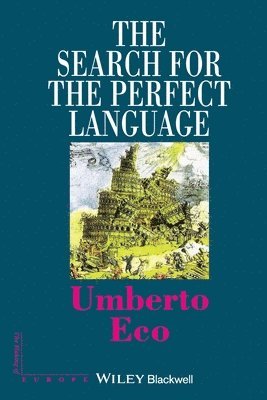
    Search for the Perfect Language

    AvUmberto Eco

    Häftad, Engelska, 1997

    Del i serien Making of Europe

    445 kr

    Beställningsvara. Skickas inom 5-8 vardagar. Fri frakt över 249 kr.

    Fler format och utgåvor

    Häftad

    195 kr

    Inbunden

    1 294 kr

    Beskrivning

    The idea that there once existed a language which perfectly and unambiguously expressed the essence of all possible things and concepts has occupied the minds of philosophers, theologians, mystics and others for at least two millennia. This is an investigation into the history of that idea and of its profound influence on European thought, culture and history. From the early Dark Ages to the Renaissance it was widely believed that the language spoken in the Garden of Eden was just such a language, and that all current languages were its decadent descendants from the catastrophe of the Fall and at Babel. The recovery of that language would, for theologians, express the nature of divinity, for cabbalists allow access to hidden knowledge and power, and for philosophers reveal the nature of truth. Versions of these ideas remained current in the Enlightenment, and have recently received fresh impetus in attempts to create a natural language for artificial intelligence. The story that Umberto Eco tells ranges widely from the writings of Augustine, Dante, Descartes and Rousseau, arcane treatises on cabbalism and magic, to the history of the study of language and its origins. He demonstrates the initimate relation between language and identity and describes, for example, how and why the Irish, English, Germans and Swedes - one of whom presented God talking in Swedish to Adam, who replied in Danish, while the serpent tempted Eve in French - have variously claimed their language as closest to the original. He also shows how the late eighteenth-century discovery of a proto-language (Indo-European) for the Aryan peoples was perverted to support notions of racial superiority. To this subtle exposition of a history of extraordinary complexity, Umberto Eco links the associated history of the manner in which the sounds of language and concepts have been written and symbolized. Lucidly and wittily written, the book is, in sum, a tour de force of scholarly detection and cultural interpretation, providing a series of original perspectives on two thousand years of European History. The paperback edition of this book is not available through Blackwell outside of North America.

    Produktinformation

    • Utgivningsdatum:1997-07-15
    • Mått:155 x 230 x 25 mm
    • Vikt:580 g
    • Format:Häftad
    • Språk:Engelska
    • Serie:Making of Europe
    • Antal sidor:400
    • Förlag:John Wiley and Sons Ltd
    • ISBN:9780631205104

    Utforska kategorier

    • Språkvetenskap och lingvistik inom Språk och ordböcker
    • Filosofiska discipliner inom Filosofi och religion

    Mer om författaren

    Umberto Eco was born in Alessandria in 1932 and has been Professor of Semiotics at the University of Bologna since 1975 and the President of the International Center for Semiotic and Cognitive Studies at the Universityu of San Marino since 1988. His books include The Name of the Rose (1980), Foucault's Pendulum (1988) and the more recent works include Semiotics and Philosophy of Lanaguage (1984) and The Limits of Interpretation (1990).

    Recensioner i media

    "This is as much a history of the study of language and its origins as it is a tour de force pursuit using scholarly detection and cultural interpretation, thus providing a series of original perspectives on two thousand years of European history." The Medieval Review

    Innehållsförteckning

    • Series Editor's Preface. Introduction.1. From Adam to Confusio Linguarum. .Genesis 2, 10, 11.Before and After Europe.Side-effects.A Semiotic Model for Natural Language.2. The Kabbalistic Pansemioticism. .The Reading of the Torah.Cosmic Permutability and the Kabbala of Names.The Mother Tongue.3. The Perfect Language of Dante.Latin and the Vernacular.Language and Lingusitic Behavior.The First Gift to Adam.Dante and Universal Grammar.The Illustrious Vernacular.Dante and Abulafia.4. The Ars Magna of Raymond Lull. .The Elements of the Ars Combinatoria. .The Alphabet and the Four Figures.The Arbor Scientarium.The Concordia Universalis of Nicholas of Cusa.5. The Monogenetic Hypothesis and the Mother Tongues. .The Return to Hebrew.Postel's Universalistic Utopia.The Etymological Furor.Conventionalism, Epicureanism and Polygenesis.The Pre-Hebraic Language.The Nationalistic Hypotheses.Philosophers against Monogeneticism.A Dream that refused to Die.New Prospects for the Monogenetic Hypothesis.6. Kabbalism and Lullism in Modern Culture.Magic Names and Kabbalistic Hebrew.Kabbalism and Lullism in the Steganographies.Lullian Kabbalism.Bruno: Ars Combinatoria and Infinite Worlds.Infinite Songs and Locutions.7. The Perfect Language of Images.Horapollo's Hieroglyphica.The Egyptian Alphabet.Kircher's Egyptology.Kircher's Chinese.The Kircherian Ideology.Later Critics.The Egyptian vs. the Chinese Way.Images for Aliens.8. Magic Language.Hypotheses.Dee's Magic Language.Perfection and Secrecy.9. Polygraphies.Kircher's Polygraphy.Beck and Becher.First Attempts at a Content Organizations.10. A Priori Philosophical Languages. .Bacon.Comenius.Descarted and Mersenne.The English Debate on Character and Traits.Primitives and Organization Content.11. George Dalgarno.12. John Wilkins. .The Tables and the Grammar.The Real Characters.The Dictionary: Synonyms, Periphrases, Metaphors.An Open Classification?.The Limits of Classification.The Hypertext of Wilkins.13. Francis Lodwick. .14. From Liebniz to the Encyclopédie.Characteristica and Calculus.The Problem of the Primitives.The Encyclopedia and the Aphabet of Thought.Blind Thought.The I Ching and the Binary Calculus.Side-effects.The 'Library' of Liebnitz and the Encyclopédie.15. Philosophic Language from the Enlightenment to Today. .Eighteenth-century Projects.The Last Flowering of Philosophic Languages.Space Languages.Artificial Intelligence.Some Ghosts of the Perfect Language.16. The Internatonal Auxiliary Languages.The Mixed Systems.The Babel of A Posteriori Languages.Esperanto.An Optimized Grammar.Theoretical Objections and Counter-objections.The 'Political' Possibilitites of an IAL.Limits and Effability of an IAL.Conclusion.Translation.The Gift to Adam.Notes.Bibliography.Index.

    Betyg & recensioner

    3/5