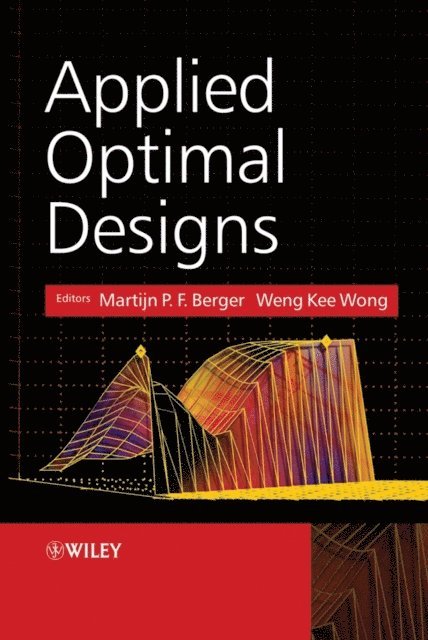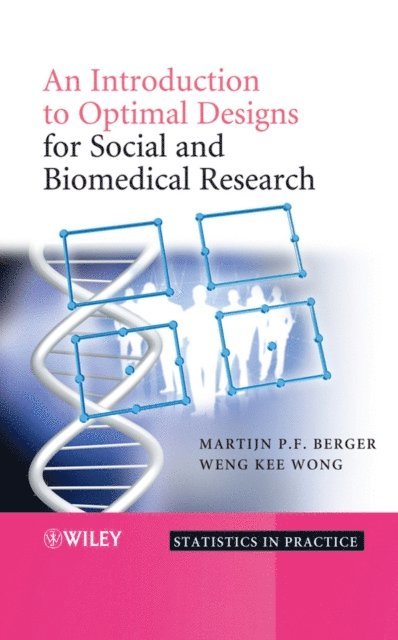
Introduction to Optimal Designs for Social and Biomedical Research
1 012 kr
Beställningsvara. Skickas inom 5-8 vardagar. Fri frakt över 249 kr.
Beskrivning
Produktinformation
- Utgivningsdatum:2009-05-28
- Mått:159 x 235 x 24 mm
- Vikt:640 g
- Format:Inbunden
- Språk:Engelska
- Serie:Statistics in Practice
- Antal sidor:346
- Förlag:John Wiley & Sons Inc
- ISBN:9780470694503
Utforska kategorier
Mer om författaren
Martijn Berger, Department of Methodology and Statistics, University of Maastricht, The NetherlandsProfessor Berger has been teaching and conducting research in this area for over 20 years. He has an extensive collection of publications to his name, including articles in a wide range of journals, a contributed chapter in Wiley's recent Encyclopedia of Statistics in Behavioural Science, and the 2005 book Applied Optimal Designs, co-authored with Weng Kee Wong.Weng Kee Wong, Department of Biostatistics, University of California - Los Angeles, USAOne of the leading experts in the US working in this field, Professor Wong is currently conducting grant-funded research into making optimal design methods more accessible for practitioners. As well as co-authoring Applied Optimal Designs, he has published over a hundred refereed articles, in numerous journals. He has held the position of Associate Editor for many such journals, including a current, second 3-year term for Biometrics.
Innehållsförteckning
- Preface xiAcknowledgements xiii1 Introduction to designs 11.1 Introduction 11.2 Stages of the research process 41.2.1 Choice of a ‘good’ design 51.3 Research design 61.3.1 Choice of independent variables and levels 61.3.2 Units of analysis 61.3.3 Variables 71.3.4 Replication 81.4 Types of research designs 81.5 Requirements for a ‘good’ design 91.5.1 Statistical conclusion validity 101.5.2 Internal validity 121.5.3 Control of (unwanted) variation 131.6 Ethical aspects of design choice 161.7 Exact versus approximate designs 171.8 Examples 191.8.1 Radiation dosage example 191.8.2 Designs for the Poggendorff and Ponzo illusion experiments 201.8.3 Uncertainty about best fitting regression models 221.8.4 Designs for a priori contrasts among composite faces 231.8.5 Designs for calibration of item parameters in item response theory models 241.9 Summary 262 Designs for simple linear regression 272.1 Design problem for a linear model 272.1.1 The design 282.1.2 The linear regression model 312.1.3 Estimation of parameters and efficiency 322.2 Designs for radiation-dosage example 352.3 Relative efficiency and sample size 362.4 Simultaneous inference 372.5 Optimality criteria 392.5.1 D-optimality criterion 402.5.2 A-optimality criterion 412.5.3 G-optimality criterion 412.5.4 E-optimality criterion 432.5.5 Number of distinct design points 432.6 Relative efficiency 442.7 Matrix formulation of designs for linear regression 442.8 Summary 493 Designs for multiple linear regression analysis 513.1 Design problem for multiple linear regression 513.1.1 The design 523.1.2 The multiple linear regression model 543.1.3 Estimation of parameters and efficiency 543.2 Designs for vocabulary-growth study 563.3 Relative efficiency and sample size 603.4 Simultaneous inference 613.5 Optimality criteria for a subset of parameters 623.6 Relative efficiency 643.7 Designs for polynomial regression model 653.7.1 Exact D-optimal designs for a quadratic regression model 693.7.2 Scale dependency of A- and E-optimality criteria 713.8 The Poggendorff and Ponzo illusion study 713.9 Uncertainty about best fitting regression models 763.10 Matrix notation of designs for multiple regression models 793.10.1 Design for regression models with two independent variables 803.10.2 Design for regression models with two non-additive independent variables 823.11 Summary 854 Designs for analysis of variance models 874.1 A typical design problem for an analysis of variance model 874.1.1 The design 894.1.2 The analysis of variance model 904.1.3 Formulation of an ANOVA model as a regression model 914.2 Estimation of parameters and efficiency 954.2.1 Measures of uncertainty 964.3 Simultaneous inference and optimality criteria 974.4 Designs for groups under stress study 984.4.1 A priori planned unequal sample sizes 994.4.2 Not planned unequal sample sizes 1004.5 Specific hypotheses and contrasts 1014.5.1 Loss of efficiency and power 1034.6 Designs for the composite faces study 1064.7 Balanced designs versus unbalanced designs 1094.8 Matrix notation for Groups under Stress study 1094.9 Summary 1115 Designs for logistic regression models 1135.1 Design problem for logistic regression 1135.2 The design 1145.3 The logistic regression model 1155.3.1 Design for a single dichotomous independent variable 1165.3.2 Design for multiple qualitative independent variables 1225.3.3 Design for a single quantitative independent variable 1255.3.4 Design for two independent quantitative variables 1305.4 Approaches to deal with local optimality 1335.5 Designs for calibration of item parameters in item response theory models 1345.6 Matrix formulation of designs for logistic regression 1375.6.1 Hours of practice experiment 1385.6.2 Problem solving study 1405.7 Summary 1416 Designs for multilevel models 1436.1 Design problem for multilevel models 1436.1.1 The design 1446.1.2 Validity considerations 1466.2 The multilevel regression model 1476.2.1 Cluster randomization of treatment 1476.2.2 Subject randomization of treatment 1496.3 Cluster versus subject randomization 1516.4 Cost function 1536.5 Example: Nursing home study 1556.5.1 Cluster randomization 1576.5.2 Subject randomization 1596.6 Optimal design and power 1606.6.1 Power for cluster randomized design 1626.6.2 Power for multi-center design 1646.6.3 Increase of efficiency and power by including covariates 1656.6.4 Unequal sample sizes 1656.7 Design effect in multilevel surveys 1666.7.1 Values of intra-class correlation ρ 1686.7.2 Cluster randomized sampling versus simple random sampling 1686.8 Matrix formulation of the multilevel model 1696.8.1 Cluster randomization of treatment 1706.8.2 Subject randomization of treatment 1726.9 Summary 1747 Longitudinal designs for repeated measurement models 1757.1 Design problem for repeated measurements 1757.2 The design 1797.3 Analysis techniques for repeated measures 1807.4 The linear mixed effects model for repeated measurement data 1817.4.1 Random intercept model 1827.4.2 Random intercept and slope model 1837.5 Variance–covariance structures 1847.5.1 Compound symmetry structure 1847.5.2 Auto-correlation structure 1857.6 Estimation of parameters and efficiency 1877.6.1 Small sample behaviour of estimators 1887.7 Bone mineral density example 1897.7.1 Improvement of the longitudinal design 1947.8 Cost function 1967.9 D-optimal designs for linear mixed effects models with autocorrelated errors 2007.10 Miscellanea 2077.10.1 Homoscedasticity 2077.10.2 Uninformative dropout 2087.11 Matrix formulation of the linear mixed effects model 2087.12 Summary 2118 Two-treatment crossover designs 2138.1 Design problem for crossover studies 2138.2 The design 2168.3 Confounding treatment effects with nuisance effects 2188.4 The linear model for crossover designs 2218.5 Estimation of parameters and efficiency 2238.6 Cost and efficiency of the crossover design 2238.6.1 Cost function 2268.7 Optimal crossover designs for two treatments 2298.7.1 Some further observations 2318.8 Matrix formulation of the mixed model for crossover designs 2328.9 Summary 2359 Alternative optimal designs for linear models 2379.1 Introduction 2379.2 Information matrix 2389.3 DA- or Ds-optimal designs 2399.4 Extrapolation optimal design 2419.5 L-optimal designs 2429.6 Bayesian optimal designs 2449.7 Minimax optimal design 2479.8 Multiple-objective optimal designs 2509.8.1 Constrained optimal design 2519.8.2 Compound optimal design 2539.9 Summary 25510 Optimal designs for nonlinear models 25710.1 Introduction 25710.2 Linear models versus nonlinear models 25810.2.1 The Arrhenius equation 25810.2.2 The compartmental model 25910.2.3 The Michaelis–Menten model 26010.2.4 The Emax model 26110.3 Design issues for nonlinear models 26110.3.1 Local optimality 26210.4 Alternative optimal designs with examples 26510.4.1 DA or Ds-optimal design 26510.4.2 Extrapolation optimal design 26610.4.3 Optimal design for estimating percentiles 26610.5 Bayesian optimal designs 26710.6 Minimax optimal design 26910.7 Multiple-objective optimal designs 27110.8 Optimal design for model discrimination 27310.9 Summary 27511 Resources for the construction of optimal designs 27711.1 Introduction 27711.2 Sequential construction of optimal designs 27811.3 Exchange of design points 28311.3.1 Exchange algorithms 28311.4 Other algorithms 28411.5 Optimal design software 28511.6 A web site for finding optimal designs 28611.6.1 Optimal designs for the Michaelis–Menten and Emax models 28811.6.2 Optimal designs for discriminating among toxicological models 29011.7 Summary 294References 295Author Index 313Subject Index 319
Mer från samma serie
Statistical Analysis and Modelling of Spatial Point Patterns
Janine Illian, Antti Penttinen, Helga Stoyan, Dietrich Stoyan
Inbunden, 2008
1 484 kr
Multiple Imputation and its Application
James R. Carpenter, Jonathan W. Bartlett, Tim P. Morris, Angela M. Wood, Matteo Quartagno, Michael G. Kenward
Inbunden, 2023
883 kr
Statistical Practice in Business and Industry
Shirley Coleman, Tony Greenfield, Dave Stewardson, Douglas C. Montgomery
Inbunden, 2008
1 275 kr
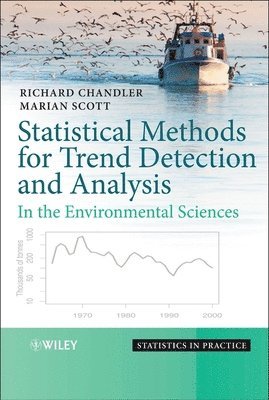
Statistical Methods for Trend Detection and Analysis in the Environmental Sciences
Richard Chandler, Marian Scott
Inbunden, 2011
1 123 kr
Du kanske också är intresserad av
- Nyhet
- -22%
- -30%
- -22%
- -19%
- 4 för 3
En flicka som kallas Alice
Kristin Hannah
Pocket, 2025
99 kr
- Signerad!
SIGNERAD - Enkel privatekonomi : Din praktiska guide till livets alla pengafrågor
Annifrid Lilja, Björn Lilja
Kartonnage, 2026
229 kr
- -23%
- -19%