• Fri frakt över 249 kr
  • •
  • Snabba leveranser
  • •
  • Billiga böcker
Kundservice

Du är på sajten för privatpersoner.

Företag, bibliotek eller offentlig verksamhet?

Du handlar på classic.bokus.com, där alla dina funktioner finns intakta.
Till classic.bokus.com
Bokus logotyp. Gå till startsidan.
  • Erbjudanden
  • Student
  • Topplistor
  • Barn & ungdom
  • Bokus Play
  • E-böcker
  • Ljudböcker
  • Pocketböcker
  • Spel och pussel

Pocketfynda! Hundratals böcker för 49 kr/st →

Sidfot

Mina sidor

    Hjälp

    • Kundservice
    • Vanliga frågor och svar
    • Frakt och leverans
    • Retur vid ångerrätt
    • Reklamera vara
    • Betalning
    • Köpvillkor
    • Allmänna villkor
    • Information om webbplatsens tillgänglighet

    Om Bokus

    • Om oss
    • Pressrum
    • För studenter
    • För företag
    • För bibliotek och offentlig verksamhet
    • För leverantörer
    • Hållbarhet

    Populärt

    • Aktuella erbjudanden
    • Presentkort
    • Studentlitteratur
    • Nya böcker
    • Topplistor
    • Signerade böcker
    • Engelska böcker

    Inspiration

    • Boktips
    • BookTok
    • Barnbokskaraktärer
    • Populära författare
    Logotyp för Bokus
    Följ oss på Facebook (extern länk)Följ oss på Instagram (extern länk)Följ oss på YouTube (extern länk)Följ oss på TikTok (extern länk)
    bokus @ CookiesAnpassa cookiesIntegritetspolicyKöpvillkor
    Till Citymail hemsida (extern länk)Till Budbee hemsida (extern länk)Till Postnord hemsida (extern länk)Till Schenker hemsida (extern länk)Till Early Bird hemsida (extern länk)Till Walleys hemsida (extern länk)
    1. Naturvetenskap och teknik
    2. Matematik och naturvetenskap
    3. Matematik

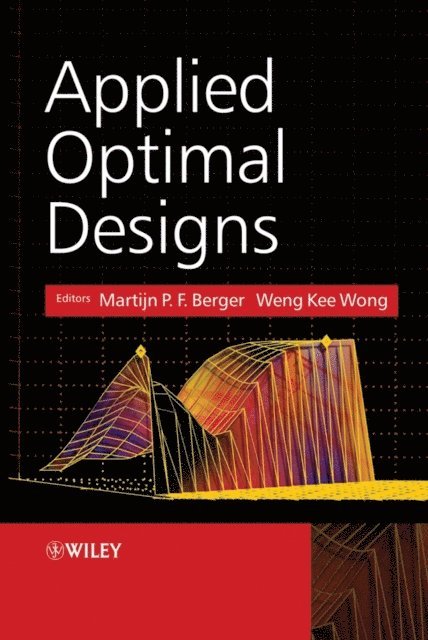
    Applied Optimal Designs

    AvMarijn Berger,Martijn P.F. Berger

    Inbunden, Engelska, 2005

    1 541 kr

    Beställningsvara. Skickas inom 5-8 vardagar. Fri frakt över 249 kr.

    Beskrivning

    There is an increasing need to rein in the cost of scientific study without sacrificing accuracy in statistical inference. Optimal design is the judicious allocation of resources to achieve the objectives of studies using minimal cost via careful statistical planning. Researchers and practitioners in various fields of applied science are now beginning to recognize the advantages and potential of optimal experimental design. Applied Optimal Designs is the first book to catalogue the application of optimal design to real problems, documenting its widespread use across disciplines as diverse as drug development, education and ground water modelling. Includes contributions covering: Bayesian design for measuring cerebral blood-flowOptimal designs for biological modelsComputer adaptive testingGround water modellingEpidemiological studies and pharmacological modelsApplied Optimal Designs bridges the gap between theory and practice, drawing together a selection of incisive articles from reputed collaborators. Broad in scope and inter-disciplinary in appeal, this book highlights the variety of opportunities available through the use of optimal design. The wide range of applications presented here should appeal to statisticians working with optimal designs, and to practitioners new to the theory and concepts involved.

    Produktinformation

    • Utgivningsdatum:2005-01-26
    • Mått:158 x 235 x 22 mm
    • Vikt:567 g
    • Format:Inbunden
    • Språk:Engelska
    • Antal sidor:320
    • Förlag:John Wiley & Sons Inc
    • ISBN:9780470856970

    Utforska kategorier

    • Matematik inom Naturvetenskap och teknik

    Mer om författaren

    Martijn P.F. Berger, Department of Methodology and Statistics, University of Maastricht, the Netherlands, and Weng Kee Wong, Department of Biostatistics, School of Public Health, UCLA, USA.

    Recensioner i media

    "The wide range of analytical concepts and applications focused upon here will attract statisticians interested in design theory and researchers in many of the fields in which it is used." (Journal of the American Statistical Association, March 2006)

    Innehållsförteckning

    • List of Contributors. Editors’ Foreword.1 Optimal Design in Educational Testing (Steven Buyske).1.1 Introduction.1.2 Test Design .1.3 Sampling Design.1.4 Future Directions.2 Optimal On-line Calibration of Testlets (Douglas H. Jones and Mikhail S. Nediak).2.1 Introduction.2.2 Background.2.3 Solution for Optimal Designs.2.4 Simulation Results.2.5 Discussion.3 On the Empirical Relevance of Optimal Designs for the Measurement of Preferences (Heiko Großmann, Heinz Holling, Michaela Brocke, Ulrike Graßhoff and Rainer Schwabe).3.1 Introduction.3.2 Conjoint Analysis.3.3 Paired Comparison Models in Conjoint Analysis.3.4 Design Issues.3.5 Experiments.3.6 Discussion.4 Designing Optimal Two-stage Epidemiological Studies (Marie Reilly and Agus Salim).4.1 Introduction.4.2 Illustrative Examples.4.3 Meanscore.4.4 Optimal Design and Meanscore.4.5 Deriving Optimal Designs in Practice.4.6 Summary.4.7 Appendix 1 Brief Description of Software Used.4.8 Appendix 2 The Optimal Sampling Package.4.9 Appendix 3 Using the Optimal Package in R.4.10 Appendix 4 Using the Optimal Package in S-Plus.4.11 Appendix 5 Using the Optimal Package in STATA.5 Response-Driven Designs in Drug Development (Valerii V. Fedorov and Sergei L. Leonov).5.1 Introduction.5.2 Motivating Example: Quantal Models for Dose Response.5.3 Continuous Models.5.4 Variance Depending on Unknown Parameters and Multi-response Models.5.5 Optimal Designs with Cost Constraints5.6 Adaptive Designs5.7 Discussion6 Design of Experiments for Microbiological Models (Holger Dette, Viatcheslav B. Melas and Nikolay Strigul).6.1 Introduction.6.2 Experimental Design for Nonlinear Models.6.3 Applications of Optimal Experimental Design in Microbiology.6.4 Bayesian Methods for Regression Models.6.5 Conclusions.7 Selected Issues in the Design of Studies of Interrater Agreement (Allan Donner and Mekibib Altaye).7.1 Introduction.7.2 The Choice between a Continuous or Dichotomous Variable.7.3 The Choice between a Polychotomous or Dichotomous Outcome Variable.7.4 Incorporation of Cost Considerations.7.5 Final Comments.8 Restricted Optimal Design in the Measurement of Cerebral Blood Flow Using the Kety–Schmidt Technique (J.N.S. Matthews and P.W. James).8.1 Introduction.8.2 The Kety–Schmidt Method.8.3 The Statistical Model and Optimality Criteria.8.4 Locally Optimal Designs.8.5 Bayesian Designs and Prior Distributions.8.6 Optimal Bayesian Designs.8.7 Practical Designs.8.8 Concluding Remarks.9 Optimal Experimental Design for Parameter Estimation and Contaminant Plume Characterization in Groundwater Modelling (James McPhee and William W-G. Yeh).9.1 Introduction.9.2 Groundwater Flow and Mass Transport in Porous Media: Modelling Issues.9.3 Problem Formulation.9.4 Solution Algorithms.9.5 Case Studies.9.6 Summary and Conclusions.10 The Optimal Design of Blocked Experiments in Industry (Peter Goos, Lieven Tack and Martina Vandebroek).10.1 Introduction.10.2 The Pastry Dough Mixing Experiment.10.3 The Problem.10.4 Fixed Block Effects Model.10.5 Random Block Effects Model.10.6 The Pastry Dough Mixing Experiment Revisited.10.7 Time Trends and Cost Considerations.10.8 Optimal Run Orders for Blocked Experiments.10.9 A Time Trend in the Pastry Dough Mixing Experiment.10.10 Summary.Index.