308 kr
Skickas . Fri frakt över 249 kr.
Fler format och utgåvor
Beskrivning
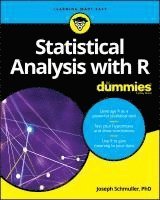
Understanding the world of R programming and analysis has never been easier Most guides to R, whether books or online, focus on R functions and procedures. But now, thanks to Statistical Analysis with R For Dummies, you have access to a trusted, easy-to-follow guide that focuses on the foundational statistical concepts that R addresses—as well as step-by-step guidance that shows you exactly how to implement them using R programming. People are becoming more aware of R every day as major institutions are adopting it as a standard. Part of its appeal is that it's a free tool that's taking the place of costly statistical software packages that sometimes take an inordinate amount of time to learn. Plus, R enables a user to carry out complex statistical analyses by simply entering a few commands, making sophisticated analyses available and understandable to a wide audience. Statistical Analysis with R For Dummies enables you to perform these analyses and to fully understand their implications and results. Gets you up to speed on the #1 analytics/data science software toolDemonstrates how to easily find, download, and use cutting-edge community-reviewed methods in statistics and predictive modelingShows you how R offers intel from leading researchers in data science, free of chargeProvides information on using R Studio to work with RGet ready to use R to crunch and analyze your data—the fast and easy way!
Produktinformation
- Utgivningsdatum:2017-05-16
- Mått:185 x 231 x 31 mm
- Vikt:612 g
- Format:Häftad
- Språk:Engelska
- Antal sidor:464
- Förlag:John Wiley & Sons Inc
- ISBN:9781119337065
Utforska kategorier
Mer om författaren
Joseph Schmuller, PhD, has taught undergraduate and graduate statistics, and has 25 years of IT experience. The author of four editions of Statistical Analysis with Excel For Dummies and three editions of Teach Yourself UML in 24 Hours (SAMS), he has created online coursework for Lynda.com and is a former Editor in Chief of PC AI magazine. He is a Research Scholar at the University of North Florida.
Innehållsförteckning
- Introduction 1About This Book 1Similarity with This Other For Dummies Book 2What You Can Safely Skip 2Foolish Assumptions 2How This Book Is Organized 3Part 1: Getting Started with Statistical Analysis with R 3Part 2: Describing Data 3Part 3: Drawing Conclusions from Data 3Part 4: Working with Probability 3Part 5: The Part of Tens 4Online Appendix A: More on Probability 4Online Appendix B: Non-Parametric Statistics 4Online Appendix C: Ten Topics That Just Didn’t Fit in Any Other Chapter 4Icons Used in This Book 4Where to Go from Here 5Part 1: Getting Started with Statistical Analysis with R 7Chapter 1: Data, Statistics, and Decisions 9The Statistical (and Related) Notions You Just Have to Know 10Samples and populations 10Variables: Dependent and independent 11Types of data 12A little probability 13Inferential Statistics: Testing Hypotheses 14Null and alternative hypotheses 14Two types of error 15Chapter 2: R: What It Does and How It Does It 17Downloading R and RStudio 18A Session with R 21The working directory 21So let’s get started, already 22Missing data 26R Functions 26User-Defined Functions 28Comments 29R Structures 29Vectors 30Numerical vectors 30Matrices 31Factors 33Lists 34Lists and statistics 35Data frames 36Packages 39More Packages 42R Formulas 43Reading and Writing 44Spreadsheets 44CSV files 46Text files 47Part 2: Describing Data 49Chapter 3: Getting Graphic 51Finding Patterns 51Graphing a distribution 52Bar-hopping 53Slicing the pie 54The plot of scatter 55Of boxes and whiskers 56Base R Graphics 57Histograms 57Adding graph features 59Bar plots 60Pie graphs 62Dot charts 62Bar plots revisited 64Scatter plots 67Box plots 71Graduating to ggplot2 71Histograms 72Bar plots 74Dot charts 75Bar plots re-revisited 78Scatter plots 82Box plots 86Wrapping Up 89Chapter 4: Finding Your Center 91Means: The Lure of Averages 91The Average in R: mean() 93What’s your condition? 93Eliminate $-signs forth with() 94Exploring the data 95Outliers: The flaw of averages 96Other means to an end 97Medians: Caught in the Middle 99The Median in R: median() 100Statistics à la Mode 101The Mode in R 101Chapter 5: Deviating from the Average 103Measuring Variation 104Averaging squared deviations: Variance and how to calculate it 104Sample variance 107Variance in R 107Back to the Roots: Standard Deviation 108Population standard deviation 108Sample standard deviation 109Standard Deviation in R 109Conditions, Conditions, Conditions 110Chapter 6: Meeting Standards and Standings 111Catching Some Z’s 112Characteristics of z-scores 112Bonds versus the Bambino 113Exam scores 114Standard Scores in R 114Where Do You Stand? 117Ranking in R 117Tied scores 117Nth smallest, Nth largest 118Percentiles 118Percent ranks 120Summarizing 121Chapter 7: Summarizing It All 123How Many? 123The High and the Low 125Living in the Moments 125A teachable moment 126Back to descriptives 126Skewness 127Kurtosis 130Tuning in the Frequency 131Nominal variables: table() et al 131Numerical variables: hist() 132Numerical variables: stem() 138Summarizing a Data Frame 139Chapter 8: What’s Normal? 143Hitting the Curve 143Digging deeper 144Parameters of a normal distribution 145Working with Normal Distributions 147Distributions in R 147Normal density function 147Cumulative density function 152Quantiles of normal distributions 155Random sampling 156A Distinguished Member of the Family 158Part 3: Drawing Conclusions From Data 161Chapter 9: The Confidence Game: Estimation 163Understanding Sampling Distributions 164An EXTREMELY Important Idea: The Central Limit Theorem 165(Approximately) Simulating the central limit theorem 167Predictions of the central limit theorem 171Confidence: It Has Its Limits! 173Finding confidence limits for a mean 173Fit to a t 175Chapter 10: One-Sample Hypothesis Testing 179Hypotheses, Tests, and Errors 179Hypothesis Tests and Sampling Distributions 181Catching Some Z’s Again 183Z Testing in R 185t for One 187t Testing in R 188Working with t-Distributions 189Visualizing t-Distributions 190Plotting t in base R graphics 191Plotting t in ggplot2 192One more thing about ggplot2 197Testing a Variance 198Testing in R 199Working with Chi-Square Distributions 201Visualizing Chi-Square Distributions 201Plotting chi-square in base R graphics 202Plotting chi-square in ggplot2 203Chapter 11: Two-Sample Hypothesis Testing 205Hypotheses Built for Two 205Sampling Distributions Revisited 206Applying the central limit theorem 207Z’s once more 208Z-testing for two samples in R 210t for Two 212Like Peas in a Pod: Equal Variances 212t-Testing in R 214Working with two vectors 214Working with a data frame and a formula 215Visualizing the results 216Like p’s and q’s: Unequal variances 219A Matched Set: Hypothesis Testing for Paired Samples 220Paired Sample t-testing in R 222Testing Two Variances 222F-testing in R 224F in conjunction with t 225Working with F-Distributions 226Visualizing F-Distributions 226Chapter 12: Testing More than Two Samples 231Testing More Than Two 231A thorny problem 232A solution 233Meaningful relationships 237ANOVA in R 237Visualizing the results 239After the ANOVA 239Contrasts in R 242Unplanned comparisons 243Another Kind of Hypothesis, Another Kind of Test 244Working with repeated measures ANOVA 245Repeated measures ANOVA in R 247Visualizing the results 249Getting Trendy 250Trend Analysis in R 254Chapter 13: More Complicated Testing 255Cracking the Combinations 255Interactions 257The analysis 257Two-Way ANOVA in R 259Visualizing the two-way results 261Two Kinds of Variables at Once 263Mixed ANOVA in R 266Visualizing the Mixed ANOVA results 268After the Analysis 269Multivariate Analysis of Variance 270MANOVA in R 271Visualizing the MANOVA results 273After the analysis 275Chapter 14: Regression: Linear, Multiple, and the General Linear Model 277The Plot of Scatter 277Graphing Lines 279Regression: What a Line! 281Using regression for forecasting 283Variation around the regression line 283Testing hypotheses about regression 285Linear Regression in R 290Features of the linear model 292Making predictions 292Visualizing the scatter plot and regression line 293Plotting the residuals 294Juggling Many Relationships at Once: Multiple Regression 295Multiple regression in R 297Making predictions 298Visualizing the 3D scatter plot and regression plane 298ANOVA: Another Look 301Analysis of Covariance: The Final Component of the GLM 305But wait — there’s more 311Chapter 15: Correlation: The Rise and Fall of Relationships 313Scatter plots Again 313Understanding Correlation 314Correlation and Regression 316Testing Hypotheses About Correlation 319Is a correlation coefficient greater than zero? 319Do two correlation coefficients differ? 320Correlation in R 322Calculating a correlation coefficient 322Testing a correlation coefficient 322Testing the difference between two correlation coefficients 323Calculating a correlation matrix 324Visualizing correlation matrices 324Multiple Correlation 326Multiple correlation in R 327Adjusting R-squared 328Partial Correlation 329Partial Correlation in R 330Semipartial Correlation 331Semipartial Correlation in R 332Chapter 16: Curvilinear Regression: When Relationships Get Complicated 335What Is a Logarithm? 336What Is e? 338Power Regression 341Exponential Regression 346Logarithmic Regression 350Polynomial Regression: A Higher Power 354Which Model Should You Use? 358Part 4: Working with Probability 359Chapter 17: Introducing Probability 361What Is Probability? 361Experiments, trials, events, and sample spaces 362Sample spaces and probability 362Compound Events 363Union and intersection 363Intersection again 364Conditional Probability 365Working with the probabilities 366The foundation of hypothesis testing 366Large Sample Spaces 366Permutations 367Combinations 368R Functions for Counting Rules 369Random Variables: Discrete and Continuous 371Probability Distributions and Density Functions 371The Binomial Distribution 374The Binomial and Negative Binomial in R 375Binomial distribution 375Negative binomial distribution 377Hypothesis Testing with the Binomial Distribution 378More on Hypothesis Testing: R versus Tradition 380Chapter 18: Introducing Modeling 383Modeling a Distribution 383Plunging into the Poisson distribution 384Modeling with the Poisson distribution 385Testing the model’s fit 388A word about chisqtest() 391Playing ball with a model 392A Simulating Discussion 396Taking a chance: The Monte Carlo method 396Loading the dice 396Simulating the central limit theorem 401Part 5: The Part of Tens 405Chapter 19: Ten Tips for Excel Emigrés 407Defining a Vector in R Is Like Naming a Range in Excel 407Operating on Vectors Is Like Operating on Named Ranges 408Sometimes Statistical Functions Work the Same Way 412And Sometimes They Don’t 412Contrast: Excel and R Work with Different Data Formats 413Distribution Functions Are (Somewhat) Similar 414A Data Frame Is (Something) Like a Multicolumn Named Range 416The sapply() Function Is Like Dragging 417Using edit() Is (Almost) Like Editing a Spreadsheet 418Use the Clipboard to Import a Table from Excel into R 419Chapter 20: Ten Valuable Online R Resources 421Websites for R Users 421R-bloggers 421Microsoft R Application Network 422Quick-R 422RStudio Online Learning 422Stack Overflow 422Online Books and Documentation 423R manuals 423R documentation 423RDocumentation 423YOU CANanalytics 423The R Journal 424Index 425
Hoppa över listan


Mer från samma författare
Data Analytics & Visualization All-in-One For Dummies
Jack A. Hyman, Luca Massaron, Paul McFedries, John Paul Mueller, Jonathan Reichental, Joseph Schmuller, Alan R. Simon, Allen G. Taylor
Häftad
358 kr
Hoppa över listan


Du kanske också är intresserad av
Data Analytics & Visualization All-in-One For Dummies
Jack A. Hyman, Luca Massaron, Paul McFedries, John Paul Mueller, Jonathan Reichental, Joseph Schmuller, Alan R. Simon, Allen G. Taylor
Häftad
358 kr