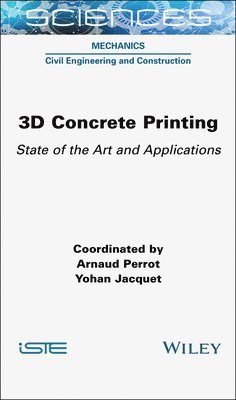
3D Concrete Printing
State of the Art and Applications
Del i serien ISTE Consignment
1 623 kr
Beställningsvara. Skickas inom 7-10 vardagar. Fri frakt över 249 kr.
Beskrivning
Produktinformation
- Utgivningsdatum:2025-02-04
- Mått:156 x 234 x 16 mm
- Vikt:567 g
- Format:Inbunden
- Språk:Engelska
- Serie:ISTE Consignment
- Antal sidor:272
- Förlag:ISTE Ltd
- ISBN:9781789452006
Utforska kategorier
Mer om författaren
Arnaud Perrot is Research Professor at the Université Bretagne Sud, France. He is the author of over 100 scientific publications in the field of the processing and rheology of cement-based materials.Yohan Jacquet is a researcher at the Technische Universität Berlin, Germany. He is an expert in the rheology and formulation of construction materials.
Innehållsförteckning
- PrefaceArnaud PERROTChapter 1 3D Concrete Printing: Technologies, Applications and Classifications 1Arnaud PERROT, Yohan JACQUET and Sofiane AMZIANE1.1 Introduction: the different facets of printing 11.2 3D printing: from digital model to physical object 21.2.1 From digital model to print 21.2.2 Printing processes 31.2.3 Printing processes for cementitious materials 41.3 3D concrete printing – application examples 51.3.1 Prefabrication 51.3.2 On-site printing 81.3.3 Toward the democratization of 3D concrete printing? 101.4 Classification of concrete printing processes 111.4.1 Classification proposed by Duballet and co-authors 111.4.2 Classification proposed by RILEM 161.4.3 Complementary classification 181.5 Printing concrete with alternative binders or without cement? 191.6 Conclusion 211.7 References 21Chapter 2 3D Concrete Printing by Extrusion and Filament Deposition 31Arnaud PERROT and Yohan JACQUET2.1 Introduction 312.2 Major printing families 332.2.1 A matter of scale 332.2.2 Single- and two-component materials 342.2.3 Robotic complexity 352.3 Printable materials 362.3.1 Material behavior during printing 362.3.2 Material flow behavior 382.3.3 Material behavior at rest 392.3.4 Printing specifications 432.4 The main stages in 3D extrusion printing 432.4.1 Mixing 432.4.2 Pumping 442.4.3 Extrusion 462.4.4 Filament deposition and local stability 482.4.5 Overall structure stability during printing 512.4.6 Elastic deformation and printing precision 552.4.7 Material curing during and after printing 552.5 Conclusion 572.6 References 58Chapter 3 From Laboratory to Practice: Characterizing Fresh and Cured Printed Materials 67Nicolas DUCOULOMBIER, Victor DE BONO, Fatima Zahraa KACHKOUCH,Yohan JACQUET and Arnaud PERROT3.1 Introduction 673.2 Characterization of fresh materials 683.2.1 Laboratory formulation – specifications 683.2.2 Print control in an industrial context 773.3 Characterization of hardened materials 853.3.1 Specifications 853.3.2 Characterization of physical properties 853.3.3 Mechanical characterization of printed materials 853.4 Durability 913.5 Conclusion 933.6 References 93Chapter 4 Alternative Printing Methods for Cementitious Materials 103Alexandre PIERRE and Arnaud PERROT4.1 Introduction 1034.2 Methods with supports 1054.2.1 In situ printed supports (permanent formwork) 1054.2.2 Mobile support 1094.2.3 Sacrificial support 1104.3 Particle bed methods 1154.4 Support-free methods 1174.5 Choice of process 1184.6 Prospects and opportunities 1214.6.1 Dissolvable temporary supports 1214.6.2 Selective binding of aggregates with foams 1214.6.3 Structural reinforcements 1214.6.4 Functionally graded materials 1224.7 Conclusion 1234.8 References 123Chapter 5 Structural Applications of 3D Printing 131Romain MESNIL, Romain DUBALLET and Olivier BAVEREL5.1 Introduction 1315.1.1 Structure design 1315.1.2 Principles of structural design 1335.1.3 Chapter organization 1355.2 Assessment of hardened material properties 1355.2.1 Material or micro-structure? 1355.2.2 Toward reconciling points of view 1375.2.3 Orthotropic or isotropic material? 1385.2.4 Mechanical testing 1405.2.5 Conclusion 1405.3 Masonry 1405.3.1 Reinforced masonry 1415.3.2 Confined masonry 1415.3.3 Shell structures 1435.3.4 Link between process and structural behavior 1455.3.5 Toward a stereotomic approach to printing 1465.4 3D printing and reinforced concrete 1475.4.1 Lost or collaborative formwork? 1485.4.2 Reinforced printed concrete 1505.4.3 Fibering printed concrete 1525.5 Prestressing 1525.5.1 Principle 1525.5.2 Application 1535.5.3 Challenges 1535.6 Conclusion 1545.6.1 Structural optimization and additive manufacturing 1555.6.2 The structural language of 3D printing 1555.7 References 156Chapter 6 Reinforcement of Printed Structures 161Jean-François CARON, Nicolas DUCOULOMBIER and Léo DEMONT6.1 Introduction, a few reminders about the reinforcement of cementitious materials 1616.1.1 Structural reinforcement of cementitious materials 1626.1.2 Fibering of cementitious materials 1636.2 Reinforcement methods for additively manufactured cementitious materials and structures 1686.2.1 A posteriori reinforcements 1696.2.2 Mortar reinforcement 1716.2.3 In-line reinforcements 1726.3 Details of a special in-line reinforcement, the flow-based-pultrusion concept 1766.3.1 Technology 1766.3.2 Prototypes and devices 1766.3.3 Characteristics of the hardened and reinforced material 1796.4 Conclusion and outlook 1796.5 References 181Chapter 7 Numerical Simulation Tools for 3D Printing 189Duc-Phi DO, Zeinab DIAB, Sébastien RÉMOND and Dashnor HOXHA7.1 Introduction 1897.2 Designing the geometric model of a virtual object 1907.3 Digital modeling of the 3D printing process 1927.3.1 Simulation of buildability at structural scale 1937.3.2 Simulation of the material deposition process at printed layer scale 1997.4 Discussions on recent advances, limitations and future research directions 2027.5 Conclusion 2117.6 References 212Chapter 8 Environmental Impact of 3D Concrete Printing 219Kateryna KUZMENKO, Charlotte ROUX and Adélaïde FERRAILLE8.1 Introduction 2208.2 3D printing technology and case studies 2218.2.1 3D extrusion–deposition printing 2218.2.2 Material-saving construction elements 2228.2.3 Case study 2238.2.4 Study issues 2268.3 Methodology and case studies 2268.3.1 Life cycle assessment method 2268.3.2. Impact model, system boundaries and FU for the3D concrete printing process 2288.3.3. Impact model and FU for the constructive system3D concrete printing process 2298.4 Results 2318.4.1 Environmental impact on the scale of the printed material 2318.4.2 Environmental impact of the building system 2328.5 Discussions and prospects 2348.5.1 Alternative materials for printing 2348.5.2 Impact transfer 2358.5.3 Improving the quality and quantity of available inventory data 2368.6 Conclusion 2378.7 Acknowledgments 2378.8 References 237List of Authors 241Index 243
Mer från samma författare
Second RILEM International Conference on Earthen Construction
Christopher Beckett, Ana Bras, Antonin Fabbri, Emmanuel Keita, Céline Perlot, Arnaud Perrot
3 172 kr
Second RILEM International Conference on Earthen Construction
Christopher Beckett, Ana Bras, Antonin Fabbri, Emmanuel Keita, Céline Perlot, Arnaud Perrot
3 172 kr
Mer från samma serie
Some Complex Phenomena in Fluid and Solid Mechanics
Abdelghani Saouab, Abdelghani Saouab, Stephane Champmartin, Jaafar Khalid Naciri
1 623 kr
Symbolic Approaches to Modeling and Analysis of Biological Systems
Cedric Lhoussaine, Elisabeth Remy
1 623 kr
Numerical Methods for Strong Nonlinearities in Mechanics
Jacques Besson, Jacques Besson, Frederic Lebon, Eric Lorentz
1 623 kr
Decision-making Tools to Support Innovation
Manon Enjolras, Daniel Galvez, Mauricio Camargo
1 623 kr
Du kanske också är intresserad av
Milk and Dairy Products: Some Challenges for the Dairy Industry
Valérie Gagnaire, Valérie Gagnaire, Thomas Croguennec
1 623 kr
Numerical Methods for Strong Nonlinearities in Mechanics
Jacques Besson, Jacques Besson, Frederic Lebon, Eric Lorentz
1 623 kr