• Fri frakt över 249 kr
  • •
  • Snabba leveranser
  • •
  • Billiga böcker
Kundservice

Du är på sajten för privatpersoner.

Företag, bibliotek eller offentlig verksamhet?

Du handlar på classic.bokus.com, där alla dina funktioner finns intakta.
Till classic.bokus.com
Bokus logotyp. Gå till startsidan.
  • Erbjudanden
  • Nyheter
  • Student
  • Topplistor
  • Barn & ungdom
  • Bokus Play
  • E-böcker
  • Pocketböcker
  • Spel & pussel

10% rabatt på allt med kod NYSTART10 →

Sidfot

Mina sidor

    Hjälp

    • Kundservice
    • Vanliga frågor och svar
    • Frakt och leverans
    • Retur vid ångerrätt
    • Reklamera vara
    • Betalning
    • Köpvillkor
    • Allmänna villkor
    • Information om webbplatsens tillgänglighet

    Om Bokus

    • Om oss
    • Pressrum
    • För studenter
    • För företag
    • För bibliotek och offentlig verksamhet
    • För leverantörer
    • Hållbarhet

    Populärt

    • Aktuella erbjudanden
    • Presentkort
    • Studentlitteratur
    • Nya böcker
    • Topplistor
    • Signerade böcker
    • Engelska böcker

    Inspiration

    • Boktips
    • BookTok
    • Populära bokserier
    • Barnbokskaraktärer
    • Populära författare
    Logotyp för Bokus
    Följ oss på Facebook (extern länk)Följ oss på Instagram (extern länk)Följ oss på YouTube (extern länk)Följ oss på TikTok (extern länk)
    bokus @ CookiesAnpassa cookiesIntegritetspolicyKöpvillkor
    Till Citymail hemsida (extern länk)Till Budbee hemsida (extern länk)Till Postnord hemsida (extern länk)Till Schenker hemsida (extern länk)Till Early Bird hemsida (extern länk)Till Walleys hemsida (extern länk)
    1. Ekonomi och Ledarskap
    2. Ledarskapsböcker
    3. Ledarskap och motivation

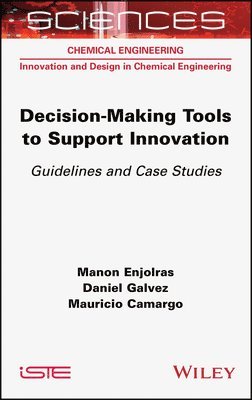
    Decision-making Tools to Support Innovation

    Guidelines and Case Studies

    AvManon Enjolras,Daniel Galvez

    Inbunden, Engelska, 2023

    Del i serien ISTE Consignment

    1 721 kr

    Beställningsvara. Skickas inom 5-8 vardagar. Fri frakt över 249 kr.

    Beskrivning

    Scientific thinking concerning the way in which we drive innovation has been widely developed in recent years. It is known that the process of innovation consists of a succession of decision-making processes that require simultaneous technical, economical, organizational and sustainable compromises. Indeed, all innovative activities in business require stakeholders to seek out the best compromise between various, often contradictory dimensions of the same problems.Through studying practical cases from various fields (e.g. energy, marketing and sustainable development), this book addresses all the stages of the innovation process, highlighting some of the main decisions that can be faced by organizations.Based on the historical research conducted at the ERPI Laboratory (University of Lorraine) in Nancy, France, this book presents six innovation practices: strategy, creativity, design, project management, human resources and capitalization of knowledge. These practices are then illustrated through examples of decision support methods' applications.

    Produktinformation

    • Utgivningsdatum:2023-08-10
    • Mått:161 x 240 x 19 mm
    • Vikt:662 g
    • Format:Inbunden
    • Språk:Engelska
    • Serie:ISTE Consignment
    • Antal sidor:272
    • Förlag:ISTE Ltd
    • ISBN:9781789450897

    Utforska kategorier

    • Ledarskap och motivation inom Ekonomi och Ledarskap
    • Tillverkningsteknik inom Naturvetenskap och teknik

    Mer om författaren

    Manon Enjolras is a lecturer at the University of Lorraine, France (ERPI Laboratory/ENSGSI). Her research concerns the metrology of innovation and the application of multicriteria and data analysis methodologies.Daniel Galvez is a professor at the Department of Industrial Engineering of the University of Santiago, Chile and coordinator of the LEIND Laboratory. His areas of research are innovation management and decision support.Mauricio Camargo is a professor at ENSGSI and the director of the ERPI Laboratory (University of Lorraine) in France. His work focuses on the management of innovation projects, technology management and the design of complex product, process and industrial systems.

    Innehållsförteckning

    • Foreword ixChristian FONTEIXIntroduction xiiiChapter 1 The Selection of Ideas During a Creativity Workshop: An Application of PROMETHEE 11.1 Context and challenges in decision-making 21.1.1 The phases of a creative workshop 21.1.2 Evaluation and selection of ideas 41.2 The PROMETHEE method 91.2.1 Methodological concept: the preference function 101.2.2 Application process 141.3 Application of PROMETHEE to the selection of ideas 161.3.1 Context of the workshop 161.3.2 Discussion of the results 221.4 To go further 231.4.1 The Gaia plane 231.4.2 Regarding the different versions of PROMETHEE 251.5 The PROMETHEE method: instructions for use 261.5.1 PROMETHEE step by step 261.5.2 Application of PROMETHEE with software support 321.6 References 39Chapter 2 The Upstream Phases of Product Design: An Application of AHP 432.1 Context and challenges in decision-making 442.1.1 The challenges of the upstream phases of the design process 442.1.2 A trend in innovation: sustainable design 452.1.3 Definition of the decision model 462.2 The AHP method: analytic hierarchy process 492.2.1 The fundamental principle: the relative importance of criteria 492.2.2 Application of the method 542.3 Going further: the question of interdependence between criteria 622.3.1 The Dematel method 632.3.2 Application to the case study 672.3.3 Proposal for an AHP/Dematel combined approach 682.4 AHP: instructions for use 722.4.1 Practical guide 722.4.2 Illustration of related free software 782.5 References 83Chapter 3 Marketing Strategy During the Market Entry Phase: An Application of Rough Sets 853.1 Context and challenges in decision-making 863.1.1 Decision-making in marketing 863.1.2 Definition of the decision model 883.2 The Rough Sets method or the theory of approximate sets 903.2.1 Terminology 903.2.2 Fundamental principle: indiscernibility 913.2.3 Application of the method 933.3 Discussion of the results obtained 963.3.1 Conditional rules obtained 963.3.2 Operational exploitation of rules 983.3.3 To go further: dominance-based rough sets approach 1003.4 The Rough Sets method: instructions for use 1033.4.1 The case of extracting information from a database: an example using the freeware program 4Emka 1033.4.2 The case of implicit preference modeling 1083.4.3 Step-by-step application 1093.5 References 120Chapter 4 Building a Coherent Project Portfolio: An Application of MAUT 1234.1 Context and challenges in decision-making 1244.1.1 The selection of innovative projects 1244.1.2 Decision-making in the petroleum industry 1244.1.3 Definition of the decision model 1264.2 The MAUT method 1274.2.1 Terminology and methodological concepts 1274.2.2 Application of the method 1304.3 To go further 1384.3.1 Consideration of the constraints in making the decision 1384.3.2 Synergies between criteria/between projects 1394.3.3 The accuracy of the utility function 1414.4 The MAUT method: instructions for use 1414.4.1 MAUT step by step 1414.4.2 Using software supports 1494.5 References 154Chapter 5 The Recruitment Process in Human Resources: An Application of ELECTRE 1575.1 Context and challenges in decision-making 1585.1.1 Human resources management and innovation 1585.1.2 The challenges of the recruitment process 1595.2 The ELECTRE method 1615.2.1 Methodological concepts 1615.2.2 Application of ELECTRE to the hiring of new staff members 1645.3 To go further 1735.3.1 Addressing incomparability in the results 1735.3.2 Improving the accuracy of input data: processing qualitative criteria 1775.4 ELECTRE: instructions for use 1785.4.1 Practical guide 1795.4.2 Illustration of related free software 1875.5 References 190Chapter 6 Knowledge Management in the Supply Chain: An Application of TOPSIS 1936.1 Context and challenges in decision-making 1946.1.1 Knowledge management in the supply chain 1946.1.2 Definition of the decision model 1966.2 The TOPSIS method 1996.2.1 Methodological concepts 2006.2.2 Application of the method 2046.3 To go further 2136.3.1 The imprecise nature of human judgment: moving towards "fuzzy logic" 2136.3.2 Sensitivity analysis or the proposal of simulation scenarios 2166.4 The TOPSIS method: instructions for use 2186.4.1 TOPSIS step by step 2186.4.2 Illustration of related free software 2256.5 References 229Conclusion 231List of Authors 237Index 239