New Histories of Science, Technology, and Medicine – serie
Visar alla böcker i serien New Histories of Science, Technology, and Medicine. Handla med fri frakt och snabb leverans.
7 produkter
7 produkter
Del 8 - New Histories of Science, Technology, and Medicine
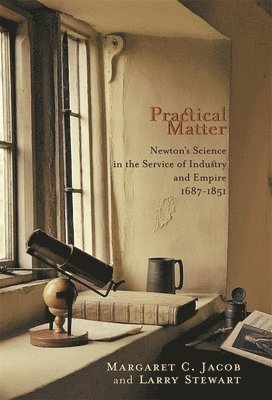
Practical Matter
Newton’s Science in the Service of Industry and Empire, 1687–1851
Häftad, Engelska, 2006
298 kr
Skickas inom 10-15 vardagar
Margaret Jacob and Larry Stewart examine the profound transformation that began in 1687. From the year when Newton published his Principia to the Crystal Palace Exhibition of 1851, science gradually became central to Western thought and economic development. The book aims at a general audience and examines how, despite powerful opposition on the Continent, a Newtonian understanding gained acceptance and practical application. By the mid-eighteenth century the new science had achieved ascendancy, and the race was on to apply Newtonian mechanics to industry and manufacturing. They end the story with the temple to scientific and technological progress that was the Crystal Palace exhibition. Choosing their examples carefully, Jacob and Stewart show that there was nothing preordained or inevitable about the centrality awarded to science. "It is easy to forget that science might have been stillborn, or remained the esoteric knowledge of court elites. Instead, for better and for worse, science became a centerpiece of Western culture."
Del 9 - New Histories of Science, Technology, and Medicine
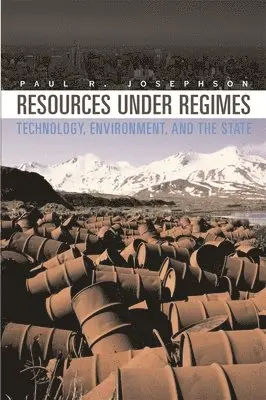
Resources under Regimes
Technology, Environment, and the State
Häftad, Engelska, 2006
298 kr
Skickas inom 10-15 vardagar
Democratic or authoritarian, every society needs clean air and water; every state must manage its wildlife and natural resources. In this provocative, comparative study, Paul R. Josephson asks to what extent the form of a government and its economy--centrally planned or market, colonial or post-colonial--determines how politicians, bureaucrats, scientists, engineers, and industrialists address environmental and social problems presented by the transformation of nature into a humanized landscape. Looking at the experiences of the industrialized and industrializing world, Resources under Regimes explores the relationship between science, technology, and the environment. Josephson considers global responses to deforestation, water pollution, and global warming, showing how different societies bring different values and assumptions to bear on the same problem, and arrive at different conclusions about the ideal outcome and the best way of achieving it. He reveals the important ways in which modern governments facilitate power generation, transportation, water production, and other technologies that improve the quality of life; and the equally critical ways in which they respond to the resulting depredations--the pollution, waste, and depletion that constitute the global environmental crisis at the beginning of the twenty-first century.
Del 10 - New Histories of Science, Technology, and Medicine
Distilling Knowledge
Alchemy, Chemistry, and the Scientific Revolution
Häftad, Engelska, 2006
287 kr
Skickas inom 10-15 vardagar
Alchemy can't be science--common sense tells us as much. But perhaps common sense is not the best measure of what science is, or was. In this book, Bruce Moran looks past contemporary assumptions and prejudices to determine what alchemists were actually doing in the context of early modern science. Examining the ways alchemy and chemistry were studied and practiced between 1400 and 1700, he shows how these approaches influenced their respective practitioners' ideas about nature and shaped their inquiries into the workings of the natural world. His work sets up a dialogue between what historians have usually presented as separate spheres; here we see how alchemists and early chemists exchanged ideas and methods and in fact shared a territory between their two disciplines. Distilling Knowledge suggests that scientific revolution may wear a different appearance in different cultural contexts. The metaphor of the Scientific Revolution, Moran argues, can be expanded to make sense of alchemy and other so-called pseudo-sciences--by including a new framework in which "process can count as an object, in which making leads to learning, and in which the messiness of conflict leads to discernment." Seen on its own terms, alchemy can stand within the bounds of demonstrative science.
Del 15 - New Histories of Science, Technology, and Medicine
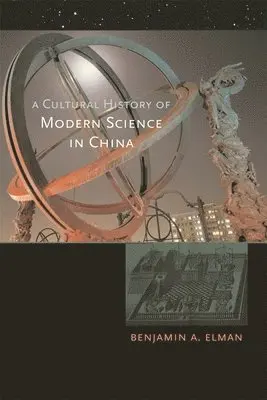
Cultural History of Modern Science in China
Häftad, Engelska, 2009
298 kr
Skickas inom 10-15 vardagar
Historians of science and Sinologists have long needed a unified narrative to describe the Chinese development of modern science, medicine, and technology since 1600. They welcomed the appearance in 2005 of Benjamin Elman's masterwork, On Their Own Terms. Now Elman has retold the story of the Jesuit impact on late imperial China, circa 1600-1800, and the Protestant era in early modern China from the 1840s to 1900 in a concise and accessible form ideal for the classroom. This coherent account of the emergence of modern science in China places that emergence in historical context for both general students of modern science and specialists of China.
Del 13 - New Histories of Science, Technology, and Medicine
Discovery of Global Warming
Revised and Expanded Edition
Häftad, Engelska, 2008
255 kr
Skickas inom 10-15 vardagar
The award-winning book is now revised and expanded.In 2001 an international panel of distinguished climate scientists announced that the world was warming at a rate without precedent during at least the last ten millennia, and that warming was caused by the buildup of greenhouse gases from human activity. The story of how scientists reached that conclusion—by way of unexpected twists and turns—was the story Spencer Weart told in The Discovery of Global Warming. Now he brings his award-winning account up to date, revised throughout to reflect the latest science and with a new conclusion that shows how the scientific consensus caught fire among the general world public, and how a new understanding of the human meaning of climate change spurred individuals and governments to action.
Del 14 - New Histories of Science, Technology, and Medicine
Monkey Trials and Gorilla Sermons
Evolution and Christianity from Darwin to Intelligent Design
Häftad, Engelska, 2009
298 kr
Skickas inom 10-15 vardagar
From the beginning, Darwin’s dangerous idea has been a snake in the garden, denounced from pulpits then and now as incompatible with the central tenets of Christian faith. Recovered here is the less well-known but equally long history of thoughtful engagement and compromise on the part of liberal theologians. Peter J. Bowler doesn’t minimize the hostility of many of the faithful toward evolution, but he reveals the existence of a long tradition within the churches that sought to reconcile Christian beliefs with evolution by finding reflections of the divine in scientific explanations for the origin of life. By tracing the historical forerunners of these rival Christian responses, Bowler provides a valuable alternative to accounts that stress only the escalating confrontation. Our polarized society, Bowler says, has all too often projected its rivalries onto the past, concealing the efforts by both scientists and theologians to find common ground. Our perception of past confrontations has been shaped by an oversimplified model of a “war” between science and religion. By uncovering the complexity of the debates sparked by Darwin’s theory, we might discover ways to depolarize our own debates about where we came from and why we are here.
Del 22 - New Histories of Science, Technology, and Medicine
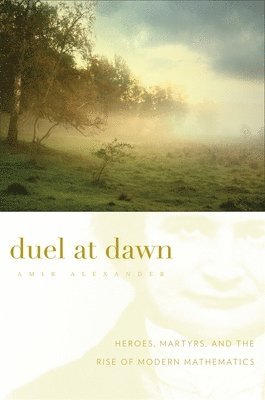
Duel at Dawn
Heroes, Martyrs, and the Rise of Modern Mathematics
Häftad, Engelska, 2011
260 kr
Skickas inom 7-10 vardagar
In the fog of a Paris dawn in 1832, Évariste Galois, the 20-year-old founder of modern algebra, was shot and killed in a duel. That gunshot, suggests Amir Alexander, marked the end of one era in mathematics and the beginning of another.Arguing that not even the purest mathematics can be separated from its cultural background, Alexander shows how popular stories about mathematicians are really morality tales about their craft as it relates to the world. In the eighteenth century, Alexander says, mathematicians were idealized as child-like, eternally curious, and uniquely suited to reveal the hidden harmonies of the world. But in the nineteenth century, brilliant mathematicians like Galois became Romantic heroes like poets, artists, and musicians. The ideal mathematician was now an alienated loner, driven to despondency by an uncomprehending world. A field that had been focused on the natural world now sought to create its own reality. Higher mathematics became a world unto itself—pure and governed solely by the laws of reason.In this strikingly original book that takes us from Paris to St. Petersburg, Norway to Transylvania, Alexander introduces us to national heroes and outcasts, innocents, swindlers, and martyrs–all uncommonly gifted creators of modern mathematics.