• Fri frakt över 249 kr
  • •
  • Snabba leveranser
  • •
  • Billiga böcker
Kundservice

Du är på sajten för privatpersoner.

Företag, bibliotek eller offentlig verksamhet?

Du handlar på classic.bokus.com, där alla dina funktioner finns intakta.
Till classic.bokus.com
Bokus logotyp. Gå till startsidan.
  • Erbjudanden
  • Nyheter
  • Student
  • Topplistor
  • Barn & ungdom
  • Bokus Play
  • E-böcker
  • Pocketböcker
  • Spel & pussel

10% rabatt på allt med kod NYSTART10 →

Sidfot

Mina sidor

    Hjälp

    • Kundservice
    • Vanliga frågor och svar
    • Frakt och leverans
    • Retur vid ångerrätt
    • Reklamera vara
    • Betalning
    • Köpvillkor
    • Allmänna villkor
    • Information om webbplatsens tillgänglighet

    Om Bokus

    • Om oss
    • Pressrum
    • För studenter
    • För företag
    • För bibliotek och offentlig verksamhet
    • För leverantörer
    • Hållbarhet

    Populärt

    • Aktuella erbjudanden
    • Presentkort
    • Studentlitteratur
    • Nya böcker
    • Topplistor
    • Signerade böcker
    • Engelska böcker

    Inspiration

    • Boktips
    • BookTok
    • Populära bokserier
    • Barnbokskaraktärer
    • Populära författare
    Logotyp för Bokus
    Följ oss på Facebook (extern länk)Följ oss på Instagram (extern länk)Följ oss på YouTube (extern länk)Följ oss på TikTok (extern länk)
    bokus @ CookiesAnpassa cookiesIntegritetspolicyKöpvillkor
    Till Citymail hemsida (extern länk)Till Budbee hemsida (extern länk)Till Postnord hemsida (extern länk)Till Schenker hemsida (extern länk)Till Early Bird hemsida (extern länk)Till Walleys hemsida (extern länk)
    1. Naturvetenskap och teknik
    2. Matematik och naturvetenskap
    3. Naturvetenskap:allmänt
    4. Naturvetenskapens historia

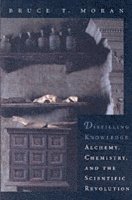
    Distilling Knowledge

    Alchemy, Chemistry, and the Scientific Revolution

    AvBruce T. Moran

    Häftad, Engelska, 2006

    Del 10 i serien New Histories of Science, Technology, and Medicine

    298 kr

    Beställningsvara. Skickas inom 10-15 vardagar. Fri frakt över 249 kr.

    Beskrivning

    Alchemy can't be science--common sense tells us as much. But perhaps common sense is not the best measure of what science is, or was. In this book, Bruce Moran looks past contemporary assumptions and prejudices to determine what alchemists were actually doing in the context of early modern science. Examining the ways alchemy and chemistry were studied and practiced between 1400 and 1700, he shows how these approaches influenced their respective practitioners' ideas about nature and shaped their inquiries into the workings of the natural world. His work sets up a dialogue between what historians have usually presented as separate spheres; here we see how alchemists and early chemists exchanged ideas and methods and in fact shared a territory between their two disciplines. Distilling Knowledge suggests that scientific revolution may wear a different appearance in different cultural contexts. The metaphor of the Scientific Revolution, Moran argues, can be expanded to make sense of alchemy and other so-called pseudo-sciences--by including a new framework in which "process can count as an object, in which making leads to learning, and in which the messiness of conflict leads to discernment." Seen on its own terms, alchemy can stand within the bounds of demonstrative science.

    Produktinformation

    • Utgivningsdatum:2006-09-01
    • Mått:140 x 210 x 13 mm
    • Vikt:295 g
    • Format:Häftad
    • Språk:Engelska
    • Serie:New Histories of Science, Technology, and Medicine
    • Antal sidor:224
    • Förlag:Harvard University Press
    • ISBN:9780674022492
    • Utmärkelser:Nominated for Watson Davis and Helen Miles Davis Prize 2005

    Utforska kategorier

    • Naturvetenskapens historia inom Naturvetenskap och teknik

    Mer om författaren

    Bruce T. Moran is Professor of History, University of Nevada at Reno.

    Recensioner i media

    Distilling Knowledge will prove to be the most important and valuable teaching or general-reader text on this subject available. I am often asked by students, colleagues, and interested members of the public to recommend such a 'general reader' text which could introduce them satisfactorily to alchemy and early chemistry. But there is no text that I could possibly recommend - not, that is, until this one. Thanks to Bruce Moran for writing this book and making my life easier.