Demografischer Wandel - Hintergründe und Herausforderungen - Böcker
Visar alla böcker i serien Demografischer Wandel - Hintergründe und Herausforderungen. Handla med fri frakt och snabb leverans.
6 produkter
6 produkter
534 kr
Skickas inom 10-15 vardagar
Dr. Albert Schmid President of the Federal Office for Migration and Refugees According to the United Nations, about 200 million people of the estimated world population of 6.8 billion are international migrants – that corresponds to about three per cent of the total world population. The proportion of international migrants in the global population has increased only marginally in the last 40 years. But, as a result of global population growth, the absolute number of migrants has increased, and their structure and spatial distribution has changed considerably. A structural shift has taken place primarily in the industrialised countries, where less than 20 per cent of the global workers are now living, but where more than 60 per cent of all migrants worldwide reside. Since 1990, more than 16 million people have moved to Germany, while about 11 million have left the country in the same period. Altogether, 15 million people of international migration origin are living in Germany, comprising almost 19 per cent of Germany’s current population of 82 million. At the end of 2006, about 64 million people out of Europe’s population of 732 million, or nine per cent, lived in a European country they were not born in. But why does anybody migrate at all? People decide to leave because, in general, they expect to find better conditions and opportunities in other countries or regions.
Ageing, Care Need and Quality of Life
The Perspective of Care Givers and People in Need of Care
Häftad, Engelska, 2010
534 kr
Skickas inom 10-15 vardagar
Steadily increasing life expectancy is one of the great achievements of industrialised societies over the last century. Life expectancy has not only been growing among the young and those reaching retirement age, but also, especially in recent decades, among people ages 80 and above. These improvements in life expectancy have led to the emergence of the so-called third age, when people retire, but are still you- ful, healthy and able to participate in society. Nevertheless, closer to the end of life, a fourth age of decrepitude and dependence on others has to be anticipated. - spite the postponement of functional limitations and severe disabilities into higher ages, the debate continues over whether the additional years gained are healthy years, or years with severe care need, particularly among the oldest old, the fastest growing segment of the population. Future improvements in life expectancy and the health status of the elderly will determine the need for care in the future. While different assumptions about these trends based on expert opinion or the extrapolation of past experiences can be made, there will always be a degree of uncertainty about future trends. A third - portant factor driving the extent of future care need is, however, already determined by the history of the past century and is embedded in the age structures of our populations.
599 kr
Skickas inom 10-15 vardagar
534 kr
Skickas inom 10-15 vardagar
This collection of research papers explores some of the salient issues relating to the impact of demographic change on the workings and outcomes of labour markets. A first chapter studies the direct impact of ageing on employment and unemployment. However, the age structure of the workforce also shapes productivity and the scope for innovation, issues which are taken up in turn. Furthermore, it is often argued that a decline in the size of the workforce may be offset by an increase in the workers’ skills and knowledge. The impact of demographic developments such as ageing and migration on the accumulation and transfer of human capital is, therefore, studied by a further set of contributions. The volume is rounded off with analyses relating to the supply of labour by women and by older workers. The authors ask, for instance, whether (female) labour migration as well as changes in retirement patterns and policies may counterbalance the expected workforce shrinking.
549 kr
Skickas inom 10-15 vardagar
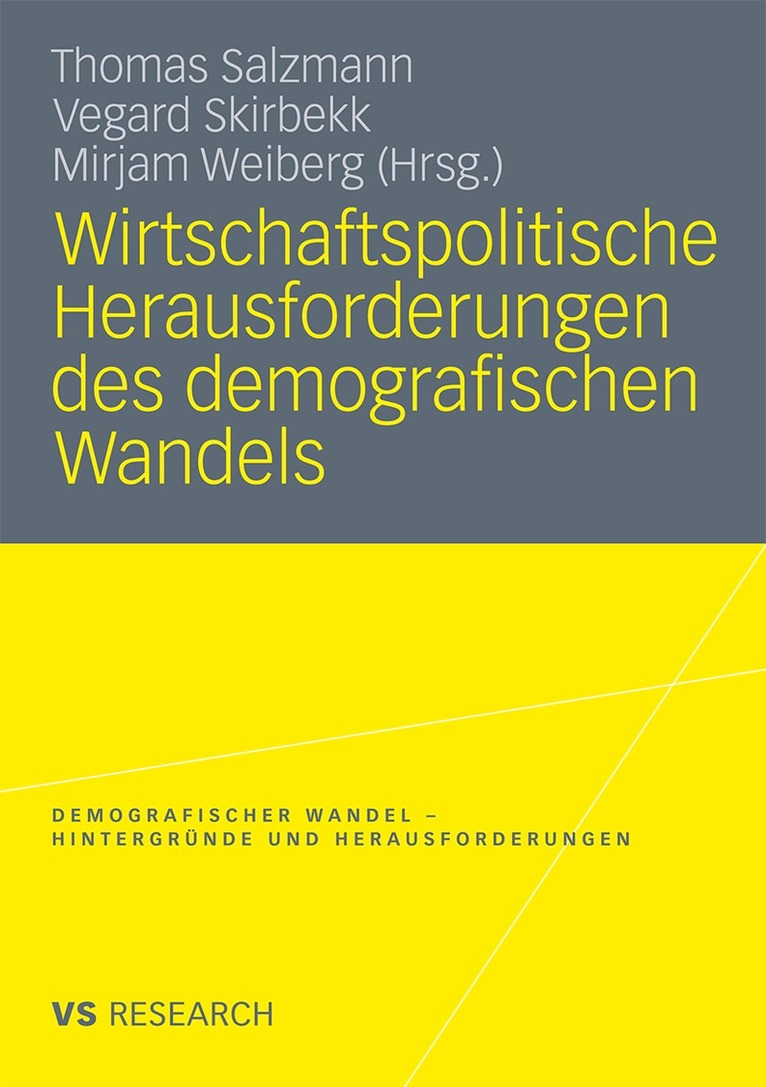
Dr. Alexander Groß Ministerialdirektor im Bundesministerium für Wirtschaft und Technologie Der für Deutschland prognostizierte Bevölkerungsrückgang und die zu erwartenden Veränderungen der Altersstruktur werden Gesellschaft, Wirtschaft und Politik zukünftig stark prägen. Die gesamtwirtschaftlichen Auswirkungen des de- grafischen Wandels werfen für die Wirtschaftspolitik eine Vielzahl von Fragen auf: Wie wird sich das Erwerbspersonenpotenzial, insbesondere das Fachkräfteangebot langfristig entwickeln? Wie können die sozialen Sicherungssysteme, vor allem im Bereich der Alterssicherung und Gesundheitsleistungen demografiefest und generationengerecht gestaltet werden? Wie können Innovationskraft, Wettbewer- fähigkeit und Arbeitsproduktivität erhalten und weiter gesteigert werden? Welche Anpassungserfordernisse ergeben sich auf Unternehmensebene, in der Infrastruktur und in den Regionen und wie können sie bestmöglich wirtschaftspolitisch begleitet werden? Zur Präsentation und Diskussion neuerer Forschungsergebnisse zu wirtschaftspolitisch relevanten Aspekten des demografischen Wandels hatten der Arbeitskreis „Junge Demographie“ der Deutschen Gesellschaft für Demographie und das Bundesministerium für Wirtschaft und Technologie zu einem zweitätigen Symposium „Wirtschaftspolitische Herausforderungen des demografischen Wandels“ eingeladen. Das Symposium fand am 26. und 27. Februar 2009 im Bundesministerium für Wirtschaft und Technologie in Berlin statt. Teilnehmer der Veranstaltung waren Vertreter aus Wirtschaft und Verbänden, Wissenschaftler verschiedener Fachrichtungen, Vertreter von Bund, Ländern und Kommunen sowie Fachjournalisten. Das Symposium diente der wirtschaftspolitischen Beratung und zielte darauf ab, neueste Erkenntnisse derwissenschaftlichen Forschung zu den langfristigen wirtschaftlichen Auswirkungen des demografischen Wandels in Deutschland und Europa zu präsentieren, wirtschaftspolitische Fragestellungen aufzuwerfen und Lösungsansätze zu diskutieren.
Ein probabilistisches Bevölkerungsprognosemodell
Entwicklung und Anwendung für Deutschland
Häftad, Tyska, 2012
470 kr
Skickas inom 10-15 vardagar
Bevölkerungsprognosen haben eine weitreichende Bedeutung für die zukünftige Gestaltung diverser gesellschaftlicher Lebensbereiche, sodass die fortlaufende Verbesserung ihrer Methodik unabdingbar ist. Zudem zeigt die Überprüfung vergangener Bevölkerungsprognosen, dass deren Genauigkeit weder durch die bessere Datenqualität noch durch die bislang verbesserte Methodik wesentlich gesteigert werden konnte. Aus diesem Grund entwickelt Christina Bohk das Probabilistic Population Projection Model (PPPM) zur Durchführung probabilistischer Bevölkerungsprognosen theoretisch, implementiert es und wendet es beispielhaft in einer Prognose für die Bevölkerung Deutschlands von 2007 bis 2050 an.