Gabriele Doblhammer – författare
Visar alla böcker från författaren Gabriele Doblhammer. Handla med fri frakt och snabb leverans.
8 produkter
8 produkter
Inbunden, Engelska, 2018
559 kr
Skickas inom 10-15 vardagar
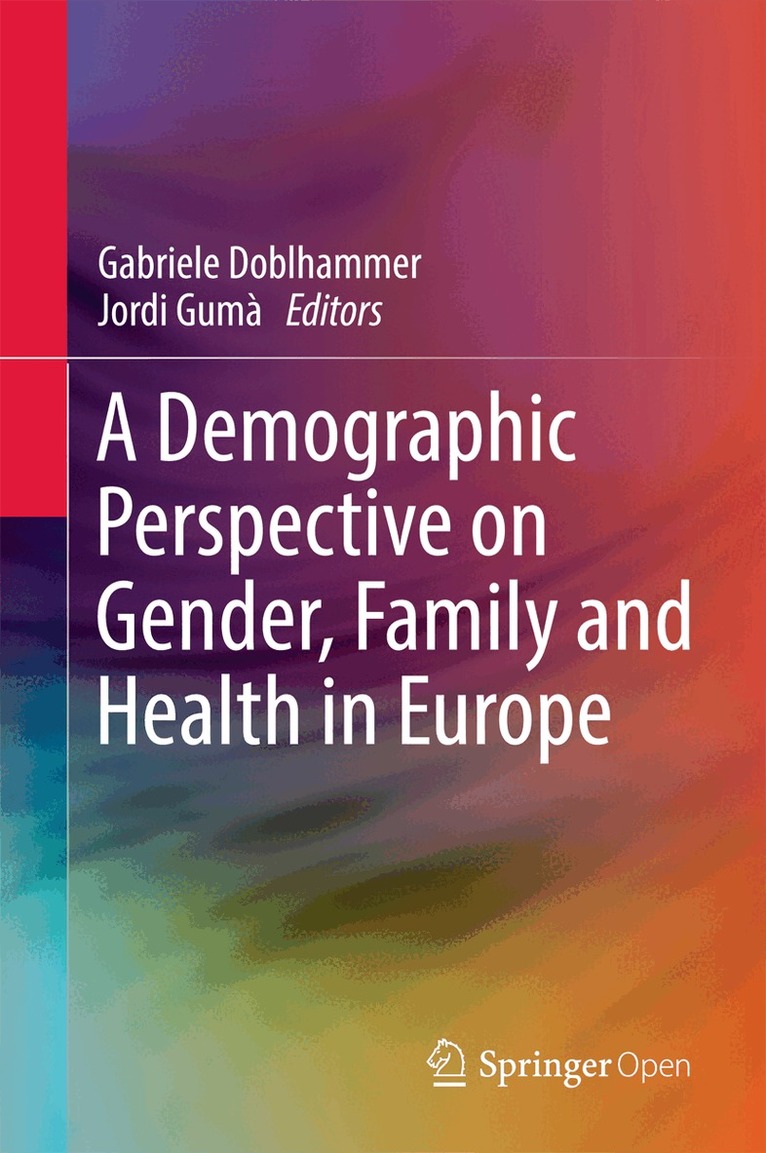
This open access book examines the triangle between family, gender, and health in Europe from a demographic perspective. It helps to understand patterns and trends in each of the three components separately, as well as their interdependencies. It overcomes the widely observable specialization in demographic research, which usually involves researchers studying either family or fertility processes or focusing on health and mortality. Coverage looks at new family and partnership forms among the young and middle-aged, their relationship with health, and the pathways through which they act. Among the old, lifelong family biography and present family situation are explored. Evidence is provided that partners advancing in age start to resemble each other more closely in terms of health, with the health of the partner being a crucial factor of an individual’s own health. Gender-specific health outcomes and pathways are central in the designs of the studies and the discussion of the results. The book compares twelve European countries reflecting different welfare state regimes and offers country-specific studies conducted in Austria, Germany, Italy - all populations which have received less attention in the past - and Sweden. As a result, readers discover the role of different concepts of family and health as well as comparisons within European countries and ethnic groups.It will be an insightful resource for students, academics, policy makers, and researchers that will help define future research in terms of gender and public health.
Häftad, Engelska, 2019
559 kr
Skickas inom 10-15 vardagar
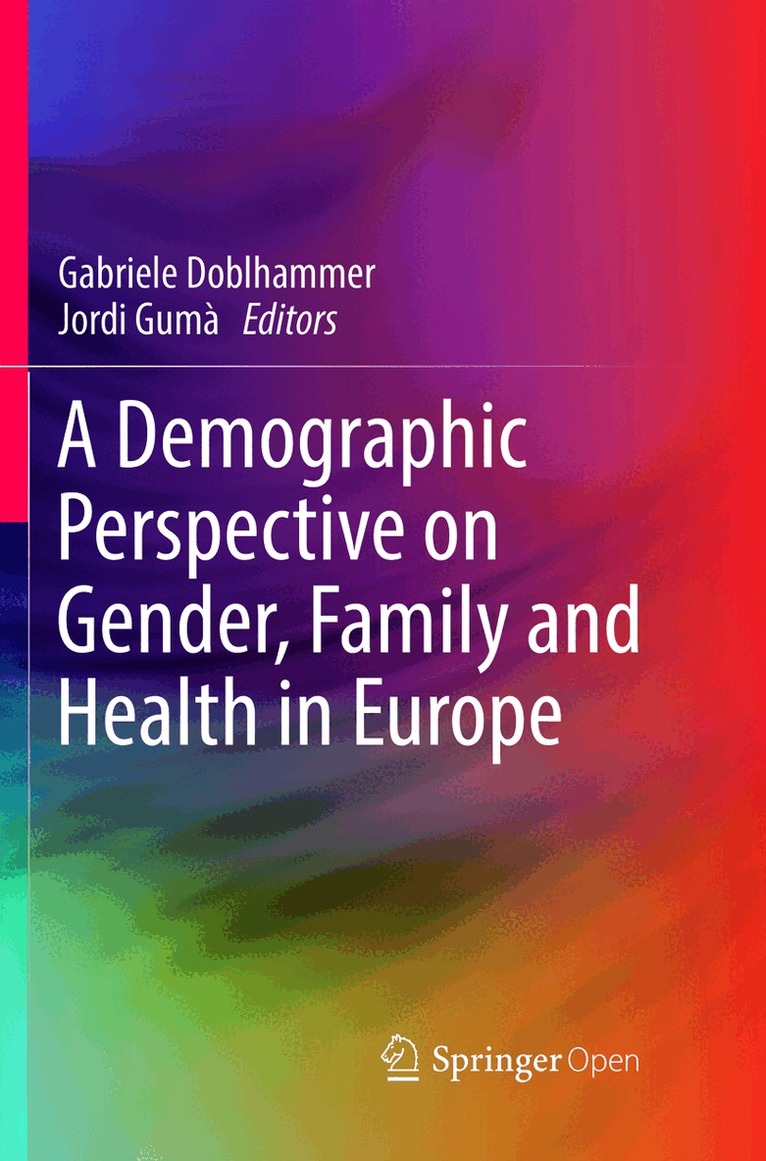
This open access book examines the triangle between family, gender, and health in Europe from a demographic perspective. It helps to understand patterns and trends in each of the three components separately, as well as their interdependencies. It overcomes the widely observable specialization in demographic research, which usually involves researchers studying either family or fertility processes or focusing on health and mortality. Coverage looks at new family and partnership forms among the young and middle-aged, their relationship with health, and the pathways through which they act. Among the old, lifelong family biography and present family situation are explored. Evidence is provided that partners advancing in age start to resemble each other more closely in terms of health, with the health of the partner being a crucial factor of an individual’s own health. Gender-specific health outcomes and pathways are central in the designs of the studies and the discussion of the results. The book compares twelve European countries reflecting different welfare state regimes and offers country-specific studies conducted in Austria, Germany, Italy - all populations which have received less attention in the past - and Sweden. As a result, readers discover the role of different concepts of family and health as well as comparisons within European countries and ethnic groups.It will be an insightful resource for students, academics, policy makers, and researchers that will help define future research in terms of gender and public health.
Häftad, Engelska, 2010
543 kr
Skickas inom 10-15 vardagar
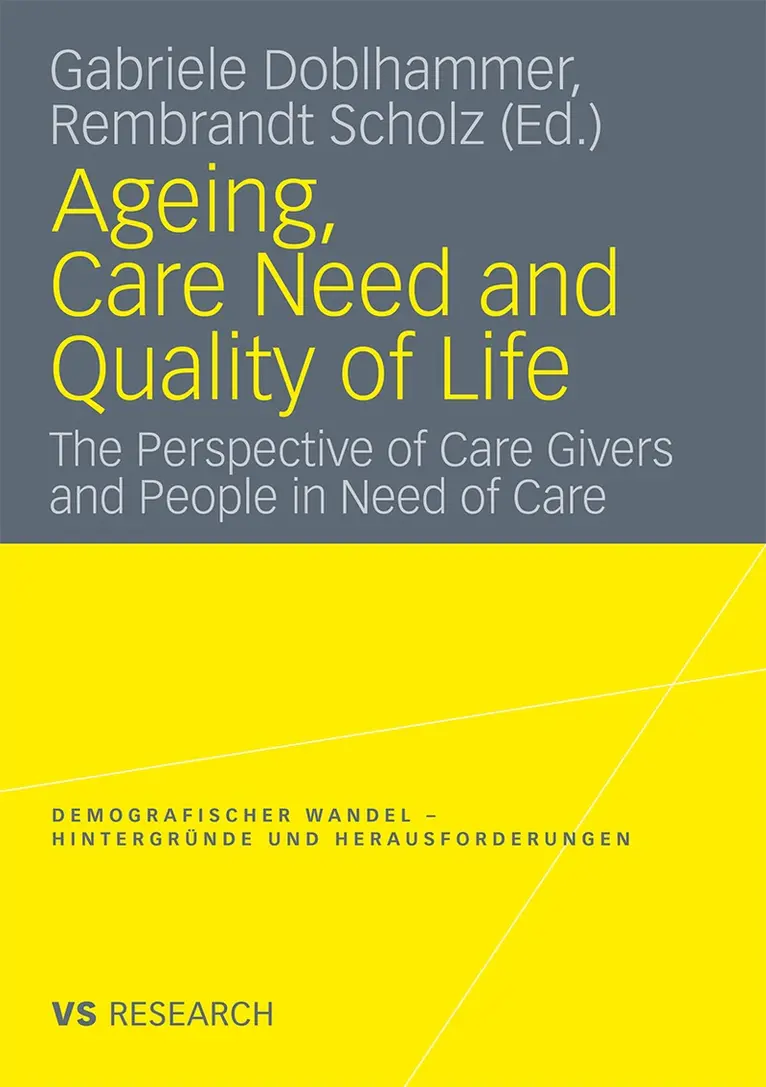
Steadily increasing life expectancy is one of the great achievements of industrialised societies over the last century. Life expectancy has not only been growing among the young and those reaching retirement age, but also, especially in recent decades, among people ages 80 and above. These improvements in life expectancy have led to the emergence of the so-called third age, when people retire, but are still you- ful, healthy and able to participate in society. Nevertheless, closer to the end of life, a fourth age of decrepitude and dependence on others has to be anticipated. - spite the postponement of functional limitations and severe disabilities into higher ages, the debate continues over whether the additional years gained are healthy years, or years with severe care need, particularly among the oldest old, the fastest growing segment of the population. Future improvements in life expectancy and the health status of the elderly will determine the need for care in the future. While different assumptions about these trends based on expert opinion or the extrapolation of past experiences can be made, there will always be a degree of uncertainty about future trends. A third - portant factor driving the extent of future care need is, however, already determined by the history of the past century and is embedded in the age structures of our populations.
E-bok
PDF, Engelska, 2010687 kr
Läs direkt efter köp
Steadily increasing life expectancy is one of the great achievements of industrialised societies over the last century. Life expectancy has not only been growing among the young and those reaching retirement age, but also, especially in recent decades, among people ages 80 and above. These improvements in life expectancy have led to the emergence of the so-called third age, when people retire, but are still you- ful, healthy and able to participate in society. Nevertheless, closer to the end of life, a fourth age of decrepitude and dependence on others has to be anticipated. - spite the postponement of functional limitations and severe disabilities into higher ages, the debate continues over whether the additional years gained are healthy years, or years with severe care need, particularly among the oldest old, the fastest growing segment of the population. Future improvements in life expectancy and the health status of the elderly will determine the need for care in the future. While different assumptions about these trends based on expert opinion or the extrapolation of past experiences can be made, there will always be a degree of uncertainty about future trends. A third - portant factor driving the extent of future care need is, however, already determined by the history of the past century and is embedded in the age structures of our populations.
Inbunden, Engelska, 2004
1 079 kr
Skickas inom 10-15 vardagar
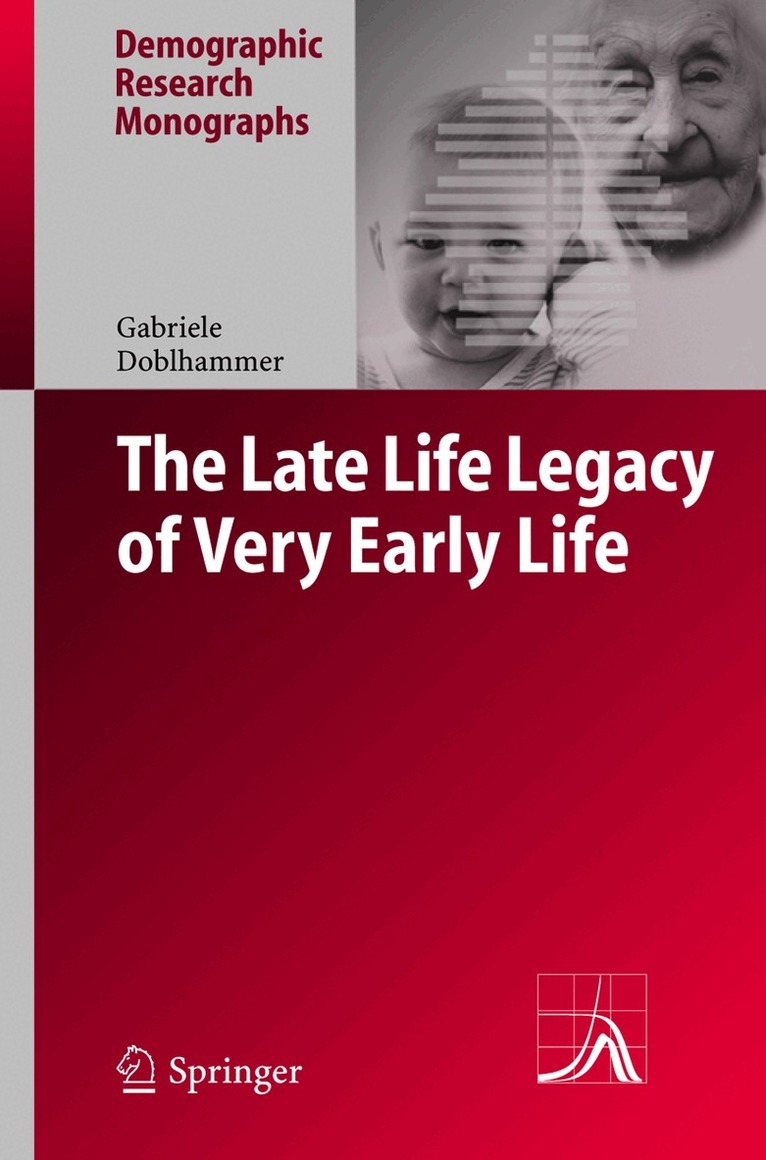
This stimulating, carefully-researched book on The Late Life Legacy of Very Early Life by Dr. Gabriele Doblhammer is the second volume of a new series of Demographic Research Monographs published by Springer Verlag. The topic of the book is fascinating. Is a person's lifespan influ enced by health and nutrition in-utero and shortly after birth? If so, why? The answers uncovered by the diligence, demographic and statistical ex pertise, and probing intelligence of the author are surprising but convinc ing. To pry open the mystery of the lingering impact of very early life, Dr. Doblharnmer focuses on month of birth. It turns out that people born in some months live substantially longer on average than people born in other months, not because of astrological forces but for reasons of health and nutrition. Dr. Doblhammer was educated in statistics and demography and earlier this year was the first person ever to receive the "Habilitation" de gree, the recognition given in the German-speaking world to proven scho lars who are qualified to become professors, in Demography. This book, which is evidence that she fully deserves this award, will not only provide important new fmdings about the legacy of early life but will also serve as a comprehensive foundation of knowledge on which future scholars can build. The series of Demographic Research Monographs is under the editorial supervision of the Max Planck Institute for Demographic Research. Prof. James W. Vaupel, Founding Director of the Institute, is Editor-in-Chief.
Häftad, Engelska, 2010
1 079 kr
Skickas inom 10-15 vardagar
This stimulating, carefully-researched book on The Late Life Legacy of Very Early Life by Dr. Gabriele Doblhammer is the second volume of a new series of Demographic Research Monographs published by Springer Verlag. The topic of the book is fascinating. Is a person's lifespan influ enced by health and nutrition in-utero and shortly after birth? If so, why? The answers uncovered by the diligence, demographic and statistical ex pertise, and probing intelligence of the author are surprising but convinc ing. To pry open the mystery of the lingering impact of very early life, Dr. Doblharnmer focuses on month of birth. It turns out that people born in some months live substantially longer on average than people born in other months, not because of astrological forces but for reasons of health and nutrition. Dr. Doblhammer was educated in statistics and demography and earlier this year was the first person ever to receive the "Habilitation" de gree, the recognition given in the German-speaking world to proven scho lars who are qualified to become professors, in Demography. This book, which is evidence that she fully deserves this award, will not only provide important new fmdings about the legacy of early life but will also serve as a comprehensive foundation of knowledge on which future scholars can build. The series of Demographic Research Monographs is under the editorial supervision of the Max Planck Institute for Demographic Research. Prof. James W. Vaupel, Founding Director of the Institute, is Editor-in-Chief.
E-bok
PDF, Engelska, 20131 459 kr
Läs direkt efter köp
This stimulating, carefully-researched book on The Late Life Legacy of Very Early Life by Dr. Gabriele Doblhammer is the second volume of a new series of Demographic Research Monographs published by Springer Verlag. The topic of the book is fascinating. Is a person''s lifespan influ enced by health and nutrition in-utero and shortly after birth? If so, why? The answers uncovered by the diligence, demographic and statistical ex pertise, and probing intelligence of the author are surprising but convinc ing. To pry open the mystery of the lingering impact of very early life, Dr. Doblharnmer focuses on month of birth. It turns out that people born in some months live substantially longer on average than people born in other months, not because of astrological forces but for reasons of health and nutrition. Dr. Doblhammer was educated in statistics and demography and earlier this year was the first person ever to receive the "Habilitation" de gree, the recognition given in the German-speaking world to proven scho lars who are qualified to become professors, in Demography. This book, which is evidence that she fully deserves this award, will not only provide important new fmdings about the legacy of early life but will also serve as a comprehensive foundation of knowledge on which future scholars can build. The series of Demographic Research Monographs is under the editorial supervision of the Max Planck Institute for Demographic Research. Prof. James W. Vaupel, Founding Director of the Institute, is Editor-in-Chief.
Engelska, 2013
648 kr
Skickas inom 5-8 vardagar