Elements in the Philosophy of Georg Wilhelm Friedrich Hegel – serie
Visar alla böcker i serien Elements in the Philosophy of Georg Wilhelm Friedrich Hegel. Handla med fri frakt och snabb leverans.
18 produkter
18 produkter
753 kr
Kommande
Hegel referred to Geist as 'self-conscious life' as a being which exists within a 'web' of sense it spins for itself both collectively and individually. As Geist collectively develops itself in history and in theory, it ties 'knots' in various parts of its web which then form the settled basis for further progress. John Dewey spoke of the fundamental 'deposits' laid down in history in the same way Hegel spoke of 'knots.' Both Hegel and Dewey thought that the kinds of obligations necessary in modern political life could only be actualized in terms of a larger conception of the good life individually and collectively led. However, Dewey argued that given the fact of democracy as a 'way of life' and not merely a form of government was the necessary replacement for Hegel's concept of Sittlichkeit (ethical life) as the living good in which the watchword is freedom.
234 kr
Kommande
Hegel referred to Geist as 'self-conscious life' as a being which exists within a 'web' of sense it spins for itself both collectively and individually. As Geist collectively develops itself in history and in theory, it ties 'knots' in various parts of its web which then form the settled basis for further progress. John Dewey spoke of the fundamental 'deposits' laid down in history in the same way Hegel spoke of 'knots.' Both Hegel and Dewey thought that the kinds of obligations necessary in modern political life could only be actualized in terms of a larger conception of the good life individually and collectively led. However, Dewey argued that given the fact of democracy as a 'way of life' and not merely a form of government was the necessary replacement for Hegel's concept of Sittlichkeit (ethical life) as the living good in which the watchword is freedom.
234 kr
Kommande
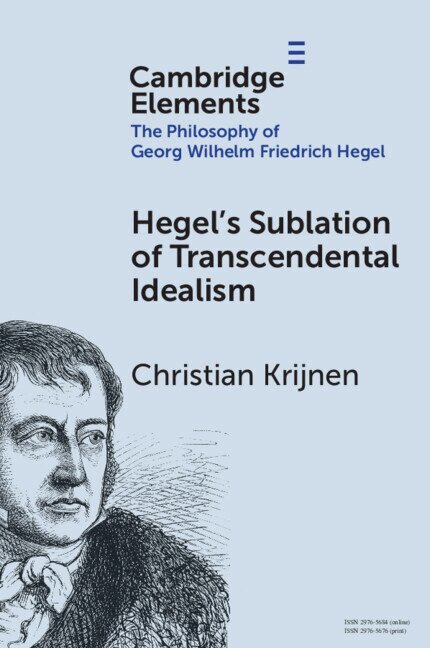
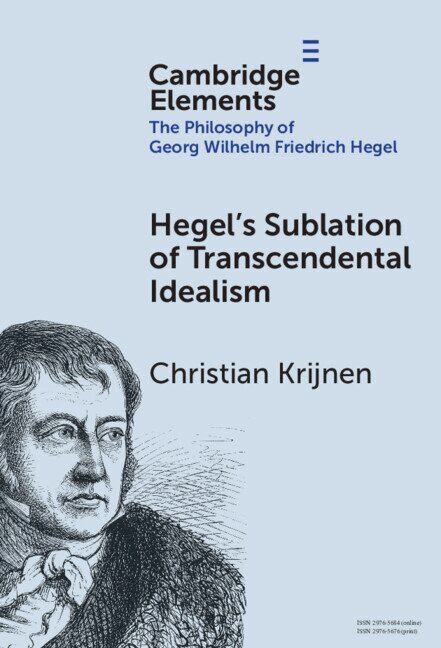
Speculative idealism is the end of transcendental idealism. Focusing on the problem of the beginning of philosophy, this thesis is substantiated in four chapters. The chapter on Kant exposes the problem of the beginning and its solution. The chapter on contemporary transcendental philosophy shows that even in the most advanced versions of transcendental philosophy, the problem of the beginning remains. The chapter on neo-Kantianism, so important for contemporary transcendental philosophy, renders explicit that here too the problem of the beginning is a paradigmatic burden of transcendental idealism. The first three chapters proof concerning all dimensions of Hegel's Logic (Being, Essence, Concept) that transcendental philosophy perishes due to the methodical profile of its reflection and requires its sublation by speculative idealism. For this reason, as becomes clear from the final chapter, a return to the late Fichte does not overcome the problem of the beginning either.
753 kr
Kommande
Speculative idealism is the end of transcendental idealism. Focusing on the problem of the beginning of philosophy, this thesis is substantiated in four chapters. The chapter on Kant exposes the problem of the beginning and its solution. The chapter on contemporary transcendental philosophy shows that even in the most advanced versions of transcendental philosophy, the problem of the beginning remains. The chapter on neo-Kantianism, so important for contemporary transcendental philosophy, renders explicit that here too the problem of the beginning is a paradigmatic burden of transcendental idealism. The first three chapters proof concerning all dimensions of Hegel's Logic (Being, Essence, Concept) that transcendental philosophy perishes due to the methodical profile of its reflection and requires its sublation by speculative idealism. For this reason, as becomes clear from the final chapter, a return to the late Fichte does not overcome the problem of the beginning either.
753 kr
Skickas inom 7-10 vardagar
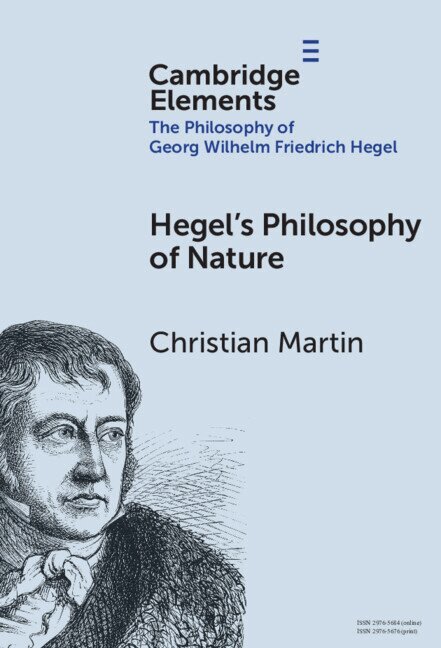
Recent years have seen new systematic interest in Hegel's philosophical conception of the physical universe. It has become clear that Hegel's account of nature is revealing both on its own as well as by providing a non-naturalist understanding of the place of mind in nature. This Element focuses on the very foundations and method of Hegel's philosophy of nature, relating them to Newtonian and to modern physics. The volume also sheds light on Hegel's global account of the physical universe as a material space-time system and on his ecological conception of the Earth as a habitable planet populated by organic life. By drawing connections to relativity theory and earth systems science it is shown that Hegel's conception of nature is very much philosophically alive and can complement scientific accounts of nature in illuminating ways.
234 kr
Skickas inom 7-10 vardagar
Recent years have seen new systematic interest in Hegel's philosophical conception of the physical universe. It has become clear that Hegel's account of nature is revealing both on its own as well as by providing a non-naturalist understanding of the place of mind in nature. This Element focuses on the very foundations and method of Hegel's philosophy of nature, relating them to Newtonian and to modern physics. The volume also sheds light on Hegel's global account of the physical universe as a material space-time system and on his ecological conception of the Earth as a habitable planet populated by organic life. By drawing connections to relativity theory and earth systems science it is shown that Hegel's conception of nature is very much philosophically alive and can complement scientific accounts of nature in illuminating ways.
753 kr
Skickas inom 7-10 vardagar
This Element discusses Heidegger's early (1924–1931) reading and critique of Hegel, which revolve around the topic of time. The standard view is that Heidegger distances himself from Hegel by arguing that whereas he takes time to be 'originarily' Dasein's 'temporality,' Hegel has a 'vulgar' conception of time as 'now-time' (the succession of formal nows). The Element defends the thesis that while this difference concerning the nature of time is certainly a part of Heidegger's 'confrontation' with Hegel, it is not its kernel. What Heidegger aspired to convey with his Hegel-critique is that they have a divergent conception of man's understanding of being (ontology). Whereas Heidegger takes ontology to be grounded in temporality, Hegel thinks it is grounded in 'the concept,' which has a dimension ('logos') manifesting eternity or timelessness. It is argued, contra Kojève, that Heidegger's reading (but not necessarily his critique) of Hegel is, in an important respect, correct.
234 kr
Skickas inom 7-10 vardagar
This Element discusses Heidegger's early (1924–1931) reading and critique of Hegel, which revolve around the topic of time. The standard view is that Heidegger distances himself from Hegel by arguing that whereas he takes time to be 'originarily' Dasein's 'temporality,' Hegel has a 'vulgar' conception of time as 'now-time' (the succession of formal nows). The Element defends the thesis that while this difference concerning the nature of time is certainly a part of Heidegger's 'confrontation' with Hegel, it is not its kernel. What Heidegger aspired to convey with his Hegel-critique is that they have a divergent conception of man's understanding of being (ontology). Whereas Heidegger takes ontology to be grounded in temporality, Hegel thinks it is grounded in 'the concept,' which has a dimension ('logos') manifesting eternity or timelessness. It is argued, contra Kojève, that Heidegger's reading (but not necessarily his critique) of Hegel is, in an important respect, correct.
234 kr
Skickas inom 7-10 vardagar
Hegel famously argues that the patriarchal, bourgeois nuclear family is a rational institution worth defending. Scholars have asked what exactly to do with this seemingly outdated part of his social and political philosophy. In particular, they have wondered whether Hegel's concept of the family can accommodate changes to our understanding of what counts as a family and what constitutes family relations. In this Element, I ask whether Hegel's defense of the family can be reconciled with family abolition, the project not of reforming the family as an institution, but of radically transforming it beyond recognition. By examining the three relationships that Hegel associates with the family - brothers and sisters, husbands and wives, and parents and children - I argue that Hegel's concept of the family can be reconciled with family abolition so described. What Hegel provides is an account of the family as a site at which important goods have been discovered and eveloped, without claiming that the family as an institution is necessary for, or even ideally suited to, their continued realization. These goods are singular individuality, ethical love, and material resources.
753 kr
Skickas inom 7-10 vardagar
Hegel famously argues that the patriarchal, bourgeois nuclear family is a rational institution worth defending. Scholars have asked what exactly to do with this seemingly outdated part of his social and political philosophy. In particular, they have wondered whether Hegel's concept of the family can accommodate changes to our understanding of what counts as a family and what constitutes family relations. In this Element, I ask whether Hegel's defense of the family can be reconciled with family abolition, the project not of reforming the family as an institution, but of radically transforming it beyond recognition. By examining the three relationships that Hegel associates with the family - brothers and sisters, husbands and wives, and parents and children - I argue that Hegel's concept of the family can be reconciled with family abolition so described. What Hegel provides is an account of the family as a site at which important goods have been discovered and eveloped, without claiming that the family as an institution is necessary for, or even ideally suited to, their continued realization. These goods are singular individuality, ethical love, and material resources.
234 kr
Skickas inom 7-10 vardagar
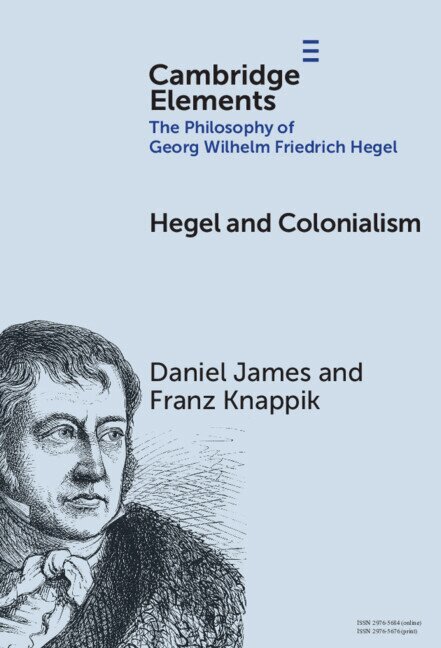
This Element offers the first comprehensive study of Hegel's views on European colonialism. In surprisingly detailed discussions scattered throughout much of his mature oeuvre, Hegel offers assessments that legitimise colonialism in the Americas, the enslavement of Africans, and British rule in India. The Element reconstructs these discussions as being held together by a systematic account of colonialism as racial domination, underpinned by central elements of his philosophy and situated within long-overlooked contexts, including Hegel's engagement with British abolitionism and Scottish four-stages theories of social development. Challenging prevailing approaches in scholarship, James and Knappik show that Hegel's accounts of issues like freedom, personhood and the dialectic of lordship and bondage are deeply entangled with his disturbing views on colonialism, slavery, and race. Lastly, they address Hegel's ambivalent legacy, examining how British Idealists and others adopted his pro-colonial ideas, while thinkers like C. L. R. James and Angela Davis transformed them for anti-colonial purposes. This title is also available as open access on Cambridge Core.
753 kr
Skickas inom 7-10 vardagar
This Element offers the first comprehensive study of Hegel's views on European colonialism. In surprisingly detailed discussions scattered throughout much of his mature oeuvre, Hegel offers assessments that legitimise colonialism in the Americas, the enslavement of Africans, and British rule in India. The Element reconstructs these discussions as being held together by a systematic account of colonialism as racial domination, underpinned by central elements of his philosophy and situated within long-overlooked contexts, including Hegel's engagement with British abolitionism and Scottish four-stages theories of social development. Challenging prevailing approaches in scholarship, James and Knappik show that Hegel's accounts of issues like freedom, personhood and the dialectic of lordship and bondage are deeply entangled with his disturbing views on colonialism, slavery, and race. Lastly, they address Hegel's ambivalent legacy, examining how British Idealists and others adopted his pro-colonial ideas, while thinkers like C. L. R. James and Angela Davis transformed them for anti-colonial purposes. This title is also available as open access on Cambridge Core.
234 kr
Skickas inom 7-10 vardagar
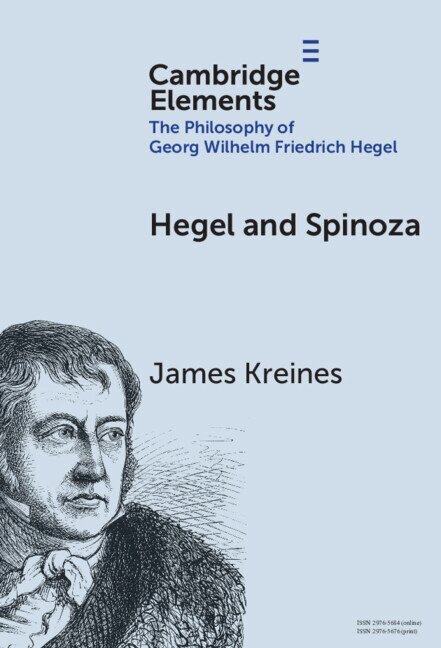
This Element concerns Hegel's engagement with Spinoza's metaphysics, and divides into three main parts. The first enlists help from Hegel's interpretation to introduce and defend philosophical strengths in Spinoza's defense of metaphysical monism. The second defends Hegel's criticism of Spinoza, concluding that Spinoza's philosophy must eliminate all finitude and determinacy, leaving only a shapeless abyss. The third employs these defenses to open up an approach to the philosophical interpretation of Hegel's Logic, the core of his philosophical system, understanding the meaning of Hegel's ambitious claims in terms of reasons that make them more than the mere unpacking of assumptions.
1 053 kr
Skickas inom 7-10 vardagar
This Element concerns Hegel's engagement with Spinoza's metaphysics, and divides into three main parts. The first enlists help from Hegel's interpretation to introduce and defend philosophical strengths in Spinoza's defense of metaphysical monism. The second defends Hegel's criticism of Spinoza, concluding that Spinoza's philosophy must eliminate all finitude and determinacy, leaving only a shapeless abyss. The third employs these defenses to open up an approach to the philosophical interpretation of Hegel's Logic, the core of his philosophical system, understanding the meaning of Hegel's ambitious claims in terms of reasons that make them more than the mere unpacking of assumptions.
234 kr
Kommande
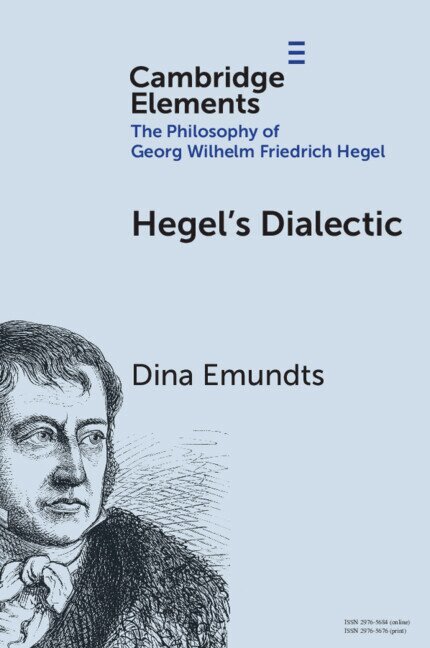
This element is a study on Hegel's dialectic. One motivation for turning to dialectic is the idea that in order to understand the complex and dynamic structure of reality and of our thinking itself, we need a different way of thinking from that provided by standard logic and by traditional philosophy. The aim of the book is to present Hegel's basic idea of dialectic and to explain it through an interpretation of the text, an account of its reception, and a survey of themes in the secondary literature. The main theses discussed are that Hegel's dialectic is primarily a method of thinking and that he develops a unified theory of dialectic in his various writings.
753 kr
Kommande
This element is a study on Hegel's dialectic. One motivation for turning to dialectic is the idea that in order to understand the complex and dynamic structure of reality and of our thinking itself, we need a different way of thinking from that provided by standard logic and by traditional philosophy. The aim of the book is to present Hegel's basic idea of dialectic and to explain it through an interpretation of the text, an account of its reception, and a survey of themes in the secondary literature. The main theses discussed are that Hegel's dialectic is primarily a method of thinking and that he develops a unified theory of dialectic in his various writings.
Hegel and Republicanism
Non-Domination, Economics, and Political Participation
Inbunden, Engelska, 2026
1 053 kr
Skickas inom 7-10 vardagar
This Element is about the relationship between the political thought of the German philosopher G. W. F. Hegel (1770-1831) and a tradition of political thinking known as republicanism that traces its roots at least to 15th century Florence and perhaps further back to Aristotle. Throughout, we will be investigating this relationship along two dimensions. First, we will be asking whether it advances our understanding of Hegel's thought to consider him to be a republican, and if so, in what way and to what extent. The point here is not to assimilate Hegel to a cause or a label, but to see whether the individual outlines of Hegel's thought might be brought into focus by adopting the lens of republicanism. Second, we will be considering whether Hegel's thought offers criticism of various other forms of republicanism and how we might evaluate that criticism.
234 kr
Skickas inom 7-10 vardagar
This Element is about the relationship between the political thought of the German philosopher G. W. F. Hegel (1770-1831) and a tradition of political thinking known as republicanism that traces its roots at least to 15th century Florence and perhaps further back to Aristotle. Throughout, we will be investigating this relationship along two dimensions. First, we will be asking whether it advances our understanding of Hegel's thought to consider him to be a republican, and if so, in what way and to what extent. The point here is not to assimilate Hegel to a cause or a label, but to see whether the individual outlines of Hegel's thought might be brought into focus by adopting the lens of republicanism. Second, we will be considering whether Hegel's thought offers criticism of various other forms of republicanism and how we might evaluate that criticism.