Ioannis Trisokkas – författare
Visar alla böcker från författaren Ioannis Trisokkas. Handla med fri frakt och snabb leverans.
5 produkter
5 produkter
Inbunden, Engelska, 2025
742 kr
Skickas inom 7-10 vardagar
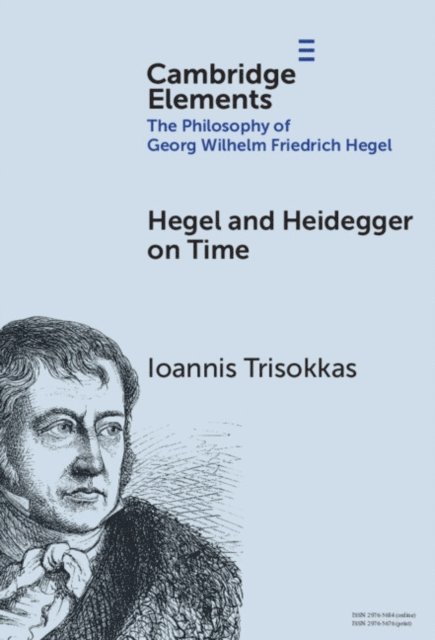
This Element discusses Heidegger's early (1924-1931) reading and critique of Hegel, which revolve around the topic of time. The standard view is that Heidegger distances himself from Hegel by arguing that whereas he takes time to be 'originarily' Dasein's 'temporality,' Hegel has a 'vulgar' conception of time as 'now-time' (the succession of formal nows). The Element defends the thesis that while this difference concerning the nature of time is certainly a part of Heidegger's 'confrontation' with Hegel, it is not its kernel. What Heidegger aspired to convey with his Hegel-critique is that they have a divergent conception of man's understanding of being (ontology). Whereas Heidegger takes ontology to be grounded in temporality, Hegel thinks it is grounded in 'the concept,' which has a dimension ('logos') manifesting eternity or timelessness. It is argued, contra Kojève, that Heidegger's reading (but not necessarily his critique) of Hegel is, in an important respect, correct.
E-bok
PDF, Engelska, 2025275 kr
Läs direkt efter köp
E-bok
Engelska, 2025278 kr
Läs direkt efter köp
Häftad, Engelska, 2025
230 kr
Skickas inom 7-10 vardagar
This Element discusses Heidegger's early (1924-1931) reading and critique of Hegel, which revolve around the topic of time. The standard view is that Heidegger distances himself from Hegel by arguing that whereas he takes time to be 'originarily' Dasein's 'temporality,' Hegel has a 'vulgar' conception of time as 'now-time' (the succession of formal nows). The Element defends the thesis that while this difference concerning the nature of time is certainly a part of Heidegger's 'confrontation' with Hegel, it is not its kernel. What Heidegger aspired to convey with his Hegel-critique is that they have a divergent conception of man's understanding of being (ontology). Whereas Heidegger takes ontology to be grounded in temporality, Hegel thinks it is grounded in 'the concept,' which has a dimension ('logos') manifesting eternity or timelessness. It is argued, contra Kojève, that Heidegger's reading (but not necessarily his critique) of Hegel is, in an important respect, correct.
E-bok
PDF, Engelska, 20123 113 kr
Läs direkt efter köp
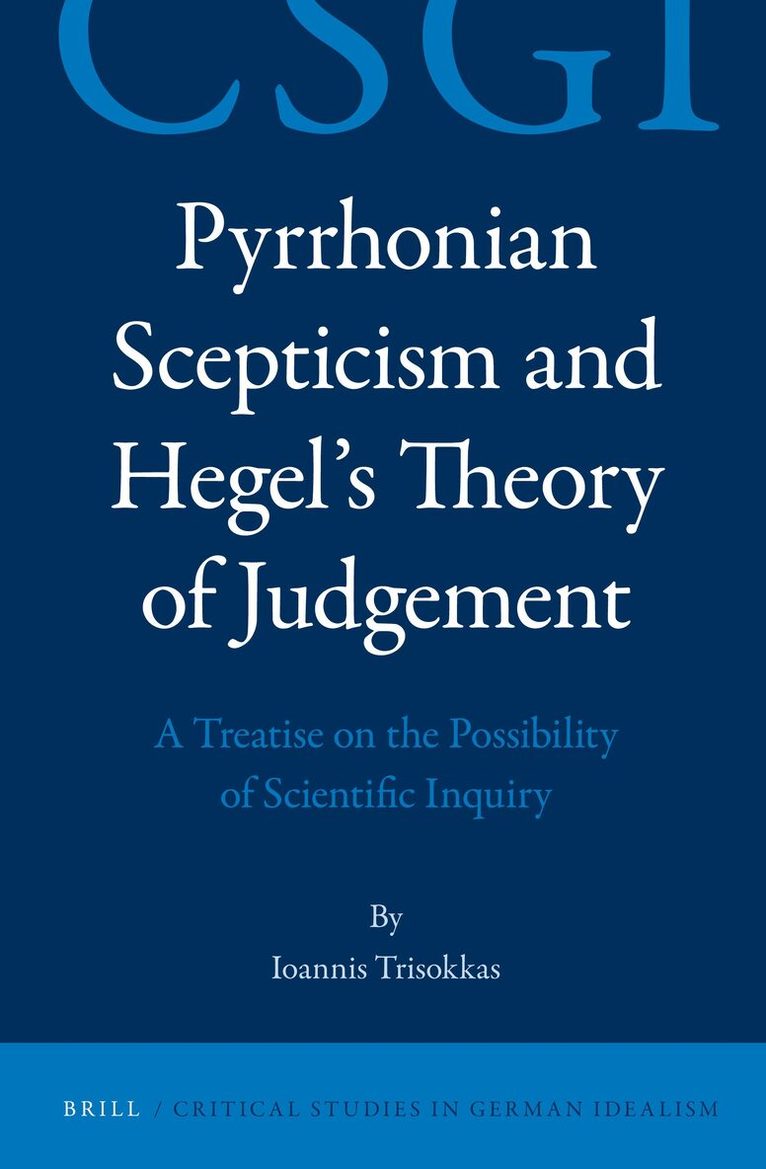
Hegel's Science of Logic is widely acknowledged as one of the greatest works of European philosophy. However, its contribution to arguably the most important philosophical problem, Pyrrhonian scepticism, has never been examined in any detail. Pyrrhonian Scepticism and Hegel's Theory of Judgement fills a great lacuna in Hegel scholarship by convincingly proving that the dialectic of the judgement in Hegel's Science of Logic successfully refutes this kind of scepticism. Although Ioannis Trisokkas has written the book primarily for those students of philosophy who already have an interest in Hegel's epistemology and philosophy of language and/or his Science of Logic, it will also appeal to those who investigate the problem of scepticism independently of the Hegel corpus.