LERA Research Volume – serie
Visar alla böcker i serien LERA Research Volume. Handla med fri frakt och snabb leverans.
21 produkter
21 produkter
Häftad, Engelska, 2011
418 kr
Skickas inom 5-8 vardagar
One of the most persistent and important, but often ignored, trends contemporary market economies continues to be the ownership of firms by their employees. Since the emergence of different experiments with employee ownership in the early twentieth century, a growing group of companies and expanding set of institutions have opened the door for firms to share the financial returns of economic production with broad groups of employees. The growth of various forms of "shared capitalism" has meant that currently a little under half of all employees in the private sector own stock in the companies in which they work or receive cash-based bonuses linked to different measures of corporate performance.Employee ownership is a complex phenomenon that can be and has been fruitfully analyzed from a number of different social scientific perspectives. This book showcases the diverse state of cutting-edge academic work on shared capitalism in the United States and Western Europe. Its chapters present a representative cross-section of current research, lively debates, and new research initiatives. Employee Ownership and Shared Capitalism illuminates shared capitalism's complexity as an organizational, psychological, sociological, and economic phenomenon that requires deep interdisciplinary understanding.Contributors: Serdar Aldatmaz (University of North Carolina); Saioa Arando (Mondragon University); Daphne Perkins Berry (University of Massachusetts Amherst); Joseph R. Blasi (Rutgers, The State University of New Jersey); Francesco Bova (University of Toronto); Marco Caramelli (INSEEC Business School); Edward J. Carberry (Erasmus University); Adrienne E. Eaton (Rutgers, The State University of New Jersey); Fred Freundlich (Mondragon University); Monica Gago (Mondragon University); Derek C. Jones (Hamilton College); Takao Kato (Colgate University); Douglas L. Kruse (Rutgers, The State University of New Jersey); Fidan Ana Kurtulus (University of Massachusetts Amherst); John Logue (Kent State University); John E. McCarthy (Rutgers, The State University of New Jersey); Joan S. M. Meyers (Rutgers, The State University of New Jersey); Paige Ouimet (University of North Carolina); Andrew Pendleton (University of York); Stu Schneider (Cooperative Home Care Associates); Paula B. Voos (Rutgers, The State University of New Jersey); Jacquelyn Yates (Kent State University)
Häftad, Engelska, 2012
333 kr
Skickas inom 5-8 vardagar
In many ways the public sector and the private sector share concerns about how best to manage their employment functions: recruitment, evaluation, incentives, discipline, retention, compensation. There are also substantial differences between the two sectors. Not surprisingly, a period such as the Great Recession and its aftermath highlights those differences. Some state and local governments that had engaged in precarious fiscal practices were thrust into public attention as their tax revenues receded. But that is not the whole story. The reasons public sector workers and human resource practices are under scrutiny go beyond the impact of a recession putting the spotlight on already-strained budgets.Public Jobs and Political Agendas spotlights the important public/private differences that account for the special attention visited upon the public sector starting with the Great Recession. The first of these differences was the timing of the response to the recession and its aftermath on revenues. The second difference involves employee compensation and the contrasts between public and private practices in that area. Intertwined with these two factors is the role of politics: social welfare programs have been targeted in recent years, with repercussions for even the most efficient state and local government agencies and their employees.Contributors: Keith A. Bender, University of Wisconsin–Milwaukee; Ilana Boivie, National Institute on Retirement Security; Ellen Dannin, Pennsylvania State University; Gloria Davis-Cooper, University of West Indies; Sabina Dewan, Center for American Progress; John S. Heywood, University of Wisconsin–Milwaukee; David Lewin, UCLA Anderson School of Management; Daniel J.B. Mitchell, UCLA Anderson School of Management and the UCLA Luskin School of Public Affairs; Charlene M. L. Roach, The University of The West Indies; William M. Rodgers III, Rutgers University; Mildred E. Warner, Cornell University; Christian Weller, University of Massachusetts Boston and Center for American Progress
Häftad, Engelska, 2015
350 kr
Skickas inom 3-6 vardagar
As a result of its size, history, immigration flows, and institutional complexity at the city, county, state, and national levels, the United States is characterized by disparate yet coexisting systems of political economy and labor policy. Some of the northeastern, midwestern, and western states have at times had a kind of "laborist capitalism" in which public policy and prominent employers acknowledged union power and legitimacy. In the South, things are different: Mississippi and South Carolina are among the states least hospitable to unionism. In such states, local business interests have preserved low taxes, lax regulations, and low wages. The authors of Disunited States of America describe several dimensions of labor policy differentiation across the states as well as examine the underlying dynamics.Contributors: Sarah Collins, Commonwealth Fund; Janice Fine, Rutgers, The State University of New Jersey; Ray Hogler, Colorado State University; David Jacobs, Morgan State University; Margaret Kahn, University of Michigan–Flint; Richard Marens, California State University–Sacramento; Michael Ogbolu, Howard University; John Schmitt, Center for American Progress; Roland Zullo, University of Michigan
Häftad, Engelska, 2015
323 kr
Skickas inom 5-8 vardagar
Inequality, Uncertainty, and Opportunity provides readers with a sense of the many ways in which financial market developments influence labor and industrial relations.
Häftad, Engelska, 2016
389 kr
Skickas inom 5-8 vardagar
Across the globe healthcare systems face the extremely complex and difficult challenge of reducing the cost of care while simultaneously increasing access and improving quality. As a result, healthcare organizations have been experimenting with a variety of different innovations designed to address the multiple and competing challenges and pressures affecting their industry from major health insurance and payment reforms (e.g., the U.S. Patient Protection and Affordable Care Act) to changes in the competitive landscape for those delivering care (e.g., in some areas increasing competition, increasing consolidation in others). This volume provides a comprehensive and in-depth analysis of the widespread innovations and organizational changes taking hold within the healthcare industry in the United States and the United Kingdom, their antecedents, and their consequences for different stakeholders. In an effort to provide a rich and multifaceted portrait of the rapidly evolving healthcare landscape, the volume brings together researchers from a range of scholarly disciplines and documents changes and innovations related to labor and employment relations, technological advances, and new methods of delivering patient care.
Häftad, Engelska, 2018
351 kr
Skickas inom 5-8 vardagar
Workers and their organizations are facing enormous obstacles today. Corporations wield immense power, not only in the marketplace but also in politics, which has, for many years, effectively blocked the updating of antiquated laws governing labor relations. Instead, unions have been subjected to a steady onslaught of attacks at the state level and growing hostility from the US Supreme Court. They have all but lost basic protections that the legal system once provided—making organizing, bargaining, and striking increasingly difficult. Black workers continue to face a decades-long job crisis characterized by disproportionate unemployment (compared with White workers) and poor job quality. Immigrant workers of all statuses feel the threat of exclusionary immigration policies and heightened xenophobic rhetoric coming from the top echelons of the US government.Similar to worker organizing in the United States before the New Deal contract, organizations in the late 20th and early 21st centuries have been scrambling to find leverage within an increasingly hostile economic, political, and legal environment. Despite formidable obstacles, this volume shows that vibrant, creative experimentation has never ceased. In lieu of new federal regulation, public and private sector national unions and local affiliates have been actively trying out new approaches that pair organizing with mechanisms that support bargaining. They have doubled down on electoral politics and creative policy fights to raise standards and facilitate organizing, with an unprecedented focus on low-wage workers. They have forged closer, more equal partnerships with community organizations than ever before. Still much more work needs to be done.New organizational models are also emergent. These experiments, which include worker centers and what some refer to as "alt labor" groups, diverge from traditional labor unions in a number of ways. They aim to represent workers and their workplace interests but do not typically work within the New Deal collective bargaining construct regulated by the government.
Häftad, Engelska, 2019
406 kr
Skickas inom 5-8 vardagar
Nearly three decades after the passage of the Americans with Disabilities Act (ADA), people with disabilities continue to be significantly underrepresented in the American Labor force. This loss of talent to U.S. organizations and restriction of opportunities for millions of workers have broader implications for civil society. People denied access to the workforce are limited in their ability to contribute to the economy and to their communities, heightening their reliance on public support systems and reducing the number of people participating in community life.This LERA volume focuses on the employment of individuals with disabilities. Its purpose is to review the current employment situation for Americans with disabilities, place it in the context of the U.S. regulatory system, describe current issues, identify ways that employers are approaching possible remediation of these issues, and identify emerging concerns and opportunities. A multi-disciplinary team of researchers and practitioners provide a broad-based overview of related issues, approaches, and opportunities. This volume will be useful to a wide array of professionals, including labor and employment relations attorneys and specialists; human resource, diversity and inclusion, and equal employment opportunity professionals; as well as organizational leaders, managers, and supervisors who are seeking to improve employment opportunities for individuals with disabilities both here and abroad.
Häftad, Engelska, 2020
418 kr
Skickas inom 5-8 vardagar
Are unions still relevant in digitized workplaces? Could basic income be the solution to both poverty and technology-driven job loss? What are the benefits and drawbacks of a guaranteed jobs policy? Are multinational firms better regulators of global work than States? What are the tensions between immigration and employment relations? What are the regional impacts of national living wage movements? Do employment laws work for non-standard work? What would emancipation in transnational labor law look like? Are European social partnerships dead? Which decades-old policy ideas should be revived to help us navigate the changing nature of work and economies?This edited research volume explores classic approaches to the regulation of employment that solidified in the period following the world wars. Unions and collective bargaining, labor and employment laws, and social partnerships are, and will continue to be, important institutions in many countries. However, the volume also reimagines old and new ideas for the governance of work and employment in global, digital, post-industrial, and rapidly changing economies and societies. Contributing authors consist of leading expert scholars and practitioners from around the world.
Häftad, Engelska, 2021
648 kr
Skickas inom 3-6 vardagar
How can we build a future of work that meets pressing challenges and delivers for workers? Contemporary societies are beset by interrelated ecological, political, and economic crises, from climate change to democratic erosion and economic instability. Uncertainty abounds about the sustainability of democratic capitalism. Yet mainstream debates on the evolution of work tend to remain narrowly circumscribed, exhibiting both technological and market determinism.This volume presents a labor studies perspective on the future of work, arguing that revaluing work—the efforts and contributions of workers—is crucial to realizing the promises of democracy and improving sustainability. It emphasizes that collective political action, and the collective agency of workers in particular, is central to driving this agenda forward. Moreover, it maintains that reproductive work—labor efforts from care to education that sustain the reproduction of society—can function as a crucible of innovation for the valuation and governance of work more broadly.Contributors: Robert Bruno, University of Illinois Urbana-Champaign; J. Mijin Cha, Occidental College; Dorothy Sue Cobble, Rutgers University; Sheri Davis-Faulkner, Rutgers University; Victor G. Devinatz, Illinois State University; Alysa Hannon, Rutgers University; William A. Herbert, Hunter College; David C. Jacobs, American University; John McCarthy, Cornell University; Joseph A. McCartin, Georgetown University; Heather A. McKay, Rutgers University; Michael Merrill, Hudson County Central Labor Council; Yana van der Meulen Rodgers, Rutgers University; Saul A. Rubinstein, Rutgers University; Erica Smiley, Jobs With Justice; Marilyn Sneiderman, Rutgers University; Joseph van der Naald, City University of New York; Michell Van Noy, Rutgers University; Naomi R Williams, Rutgers University; Joel S. Yudken, High Road Strategies LLC; Elaine Zundl, Harvard Kennedy School
Häftad, Engelska, 2022
648 kr
Skickas inom 3-6 vardagar
Traditional industrial relations theories of organizing, employment relations, and economic democracy are cloaked in the language of color-blindness, with conceptualizations of justice and class identity viewed through the lens of dominant social identity groups. This has led to theoretical distortions and incomplete notions of worker justice—consistent with systemic biases that reinforce and perpetuate discrimination.This research volume takes a different approach. Through the counternarratives of our contributors—artists, activists, union organizers, and scholars with academic and lived expertise within the world of work—we bring forth a racial reckoning in industrial relations theory and praxis. Specifically, the collection of voices presented here embrace the traditions and tenets of critical race theory and intersectionality (CRT/I) to acknowledge and deconstruct the false realities that thrive in traditional identity-neutral approaches to understanding industrial relations systems and the greater social systems that govern the relationships between actors.Consisting of traditional chapters, commentary pieces, dialogues between practitioners and scholar-activists, and art and graphic illustrations, this volume challenges the traditional hierarchies of knowledge production in academia. It uplifts the diversity of voices and possibilities for storytelling and issues concrete calls to action to the industrial relations academic and movement power brokers (gatekeepers). At a time of historic racial uprising, innovative labor contestations, and global crises amplified by structural oppressions, it offers a path forward with crucial implications for the future of work and worker mobilization.Contributors: Vicko Alverez, independent author; Valery Alzaga, Global Labor Justice–International Labor Rights Forum; Nicole Burrowes, Rutgers University, Department of History; J. Mijin Cha, Cornell University, Occidental College/Worker Institute; Sheri Davis-Faulkner, Rutgers University, Center for Innovation in Worker Organization (CIWO) and Department of Labor Studies and Employment Relations; Harmony Goldberg, Grassroots Policy ProjectHaven Media, Inc.; Tamara L. Lee, Rutgers University, Department of Labor Studies and Employment Relations; Austin McCoy, Auburn University, Department of History; Javier Morillo, Rutgers University, Center for Innovation in Worker Organization (CIWO) Fellow; Kasi Perreira, Washington State Labor Council, AFL-CIO; Danielle T. Phillips-Cunningham, Texas Woman's University, Multicultural Women's and Gender Studies; Sanjay Pinto, Cornell University, The Worker Institute; Salil Sapre, Michigan State University, School of Human Resources and Labor Relations; Erica Smiley, Jobs With JusticeMaite Tapia, Michigan State University, School of Human Resources and Labor Relations, WILL Empower; Naomi R Williams, Rutgers University, Department of Labor Studies and Employment Relations; Larry Williams, Jr., UnionBase.org
Häftad, Engelska, 2024
698 kr
Skickas inom 3-6 vardagar
Since the 1950s, union membership and collective bargaining in the United States have declined. Union density, the percentage of the workforce belonging to unions, peaked at 34.8% in 1954 and fell steadily thereafter. The most recent Bureau of Labor Statistics' report on union membership indicated that, in 2021, union density was 10.3%. Union density in the private sector workforce was reported to be 6.1% (lower than it was in 1890). In absolute numbers, total union membership stood at 14 million, down from 21 million in 1979.Union decline over the past 50 years is due to a number of factors that have negatively reinforced each other. Notable factors include structural shifts in the economy, employer opposition, weak labor laws, legislation that has substituted for union protection, the growth of human resources, and the inability of unions to respond to institutional threats with new and successful organizing and political strategies. But a number of contemporary developments suggest a revival of interest in unions. Before COVID, workers experienced less input than they expected and desired. Because unions are the main mechanism for providing workers with a greater voice in the workplace, this voice gap provides an opportunity for union growth.The voice and representation gap is evident in the many organizing drives taking place in previously unorganized sectors, such as fast food, retail, warehouses, high tech, and digital media. Unions, union organizing, and collective bargaining may finally see a change in fortune after decades of stagnation and decline.Contributors:Jai Abrams, Yale University; Jacob Apkarian, York College; Ariel Avgar, Cornell University; James N. Baron, Yale University; Dale Belman, Michigan State University; Michael H. Belzer, Wayne State University; Timothy Chandler, Louisiana State University; Clifford B. Donn, Le Moyne College; Adrienne E. Eaton, Rutgers University; Mark Erlich, New England Regional Council of Carpenters; Rafael Gely, University of Missouri; Ray Gibney, Penn State Harrisburg in 2007; Rebecca K. Givan, Rutgers University; Frank Goeddeke, Jr., Wayne State University; William A. Herbert, Hunter College and National Center for the Study of Collective Bargaining in Higher Education and the Professions; Daniel J. Julius, Case Western Reserve University, Rutgers University, and Yale University; Brenda J. Kirby, Le Moyne College; David Lewin, UCLA Anderson Graduate School of Management; Adam Seth Litwin, Cornell University; Marick F. Masters, Wayne State University; Michael Schuster, Syracuse University; Joseph van der Naald, University of New York Graduate Center; Tingting Zhang, University of Illinois Urbana-Champaign.
Häftad, Engelska, 2025
433 kr
Skickas inom 5-8 vardagar
Climate change is the defining challenge of our time. It poses an existential threat to humanity and the planet, as well as a profound social and economic crisis for millions of workers and communities. To address this challenge, we need a radical transformation of our energy system, our infrastructure, our industries, and our consumption patterns. We need a just transition that ensures a fair and equitable future for all.This transition will require massive investments in clean and renewable energy sources, public transportation, energy efficiency, waste management, ecosystem restoration, and adaptation measures. It will also create millions of new jobs across sectors and regions – jobs that can contribute to solving the climate crisis while improving the lives and livelihoods of workers and their families. However, not all climate jobs are created equally. Some may be precarious, low-paid, unsafe, or socially undesirable. Some may displace or disrupt existing workers and communities, especially those dependent on fossil fuels and other high-emitting sectors. Some may reproduce or exacerbate existing inequalities based on class, race, gender, or geography. Therefore, it is not enough to create more climate jobs – we need to create better climate jobs. We need to ensure that climate jobs are secure, community sustaining, and democratic, and that they advance the goals of social and environmental justice.This volume brings together researchers, activists, and practitioners from different disciplines and regions to explore the concept, potential, and challenges of climate jobs. Drawing on case studies from various sectors, the contributors examine how climate jobs can be created, protected, and expanded in the context of the global climate crisis and the changing world of work. They also discuss how climate jobs can be integrated into broader strategies for climate action and social transformation. The volume aims to provide a comprehensive and critical perspective on climate jobs and to inspire further debate and action on this vital topic.
Häftad, Engelska, 1994
404 kr
Skickas inom 11-20 vardagar
Häftad, Engelska, 1998
424 kr
Skickas inom 5-8 vardagar
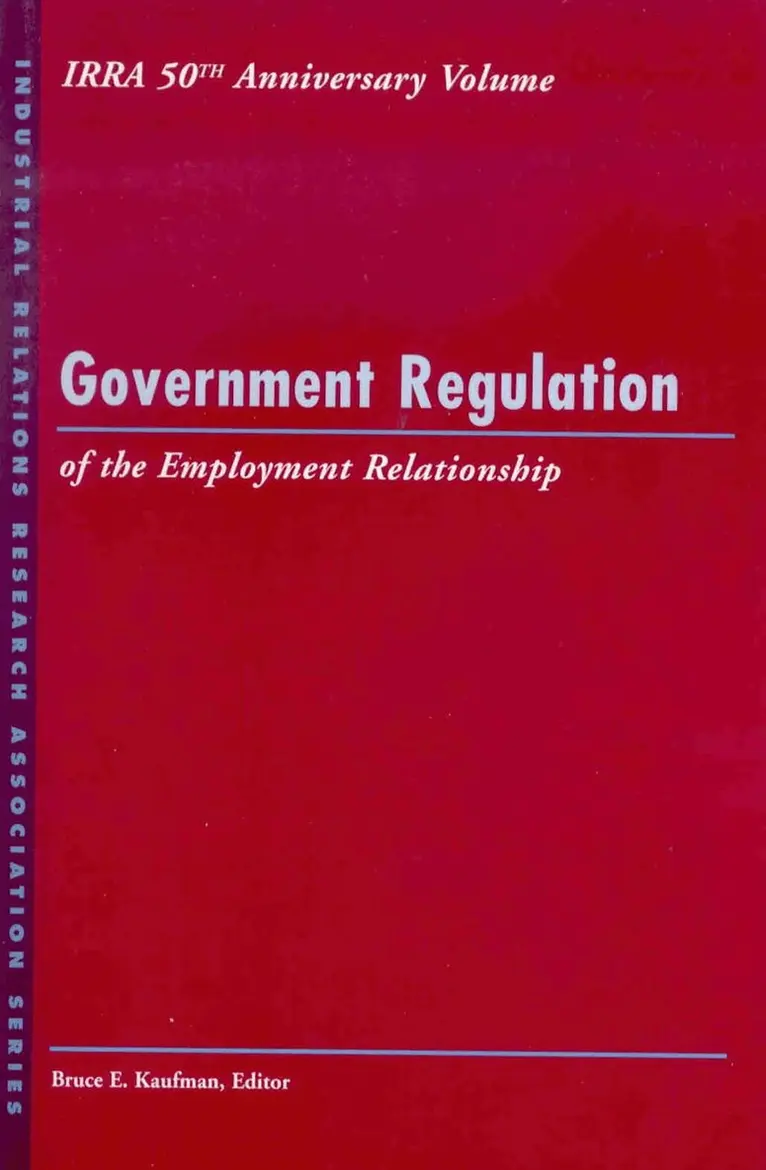
Ever since the emergence of industrial relations as a field in the late 1920s, three different approaches to labor problems have been focal points for research and debate, according to Bruce E. Kaufman. What he refers to as "employers" solutions involve personnel management; workers rely on unionism and collective bargaining; and the third component, the community, depends on government regulation in the form of protective labor legislation and social insurance programs. Kaufman contends that government regulation has contributed significantly to the remarkable progress made during the twentieth century in achieving a more productive and humane workplace. As labor problems have changed, debate about the efficacy of government regulation has continued. In this volume, some of the most distinguished scholars in industrial relations frame the current issues, develop theoretical insights, and provide an objective review of the empirical evidence.
Häftad, Engelska, 1999
419 kr
Skickas inom 5-8 vardagar
This volume examines questions related to the prevention, compensation, and accommodation of work disabilities. It focuses on disabilities arising out of workplace activity.
Häftad, Engelska, 2000
457 kr
Skickas inom 11-20 vardagar
In recent years, much attention has focused on the growth of nonstandard and contingent employment (including part-time work) which involves up to 30 percent of the total U.S. labor force. There is little agreement on either the causes or the effects of this trend. Some researchers emphasize the advantages: employees may explore the job market and obtain work that does not necessarily involve rigid schedules, while employers enjoy greater flexibility and lower costs. Others point to the disadvantages for employees, such as lack of job security, fewer benefits and chances for promotion, and often lower wages. Drawbacks for employers include a workforce that has little chance to develop firm-specific knowledge or loyalty.Chapters in Nonstandard Work: The Nature and Challenges of Emerging Employment Arrangements carefully analyze the extent and nature of various nonstandard work arrangements; their advantages and disadvantages for employees and employers; the demographic, industrial, and occupational distribution of such positions; and the question of whether standard employment itself is changing. Some contributors consider how innovative labor market intermediaries and unions might expand opportunities for workers while also helping firms to raise their productivity.
Häftad, Engelska, 2002
337 kr
Skickas inom 10-15 vardagar
Private-sector collective bargaining in the United States is under siege. Many factors have contributed to this situation, including the development of global markets, a continuing antipathy toward unions by managers, and the declining effectiveness of strikes. This volume examines collective bargaining in eight major industries—airlines, automobile manufacturing, health care, hotels and casinos, newspaper publishing, professional sports, telecommunications, and trucking—to gain insight into the challenges the parties face and how they have responded to those challenges.The authors suggest that collective bargaining is evolving differently across the industries studied. While the forces constraining bargaining have not abated, changes in the global environment, including new security considerations, may create opportunities for unions. Across the industries, one thing is clear—private-sector collective bargaining is rapidly changing.
Häftad, Engelska, 2003
312 kr
Skickas inom 11-20 vardagar
The public sector currently employs around 40 percent of all union members in the United States. Pressures for cost-effective and quality government services have placed new demands on the labor-management relationship. A fluctuating set of expectations about the appropriate responsibilities of government and a shifting political culture are severely testing the ability of the public sector to meet demands for increased accountability and expanded services.Especially in an age of knowledge workers, the traditional division between labor and management regarding leadership and work may no longer be viable. Going Public examines the forces affecting labor and management and the prospects for adopting service-oriented cooperative relationships as a key strategy for meeting the expanded demands on the public sector.Contributors: Robert R. Albright, Rensselaer Polytechnic Institute; Lorenzo Bordogna, University of Milan; Jonathan Brock, University of Washington; John F. Burton Jr., Rutgers University; Adrienne E. Eaton, Rutgers University; Stephen Goldsmith, Harvard University; Jeffrey H. Keefe, Rutgers University; Charles Kerchner, Claremont Graduate School; David B. Lipsky, Cornell University; Martin H. Malin, Chicago-Kent College of Law; Marick F. Masters, University of Pittsburgh; Sonia Ospina, New York University; Terry Thomason, University of Rhode Island; Robert M. Tobias, American University; Paula B. Voos, Rutgers University; Allon Yaroni, New York University
Häftad, Engelska, 2004
312 kr
Skickas inom 11-20 vardagar
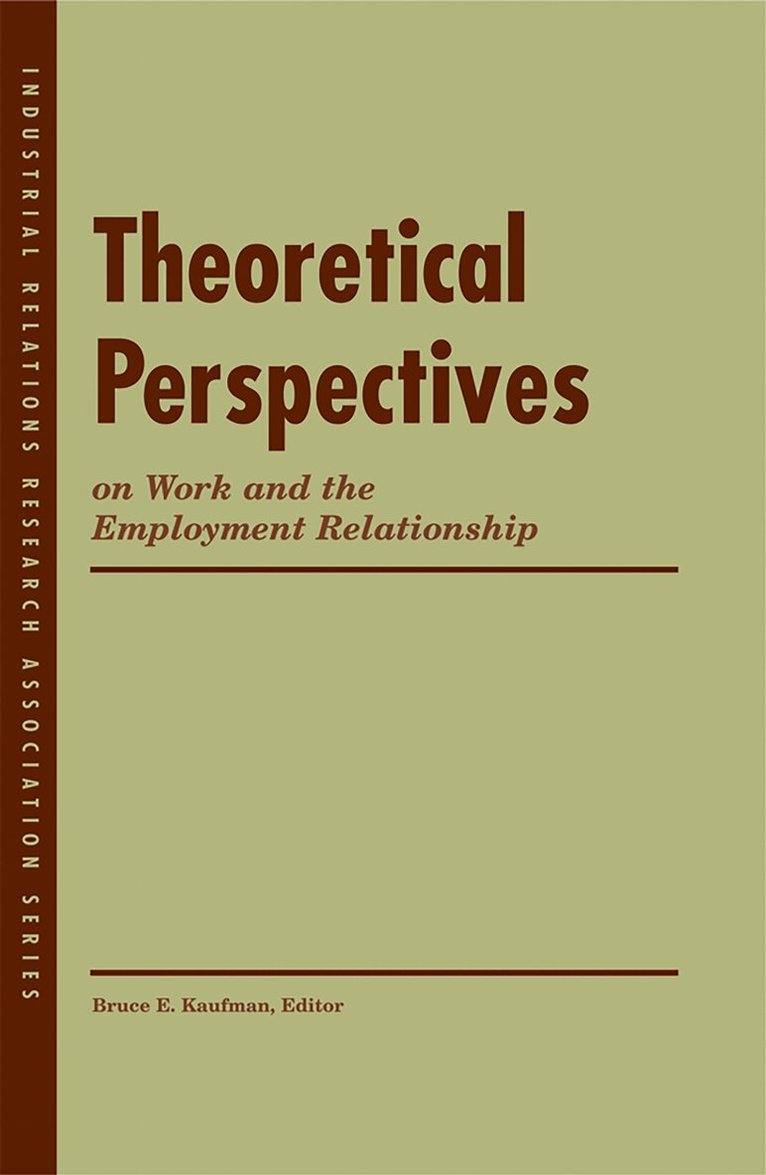
Developing a strong theoretical base for research and practice in industrial relations and human resource management has to date remained a largely unfulfilled challenge. This pioneering volume helps close the theory gap by presenting contributions from fifteen leading scholars that develop and extend theoretical perspectives on work and the employment relationship. Subject areas covered include theories of employment relations systems, varieties of capitalism, the labor process, new institutional economics, individual work motivation, strategic human resource management, a theory of transaction costs and employment contracts, efficiency versus equity, and comparative industrial relations.
Häftad, Engelska, 2005
337 kr
Skickas inom 10-15 vardagar
"In the business and economic spheres, many of the most pressing ethical issues involve the employment relationship, such as the rights of employees versus shareholders, employee privacy and monitoring, whistleblowing, pay equity, discrimination, employee safety, anti-union campaigns, and minimum labor standards. Since the field of human resources and industrial relations is ultimately about people and quality of life, there is a pressing need to develop applications of business ethics for the employment relationship in the context of research, practice, and teaching."—From the PrefaceIn recent years, by following media coverage of many scandals of accounting and accountability, the public has gained a greater understanding of what can happen when businesses do not adhere to ethical practices. It is now time for the human resources and industrial relations communities to explore the application of ethics to the employment relationship and to discover the importance of treating employees, not just numbers, properly.
Häftad, Engelska, 2009
323 kr
Skickas inom 5-8 vardagar
The concept of human rights at work has advanced significantly in the last decade. The authors of the essays in Human Rights in Labor and Employment Relations focus in various ways on how the promotion and protection of human rights at workplaces here and around the world posit a new set of values and approaches that challenge every orthodoxy in the employment relations field, every practice and rule based in that orthodoxy, and even the underlying premises and intellectual foundations of contemporary labor and employment systems.The authors constitute a diverse and accomplished group of human rights activists, practitioners, and scholars. Implementing the theme of the volume, they address a wide range of important subjects: worker health and safety, child labor, worker freedom of association, migrant and forced labor, the human rights obligations of employers, workplace discrimination, and workers with disabilities. The authors also discuss the implications of their findings for labor and employment research and, where relevant, make pragmatic proposals for change.Contributors: Susanne M. Bruyére, Cornell University; Lance Compa, Cornell University; James A. Gross, Cornell University; Jeffrey Hilgert, Cornell University; Barbara Murray, International Labour Organization; Tonia Novitz, University of Bristol; Maria L. Ontiveros, University of San Francisco Law School; Edward E. Potter, Director of Global Workplace Rights, Coca-Cola Company and U.S. Employer Delegate, International Labour Organization Conference; Marika McCauley Sine, Global Stakeholder Engagement Manager, Coca-Cola Company; Rebecca Smith, National Employment Law Project; Burns H. Weston, University of Iowa