Library of Theoria – serie
182 kr
Skickas
It is seldom noted in the philosophy of mathematics that Plato divides his world of forms or ideas into two different realms. In the higher realm, each pure number exists only as a unique entity, but in the lower realm it exists as a multiplicity. Such a bifurcation of numbers is not usually made in modern philosophy of mathematics, but this book argues that it needs to be made. Otherwise, the philosophical analysis of numbers cannot explain how, for instance, an addition such as 3 + 3 = 6 can refer to two distinct numbers 3.
One way to account for this bifurcation is by means of the usually neglected property view of numbers. This book defends a version of this view, according to which the natural numbers are properties of collections, and the real numbers are properties of proportion-relations. It is also argued that the property view of numbers harmonizes well with the findings of modern empirical research on numerical cognition.
Central to the book is Euclid´s notion of ratio, which is put forward in his Elements – here it is called proportion-relation . It is claimed that we need to revive Euclid´s distinction between numbers and magnitudes, as a distinction between two number lines, one for the original natural numbers and one for the real numbers. Strictly speaking, the original natural numbers cannot be regarded as a subclass of the real numbers. The line for the real numbers contains, however, numbers that are counterparts of the original natural numbers.
Ingvar Johansson is emeritus professor of theoretical philosophy at Umeå University, Sweden. Most of his writings are centered around questions in the philosophy of science and ontology.
The primacy of perception - Towards a neutral monism
242 kr
Skickas
Three Essays in Phenomenology and Ontology
217 kr
Skickas
242 kr
Skickas
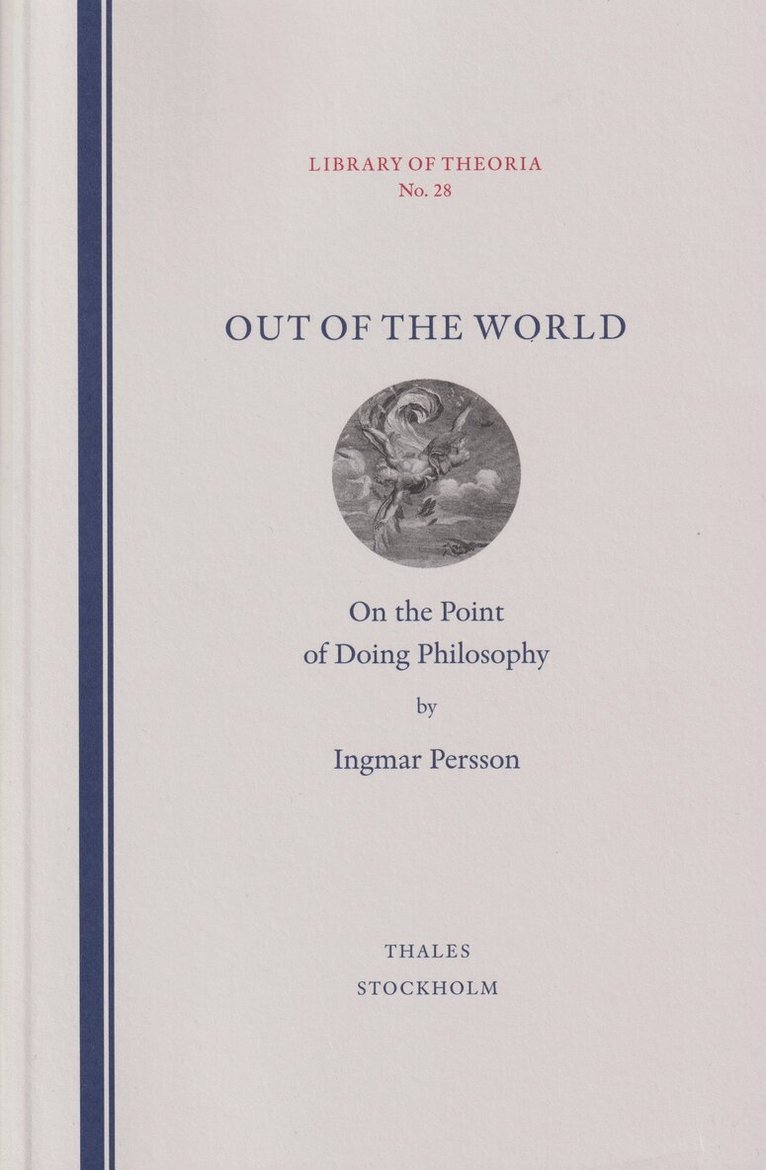
Out of the world : on the point of doing philosophy
194 kr
Skickas
It seems plausible that the point of doing philosophy is to arrive at a rational consensus about the true answers to philosophical problems. But then it appears clear that doing philosophy is bound to be pointless because it will fail to produce such a consensus. A main reason for this is that philosophical problems often take the form of firmly entrenched commonsensical intuitions being opposed by powerful philosophical arguments. Examples are issues such as whether physical things, some of which have minds, exist independently of our perception, whether our inductive and memory beliefs are justifiable, whether we have free will and responsibility, whether we have reason to be especially concerned about ourselves, and whether there are moral norms that are objectively valid. This book suggests that what side we land on in such disputes is ultimately due to features of our personality. But if this is true, the point of philosophizing could be to work out a philosophy that articulates our personality. If our philosophy has a broad scope, it will enable a fuller articulation of our personality. Moreover, it is more likely to carry implications about how to live, which provides philosophizing with a further possible point. The author sketches how his personality has shaped his views on the issues mentioned and their implications for living.
Ingmar Persson is Emeritus Professor of Practical Philosophy at the University of Gothenburg, and Distinguished Research Fellow of the Oxford Uehiro Centre for Practical Ethics, Oxford University. Among his publications are six books on Oxford University Press.
182 kr
Skickas
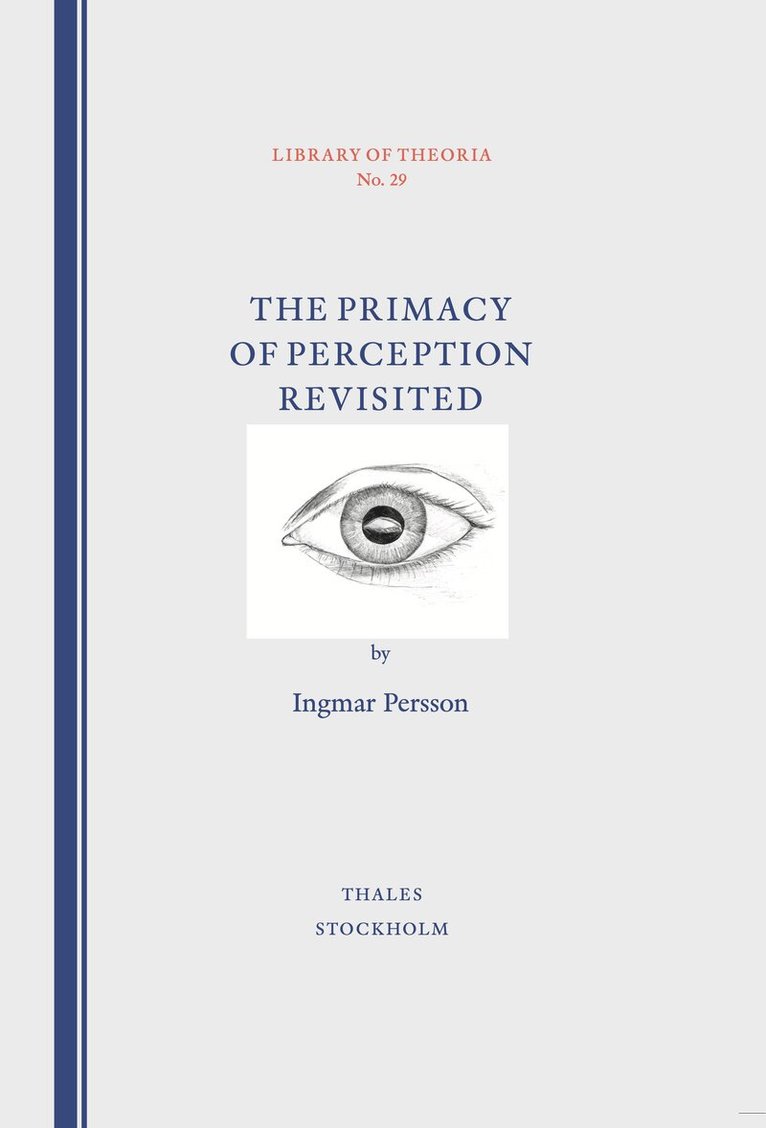
The objects of perception are primary in relation to both physical objects and sensuous representations like images, which are ultimately derived from the perceptual objects they resemble. The existence of perceptual objects is dependent on the bodies of percipients, and states of consciousness in general must have physical subjects. Pre-reflectively these states are ascribed to the whole body but, strictly speaking, they are dependent only on the brain or parts of it. In the end, it turns out to be impossible to identify these parts. This fact in combination with the fact that it is impossible to pick out any psychological relations that are essential for our identity over time shows that there is nothing this identity could consist in. Physical reality is as contemporary physics rather than as common sense conceives it and, thus, so different from what we directly perceive that it cannot be said to be perceived even indirectly.
Ingmar Persson is Emeritus Professor of Practical Philosophy at the University of Gothenburg, and Distinguished Research Fellow at the Oxford Uehiro Centre for Practical Ethics, Oxford University. Among his publications are six books on Oxford University Press. The Primacy of Perception Revisited revises the theory of perception originally presented in his The Primacy of Perception also published in Library of Theoria.
Library of Theoria, no 29.
Logical Physics - Quantum Reality Theory
179 kr
Skickas
Causal Facts
187 kr
Skickas
Avoiding the subject - a critical inquiry into contemporary theories of sub
191 kr
Tillfälligt slut
Truth strategy simplified
164 kr
Tillfälligt slut