Oliver Wendell Holmes Devise History of the Supreme Court of the United States – serie
Visar alla böcker i serien Oliver Wendell Holmes Devise History of the Supreme Court of the United States. Handla med fri frakt och snabb leverans.
15 produkter
15 produkter
1 615 kr
Skickas inom 7-10 vardagar
The Taney Period, 1836-1864, by Carl B. Swisher, is the fifth volume of the Oliver Wendell Holmes Devise History of the Supreme Court of the United States. The volume opens with Roger B. Taney's appointment as chief justice of the Court, describing the Taney Court and its personnel. Later chapters offer a comprehensive analysis of the leading constitutional issues addressed by the United States Supreme Court during this period. Swisher covers the Taney Court's decisions on commerce power, admiralty and maritime jurisdiction, the rights of corporations, patent rights and free enterprise, and legal decisions relating to slavery, including a detailed analysis of the Dred Scott decision and its aftermath. The volume ends with the close of the Taney Period, which coincided with cases and constitutional issues related to the Civil War, including Lincoln's appointments to the Supreme Court, Northern nullification, and wartime curtailment of civil rights.
2 139 kr
Skickas inom 7-10 vardagar
Foundations of Power: John Marshall, 1801-1815 is the second volume of the Oliver Wendell Holmes Devise History of the Supreme Court of the United States. The volume covers the beginnings of the Supreme Court under Chief Justice John Marshall and surveys the first fourteen years of John Marshall's tenure. The authors describe the judicial business transacted by the chief justice and the ten Associate Justices with whom he served during those years. They argue that John Marshall's great accomplishment as Chief Justice was to establish the rule of law as the basis of the Supreme Court's jurisprudence. The book chronicles how, by becoming 'a bulwark of an identifiable rule of law as distinct from the accommodations of politics', the relatively feeble institution of the 1790s moved toward the authoritative Marshall Court of 1819.
2 394 kr
Skickas inom 7-10 vardagar
Antecedents and Beginnings to 1801 is the first of twelve volumes in the Oliver Wendell Holmes Devise History of the Supreme Court of the United States. In this first volume, Julius Goebel Jr. details the creation of a national judiciary in the United States under the Act of 1789 and traces the Supreme Court's development through its first decade of existence. The book is organized into three parts. The first part describes the background of American constitutionalism. Goebel then goes on to depict the Constitutional Convention, the ensuing debate over ratification, and the framing of the Bill of Rights. In the final part of the book, he explains how early legislation affected the judiciary and the initial experience of the circuit courts and of the Supreme Court. These three parts are divided into seventeen chapters, together with a statistical analysis of the business of the Supreme Court from 1789 to 1801 and substantial notes on manuscript sources.
2 139 kr
Skickas inom 7-10 vardagar
The Marshall Court and Cultural Change, 1815-1835 comprises the third and fourth volumes of the Oliver Wendell Holmes Devise History of the Supreme Court of the United States. G. Edward White completes the series' coverage of the Marshall Court, tracing the last two decades of John Marshall's term as Chief Justice. White describes the intellectual climate of the Marshall Court's work and analyzes the Court's decisions. Throughout, White stresses that the Marshall Court, despite its much-celebrated influence, must be seen as part of a unique cultural period when the heritage of the Revolution confronted the radical political, demographic, and intellectual changes of the nineteenth century. The Marshall Court itself was also unique and unlike the modern Court in that it used an informal set of deliberative procedures that gave the justices' personal predilections more influence in the Court's rulings than at any other time in Supreme Court history.
780 kr
Skickas inom 7-10 vardagar
In this supplement to Volume 7 of the Oliver Wendell Holmes Devise History of the Supreme Court of the United States, Charles Fairman examines the Electoral Commission of 1877, which was headed by Justice Joseph P. Bradley. In the disputed presidential election of 1876, the Supreme Court was involved through the appointment of five justices to the commission of fifteen created by Congress to resolve the stalemate arising from the political division between the Senate and House. Divided seven to seven along party lines, the decisive vote and opinion was that of the member appointed for judicial impartiality, Justice Bradley. In his study of the Electoral Commission of 1877, Fairman sheds new light on this controversial historical event, vindicating Justice Bradley against his detractors. This book represents an important revision of conventional narratives of the Electoral Commission, combining intensive research with all the fascination of a detective story.
1 529 kr
Skickas inom 7-10 vardagar
With this seventh volume of the Oliver Wendell Holmes Devise History of the Supreme Court of the United States, Charles Fairman completes his study of the Supreme Court in the post-Civil War period of 1864-88. In the previous volume, Fairman covered the Chief Justiceship of Salmon P. Chase; the present volume deals with the tenure of Morrison R. Waite, President Grant's fifth choice for the office. Fairman explores the significance of the Court's tentative first steps on the unending road of decisions designed to clarify and resolve some of the most persistent issues of American public law, and of a national common market. Fairman identifies the reconciliation between North and South as the most pressing issue during the Reconstruction. Accordingly, the Court was forced to mediate between the new liberties proclaimed by the post-Civil War amendments and enforcement measures and the structure of the federal system bequeathed to it by the Founders of the Republic.
1 540 kr
Skickas inom 7-10 vardagar
Reconstruction and Reunion, 1864-1888, Part 1A is the first part of the sixth volume of the Oliver Wendell Holmes Devise History of the Supreme Court of the United States. In these volumes, Charles Fairman examines the activity of the Supreme Court during the tenure of Chief Justice Salmon P. Chase, considering issues of procedure, doctrine, technicalities of pleading, and the precedents and consequences of the Court's work. The first of the two volumes is devoted to judicial politics and the internal history of the Court during the politically and constitutionally turbulent Reconstruction period. Discussions of specific cases as they relate to the constitutional issues that stemmed from the war's conduct contribute to an overall picture of the Supreme Court's role in Reconstruction and its relationship to presidential and congressional Reconstruction policies.
1 615 kr
Skickas inom 7-10 vardagar
Reconstruction and Reunion, 1864-1888, Part 1B is the second part of the sixth volume of the Oliver Wendell Holmes Devise History of the Supreme Court of the United States. In these volumes, Charles Fairman examines the activity of the Supreme Court during the tenure of Chief Justice Salmon P. Chase, considering issues of procedure, doctrine, technicalities of pleading, and the precedents and consequences of the Court's work. The second of the two parts enumerates and examines specific issues that confronted the Supreme Court during this period, including the Legal Tender Act litigation, property confiscation and wartime private contracts in the South, and railroad bond-aid controversies. Part 1B also provides a comprehensive discussion of the Thirteenth and Fourteenth Amendments and the Civil Rights Act. The concluding chapter is a summation of Salmon P. Chase's chief justiceship and the significance of his tenure for the Supreme Court and its history.
2 276 kr
Skickas inom 7-10 vardagar
The Birth of the Modern Constitution recounts the history of the United States Supreme Court in the momentous yet usually overlooked years between the constitutional revolution in the 1930s and Warren-Court judicial activism in the 1950s. 1941-1953 marked the emergence of legal liberalism, in the divergent activist efforts of Hugo Black, William O. Douglas, Frank Murphy, and Wiley Rutledge. The Stone/Vinson Courts consolidated the revolutionary accomplishments of the New Deal and affirmed the repudiation of classical legal thought, but proved unable to provide a substitute for that powerful legitimating explanatory paradigm of law. Hence the period bracketed by the dramatic moments of 1937 and 1954, written off as a forgotten time of failure and futility, was in reality the first phase of modern struggles to define the constitutional order that will dominate the twenty-first century.
1 485 kr
Skickas inom 7-10 vardagar
A highly interpretive and eminently readable study of the Supreme Court during the period in which Melvin Fuller was Chief Justice, offering a complete account of the cases the Court saw during one of the most tumultuous times in U.S. history. The legacy of the Supreme Court at the turn of the century has largely been negative: decisions such as Lochner v. New York (1905), Pollock v. Farmers' Loan & Trust Co. (1895), In re Debs (1895), and Plessy v. Ferguson have been seen by subsequent generations of lawyers and judges as embodying a judicial method and philosophy that should be avoided at all costs. This book places these decisions in their historical context. It rejects the crude instrumental interpretation of these decisions and explains them as the expression of a conception of liberty that has its roots in the founding of the nation.
1 078 kr
Skickas inom 7-10 vardagar
This book on the Supreme Court during the Chief Justiceship of Edward Douglass White (1910-21) covers an important aspect of American history during the Progressive Era. This was a time when the role of the Supreme Court was debated with a passion rarely exceeded in our history. In its constitutional, antitrust, regulatory, and race-relations decisions, the Supreme Court found itself at the heart of the most important economic and political questions of the day. This was a time when some of the most brilliant jurists in American history sat on the Court: Oliver Wendell Holmes, Jr.; Louis D. Brandeis; and Charles Evans Hughes, to name a few. This book sets the Supreme Court in the midst of the political, economic, and social turmoil of one of the most important periods of American history.
4 622 kr
Tillfälligt slut
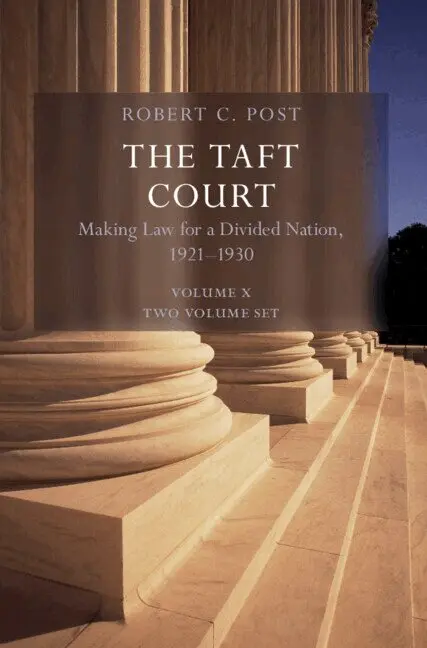
The Taft Court offers the definitive history of the Supreme Court from 1921 to 1930 when William Howard Taft was Chief Justice. Using untapped archival material, Robert C. Post engagingly recounts the ambivalent effort to create a modern American administrative state out of the institutional innovations of World War I. He shows how the Court sought to establish authoritative forms of constitutional interpretation despite the culture wars that enveloped prohibition and pervasive labor unrest. He explores in great detail how constitutional law responds to altered circumstances. The work provides comprehensive portraits of seminal figures such as Oliver Wendell Holmes Jr. and Louis Dembitz Brandeis. It describes William Howard Taft's many judicial reforms and his profound alteration of the role of Chief Justice. A critical and timely contribution, The Taft Court sheds light on jurisprudential debates that are just as relevant today as they were a century ago.
1 072 kr
Tillfälligt slut
The Taft Court offers the definitive history of the Supreme Court from 1921 to 1930 when William Howard Taft was Chief Justice. Using untapped archival material, Robert C. Post engagingly recounts the ambivalent effort to create a modern American administrative state out of the institutional innovations of World War I. He shows how the Court sought to establish authoritative forms of constitutional interpretation despite the culture wars that enveloped prohibition and pervasive labor unrest. He explores in great detail how constitutional law responds to altered circumstances. The work provides comprehensive portraits of seminal figures such as Oliver Wendell Holmes Jr. and Louis Dembitz Brandeis. It describes William Howard Taft's many judicial reforms and his profound alteration of the role of Chief Justice. A critical and timely contribution, The Taft Court sheds light on jurisprudential debates that are just as relevant today as they were a century ago.
655 kr
Skickas inom 7-10 vardagar
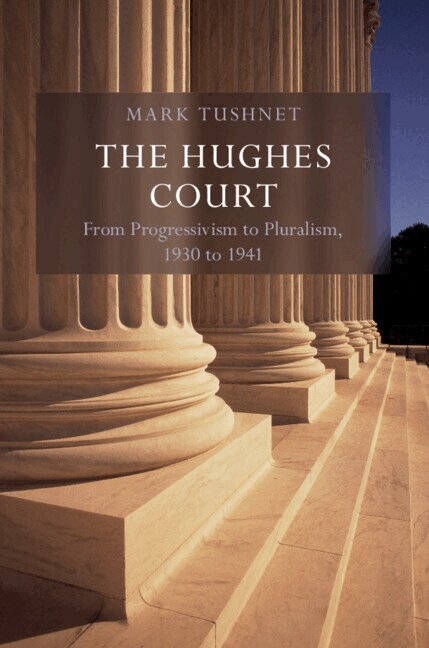
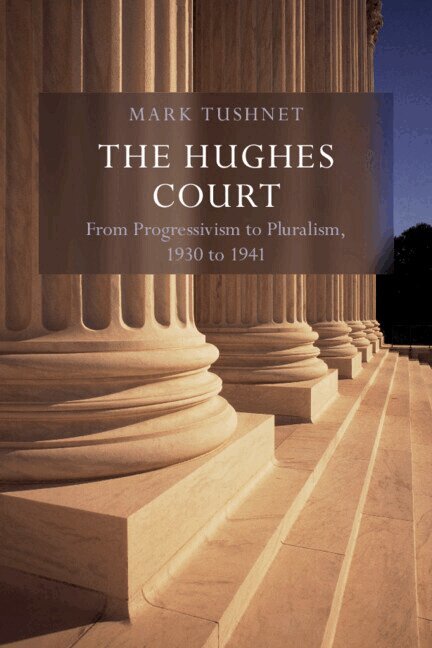
The Hughes Court: From Progressivism to Pluralism, 1930 to 1941 describes the closing of one era in constitutional jurisprudence and the opening of another. This comprehensive study of the Supreme Court from 1930 to 1941 - when Charles Evans Hughes was Chief Justice - shows how nearly all justices, even the most conservative, accepted the broad premises of a Progressive theory of government and the Constitution. The Progressive view gradually increased its hold throughout the decade, but at its end, interest group pluralism began to influence the law. By 1941, constitutional and public law was discernibly different from what it had been in 1930, but there was no sharp or instantaneous Constitutional Revolution in 1937 despite claims to the contrary. This study supports its conclusions by examining the Court's work in constitutional law, administrative law, the law of justiciability, civil rights and civil liberties, and statutory interpretation.
3 050 kr
Skickas inom 7-10 vardagar
The Hughes Court: From Progressivism to Pluralism, 1930 to 1941 describes the closing of one era in constitutional jurisprudence and the opening of another. This comprehensive study of the Supreme Court from 1930 to 1941 - when Charles Evans Hughes was Chief Justice - shows how nearly all justices, even the most conservative, accepted the broad premises of a Progressive theory of government and the Constitution. The Progressive view gradually increased its hold throughout the decade, but at its end, interest group pluralism began to influence the law. By 1941, constitutional and public law was discernibly different from what it had been in 1930, but there was no sharp or instantaneous Constitutional Revolution in 1937 despite claims to the contrary. This study supports its conclusions by examining the Court's work in constitutional law, administrative law, the law of justiciability, civil rights and civil liberties, and statutory interpretation.