Revealing Antiquity – serie
Visar alla böcker i serien Revealing Antiquity. Handla med fri frakt och snabb leverans.
14 produkter
14 produkter
374 kr
Skickas inom 5-8 vardagar
The fundamental gesture of weaving in The Craft of Zeus is the interlacing of warp and woof described by Plato in The Statesman—an interweaving signifying the union of opposites. From rituals symbolizing—even fabricating—the cohesion of society to those proposed by oracles as a means of propitiating fortune; from the erotic and marital significance of weaving and the woven robe to the use of weaving as a figure for language and the fabric of the text, this lively and lucid book defines the logic of one of the central concepts in Greek and Roman thought—a concept that has persisted, woof and warp crossing again and again, as the fabric of human history has unfolded.
320 kr
Skickas inom 5-8 vardagar
Jane Ellen Harrison (1850-1928) is the most famous female Classicist in history, the author of books that revolutionized our understanding of Greek culture and religion. A star in the British academic world, she became the quintessential Cambridge woman--as Virginia Woolf suggested when, in A Room of One's Own, she claims to have glimpsed Harrison's ghost in the college gardens.This lively and innovative portrayal of a fascinating woman raises the question of who wins (and how) in the competition for academic fame. Mary Beard captures Harrison's ability to create her own image. And she contrasts her story with that of Eugénie Sellers Strong, a younger contemporary and onetime intimate, the author of major work on Roman art and once a glittering figure at the British School in Rome--but who lost the race for renown. The setting for the story of Harrison's career is Classical scholarship in this period--its internal arguments and allegiances and especially the influence of the anthropological strain most strikingly exemplified by Sir James Frazer. Questioning the common criteria for identifying intellectual "influence" and "movements," Beard exposes the mythology that is embedded in the history of Classics. At the same time she provides a vivid picture of a sparkling intellectual scene. The Invention of Jane Harrison offers shrewd history and undiluted fun.
354 kr
Skickas inom 10-15 vardagar
This searching interpretation of past and present addresses fundamental questions about the fall of the Roman Empire. Why did ancient culture, once so strong and rich, come to an end? Was it destroyed by weaknesses inherent in its nature? Or were mistakes made that could have been avoided—was there a point at which Greco-Roman society took a wrong turn? And in what ways is modern society different?Western history is split into two discontinuous eras, Aldo Schiavone tells us: the ancient world was fundamentally different from the modern one. He locates the essential difference in a series of economic factors: a slave-based economy, relative lack of mechanization and technology, the dominance of agriculture over urban industry. Also crucial are aspects of the ancient mentality: disdain for manual work, a preference for transcending (rather than transforming) nature, a basic belief in the permanence of limits.Schiavone’s lively and provocative examination of the ancient world, “the eternal theater of history and power,” offers a stimulating opportunity to view modern society in light of the experience of antiquity.
294 kr
Skickas inom 5-8 vardagar
In this highly original work, Christopher Kelly paints a remarkable picture of running a superstate. He portrays a complex system of government openly regulated by networks of personal influence and the payment of money. Focusing on the Roman Empire after Constantine's conversion to Christianity, Kelly illuminates a period of increasingly centralized rule through an ever more extensive and intrusive bureaucracy.The book opens with a view of its times through the eyes of a high-ranking official in sixth-century Constantinople, John Lydus. His On the Magistracies of the Roman State, the only memoir of its kind to come down to us, gives an impassioned and revealing account of his career and the system in which he worked. Kelly draws a wealth of insight from this singular memoir and goes on to trace the operation of power and influence, exposing how these might be successfully deployed or skillfully diverted by those wishing either to avoid government regulation or to subvert it for their own ends. Ruling the Later Roman Empire presents a fascinating procession of officials, emperors, and local power brokers, winners and losers, mapping their experiences, their conflicting loyalties, their successes, and their failures. This important book elegantly recaptures the experience of both rulers and ruled under a sophisticated and highly successful system of government.
Del 16 - Revealing Antiquity
Mosaics as History
The Near East from Late Antiquity to Islam
Inbunden, Engelska, 2006
294 kr
Skickas inom 5-8 vardagar
Over the past century, exploration and serendipity have uncovered mosaic after mosaic in the Near East--maps, historical images, mythical figures, and religious scenes that constitute an immense treasure of new testimony from antiquity. The stories these mosaics tell unfold in this brief, richly informed book by a preeminent scholar of the classical world. G. W. Bowersock considers these mosaics a critical part of the documentation of the region's ancient culture, as expressive as texts, inscriptions on stone, and architectural remains. In their complex language, often marred by time, neglect, and deliberate defacement, he finds historical evidence, illustrations of literary and mythological tradition, religious icons, and monuments to civic pride. Eloquently evoking a shared vision of a world beyond the boundaries of individual cities, the mosaics attest to a persistent tradition of Greek taste that could embrace Judaism, Christianity, and Islam in a fundamentally Semitic land, and they suggest the extent to which these three monotheistic religions could themselves embrace Hellenism.With copious color illustrations, Bowersock's efforts return us to Syrian Antioch, Arabia, Jewish and Samaritan settlements in Palestine, the Palmyrene empire in Syria, and the Nabataean kingdom in Jordan, and show us the overlay of Hellenism introduced by Alexander the Great as well as Roman customs imported by the imperial legions and governors. Attending to one of the most evocative languages of the ages, his work reveals a complex fusion of cultures and religions that speaks to us across time.
Del 18 - Revealing Antiquity
New Heroes in Antiquity
From Achilles to Antinoos
Inbunden, Engelska, 2010
458 kr
Skickas inom 10-15 vardagar
Heroes and heroines in antiquity inhabited a space somewhere between gods and humans. In this detailed, yet brilliantly wide-ranging analysis, Christopher Jones starts from literary heroes such as Achilles and moves to the historical record of those exceptional men and women who were worshiped after death. He asks why and how mortals were heroized, and what exactly becoming a hero entailed in terms of religious action and belief. He proves that the growing popularity of heroizing the dead—fallen warriors, family members, magnanimous citizens—represents not a decline from earlier practice but an adaptation to new contexts and modes of thought. The most famous example of this process is Hadrian’s beloved, Antinoos, who can now be located within an ancient tradition of heroizing extraordinary youths who died prematurely. This book, wholly new and beautifully written, rescues the hero from literary metaphor and vividly restores heroism to the reality of ancient life.
Del 21 - Revealing Antiquity
Public Spectacles in Roman and Late Antique Palestine
Inbunden, Engelska, 2021
590 kr
Skickas inom 10-15 vardagar
Public Spectacles in Roman and Late Antique Palestine introduces readers to the panoply of public entertainment that flourished in Palestine from the first century BCE to the sixth century CE. Drawing on a trove of original archaeological and textual evidence, Zeev Weiss reconstructs an ancient world where Romans, Jews, and Christians intermixed amid a heady brew of shouts, roars, and applause to watch a variety of typically pagan spectacles.Ancient Roman society reveled in many such spectacles—dramatic performances, chariot races, athletic competitions, and gladiatorial combats—that required elaborate public venues, often maintained at great expense. Wishing to ingratiate himself with Rome, Herod the Great built theaters, amphitheaters, and hippodromes to bring these forms of entertainment to Palestine. Weiss explores how the indigenous Jewish and Christian populations responded, as both spectators and performers, to these cultural imports. Perhaps predictably, the reactions of rabbinic and clerical elites did not differ greatly. But their dire warnings to shun pagan entertainment did little to dampen the popularity of these events.Herod’s ambitious building projects left a lasting imprint on the region. His dream of transforming Palestine into a Roman enclave succeeded far beyond his rule, with games and spectacles continuing into the fifth century CE. By then, however, public entertainment in Palestine had become a cultural institution in decline, ultimately disappearing during Justinian’s reign in the sixth century.
176 kr
Skickas inom 5-8 vardagar
Spartacus (109?–71 BCE), the slave who rebelled against Rome, has been a source of endless fascination: the subject of myth-making in his own time, and of movie-making in ours. Hard facts about the man have always yielded to romanticized tales and mystifications. In this riveting, compact account, Aldo Schiavone rescues Spartacus from the murky regions of legend and brings him squarely into the arena of serious history.Schiavone transports us to Italy in the first century BCE, where the pervasive institution of slavery dominates all aspects of Roman life. In this historic landscape, carefully reconstructed by the author, we encounter Spartacus, who is enslaved after deserting from the Roman army to avoid fighting against his native Thrace. Imprisoned in Capua and trained as a gladiator, he leads an uprising that will shake the empire to its foundations.While the grandeur of the Spartacus story has always been apparent, its political significance has been less clear. What were his ambitions? Often depicted as the leader of a class rebellion that was fierce in intent but ragtag in makeup and organization, Spartacus emerges here in a very different light: the commander of an army whose aim was to incite Italy to revolt against Rome and to strike at the very heart of the imperial system. Surprising, persuasive, and highly original, Spartacus challenges the lore and illuminates the reality of a figure whose achievements, and whose ultimate defeat, are more extraordinary and moving than the fictions we make from them.
262 kr
Skickas inom 5-8 vardagar
Hypatia—brilliant mathematician, eloquent Neoplatonist, and a woman renowned for her beauty—was brutally murdered by a mob of Christians in Alexandria in 415. She has been a legend ever since. In this engrossing book, Maria Dzielska searches behind the legend to bring us the real story of Hypatia's life and death, and new insight into her colorful world.Historians and poets, Victorian novelists and contemporary feminists have seen Hypatia as a symbol—of the waning of classical culture and freedom of inquiry, of the rise of fanatical Christianity, or of sexual freedom. Dzielska shows us why versions of Hypatia's legend have served her champions' purposes, and how they have distorted the true story. She takes us back to the Alexandria of Hypatia's day, with its Library and Museion, pagan cults and the pontificate of Saint Cyril, thriving Jewish community and vibrant Greek culture, and circles of philosophers, mathematicians, astronomers, and militant Christians. Drawing on the letters of Hypatia's most prominent pupil, Synesius of Cyrene, Dzielska constructs a compelling picture of the young philosopher's disciples and her teaching. Finally she plumbs her sources for the facts surrounding Hypatia's cruel death, clarifying what the murder tells us about the tensions of this tumultuous era.
310 kr
Skickas inom 5-8 vardagar
Ancient Greeks and Romans often turned to magic to achieve personal goals. Magical rites were seen as a route for direct access to the gods, for material gains as well as spiritual satisfaction. In this fascinating survey of magical beliefs and practices from the sixth century B.C.E. through late antiquity, Fritz Graf sheds new light on ancient religion.Evidence of widespread belief in the efficacy of magic is pervasive: the contemporaries of Plato and Aristotle placed voodoo dolls on graves in order to harm business rivals or attract lovers. The Twelve Tables of Roman Law forbids the magical transference of crops from one field to another. Graves, wells, and springs throughout the Mediterranean have yielded vast numbers of Greek and Latin curse tablets. And ancient literature abounds with scenes of magic, from necromancy to love spells. Graf explores the important types of magic in Greco-Roman antiquity, describing rites and explaining the theory behind them. And he characterizes the ancient magician: his training and initiation, social status, and presumed connections with the divine world. With trenchant analysis of underlying conceptions and vivid account of illustrative cases, Graf gives a full picture of the practice of magic and its implications. He concludes with an evaluation of the relation of magic to religion. Magic in the Ancient World offers an unusual look at ancient Greek and Roman thought and a new understanding of popular recourse to the supernatural.
Del 5 - Revealing Antiquity
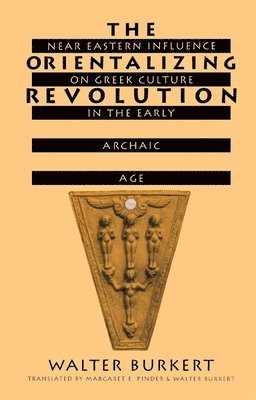
Orientalizing Revolution
Near Eastern Influence on Greek Culture in the Early Archaic Age
Häftad, Engelska, 1998
319 kr
Skickas inom 5-8 vardagar
The splendid culture of the ancient Greeks has often been described as emerging like a miracle from a genius of its own, owing practically nothing to its neighbors. Walter Burkert offers a decisive argument against that distorted view, pointing toward a balanced picture of the archaic period “in which, under the influence of the Semitic East—from writers, craftsmen, merchants, healers—Greek culture began its unique flowering, soon to assume cultural hegemony in the Mediterranean.”
Del 20 - Revealing Antiquity
From Shame to Sin
The Christian Transformation of Sexual Morality in Late Antiquity
Häftad, Engelska, 2016
190 kr
Skickas inom 5-8 vardagar
When Rome was at its height, an emperor’s male beloved, victim of an untimely death, would be worshipped around the empire as a god. In this same society, the routine sexual exploitation of poor and enslaved women was abetted by public institutions. Four centuries later, a Roman emperor commanded the mutilation of men caught in same-sex affairs, even as he affirmed the moral dignity of women without any civic claim to honor. The gradual transformation of the Roman world from polytheistic to Christian marks one of the most sweeping ideological changes of premodern history. At the center of it all was sex. Exploring sources in literature, philosophy, and art, Kyle Harper examines the rise of Christianity as a turning point in the history of sexuality and helps us see how the roots of modern sexuality are grounded in an ancient religious revolution.While Roman sexual culture was frankly and freely erotic, it was not completely unmoored from constraint. Offending against sexual morality was cause for shame, experienced through social condemnation. The rise of Christianity fundamentally changed the ethics of sexual behavior. In matters of morality, divine judgment transcended that of mere mortals, and shame—a social concept—gave way to the theological notion of sin. This transformed understanding led to Christianity’s explicit prohibitions of homosexuality, extramarital love, and prostitution. Most profound, however, was the emergence of the idea of free will in Christian dogma, which made all human action, including sexual behavior, accountable to the spiritual, not the physical, world.
335 kr
Skickas inom 5-8 vardagar
Pompeii's tragedy is our windfall: an ancient city fully preserved, its urban design and domestic styles speaking across the ages. This richly illustrated book conducts us through the captured wonders of Pompeii, evoking at every turn the life of the city as it was 2,000 years ago.When Vesuvius erupted in 79 A.D. its lava preserved not only the Pompeii of that time but a palimpsest of the city's history, visible traces of the different societies of Pompeii's past. Paul Zanker, a noted authority on Roman art and architecture, disentangles these tantalizing traces to show us the urban images that marked Pompeii's development from country town to Roman imperial city. Exploring Pompeii's public buildings, its streets and gathering places, we witness the impact of religious changes, the renovation of theaters and expansion of athletic facilities, and the influence of elite families on the city's appearance. Through these stages, Zanker adeptly conjures a sense of the political and social meanings in urban planning and public architecture.The private houses of Pompeii prove equally eloquent, their layout, decor, and architectural detail speaking volumes about the life, taste, and desires of their owners. At home or in public, at work or at ease, these Pompeians and their world come alive in Zanker's masterly rendering. A provocative and original reading of material culture, his work is an incomparable introduction to urban life in antiquity.
398 kr
Skickas inom 10-15 vardagar
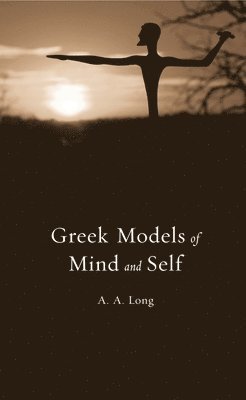
This lively book offers a wide-ranging study of Greek notions of mind and human selfhood from Homer through Plotinus. A. A. Long anchors his discussion in questions of recurrent and universal interest. What happens to us when we die? How is the mind or soul related to the body? Are we responsible for our own happiness? Can we achieve autonomy? Long asks when and how these questions emerged in ancient Greece, and shows that Greek thinkers’ modeling of the mind gave us metaphors that we still live by, such as the rule of reason or enslavement to passion. He also interrogates the less familiar Greek notion of the intellect’s divinity, and asks what that might mean for us.Because Plato’s dialogues articulate these themes more sharply and influentially than works by any other Greek thinker, Plato receives the most sustained treatment in this account. But at the same time, Long asks whether Plato’s explanation of the mind and human behavior is more convincing for modern readers than that contained in the older Homeric poems. Turning to later ancient philosophy, especially Stoicism, Long concludes with an exploration of Epictetus’s injunction to live life by making correct use of one’s mental impressions.An authoritative treatment of Greek modes of self-understanding, Greek Models of Mind and Self demonstrates how ancient thinkers grappled with what is closest to us and yet still most mysterious—our own essence as singular human selves—and how the study of Greek thought can enlarge and enrich our experience.