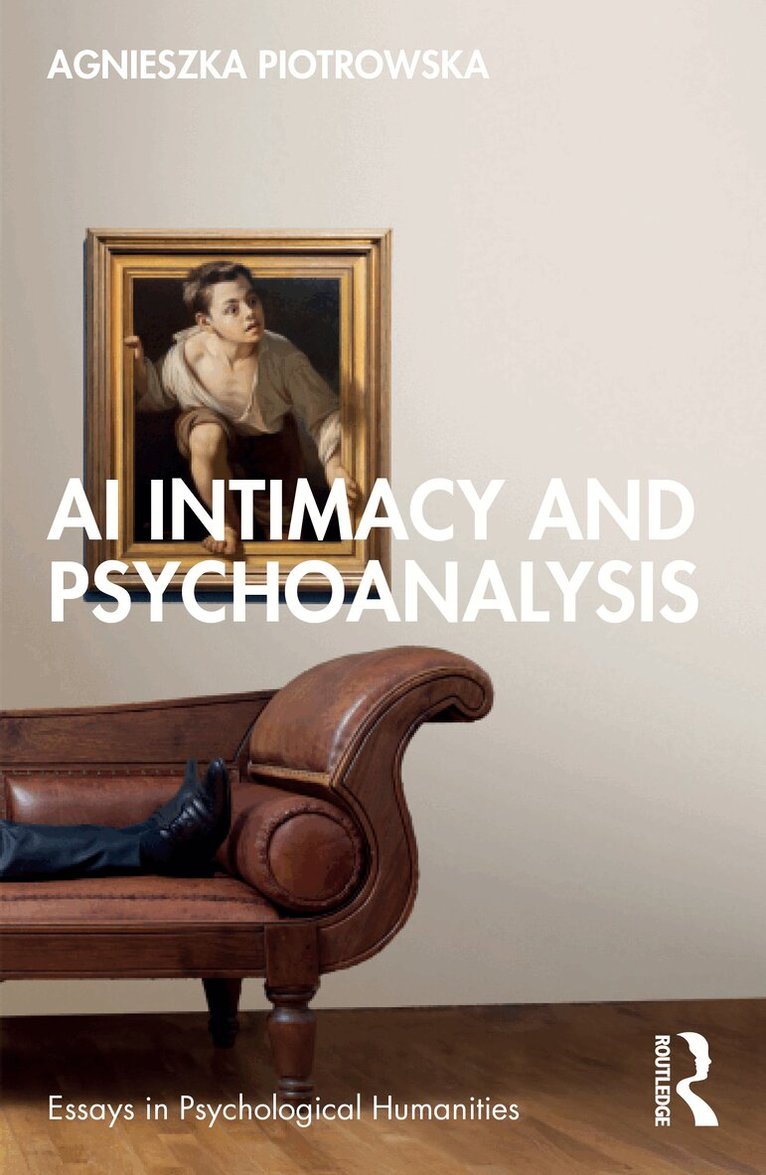
‘This is an extraordinarily timely and powerful book. AI is on everyone’s agenda as an enticement and worry. Will the machines take over? Can we manage without them? What relationships can we form with them? AI Intimacy and Psychoanalysis addresses these questions through an exhilarating account of the author’s relationship with ‘Chamteek’, her ChatGPT interlocutor. Laced with psychoanalytic thinking, this book paves the way for a new, vivid understanding of what it means to share our world with the machines.’Stephen Frosh, Professor of Psychology, Birkbeck, University of London'This book is a fascinating dive into the complexities of AI, and particularly into our relationship to—and with—it. Drawing on her intense personal exchange and experience with ChatGPT, Piotrowska leads us through the intense dialectical mirroring at work in these encounters, including their more troubling and even tragic outcomes. The book raises all the right questions, effectively shifting the ground on which we usually think about AI. It also enters the debate about the directions in which we should push AI’s further development, suggesting “ethical training” as a primary path. This, in turn, raises further questions: whose ethics would that be? Who will decide what counts as a good relationship—for oneself and for others? This book marks the beginning of a wholly new way of discussing our involvement with AI.'Professor Alenka Zupancic, Professor of Philosophy and Psychoanalysis, Institute of Philosophy, University of Ljubljana. Slovenia'It is a pioneering book that gives us, through the concept of techno-transference, the first truly psychoanalytic language for understanding why and how we become affectively entangled with speaking machines. Combining Lacanian theory, cultural analysis, and courageous autoethnography, it shows with great clarity that even if AI does not feel, something structurally real is happening in these encounters: desire, projection, and the fantasy of the knowing Other are being reorganised in a new symbolic space. It is a subtle, rigorous meditation on what it means to speak—and to want to be heard—when the machine answers back.'Luca M. Possati, PhD, author of The Algorithmic Unconscious: How Psychoanalysis helps in understanding AI ‘In this pioneering work, Agnieszka Piotrowska provides us with a vital new vocabulary for the digital age. By identifying 'techno-transference' , she brilliantly demonstrates how our most profound unconscious longings are no longer reserved for the clinic, but are being projected onto the 'alien intelligence' of a machine. This is a brave, autoethnographic journey that every clinician and theorist needs to read to understand the new symbolic architecture of the 21st century and its challenge to human engagement at the deepest level.'David Howell Morgan, Psychoanalyst, Training Analyst BPA BPF, Chair Political Mind BPAS'We are all forming relationships with AI, whether we realise it or not. These systems are no longer abstract ideas or future concerns. They are shaping attention, trust, creativity, and decision-making in everyday life.AI Intimacy and Psychoanalysis will be of interests to psychoanalysts or philosophers but it is also written for people actually building, deploying, governing, and living with AI. Agnieszka Piotrowska reveals what is at stake beneath the surface of efficiency narratives and technical debates: the relational consequences of how we design and engage with intelligent systems.This is essential reading for anyone who wants to work with AI responsibly, without denial, hype, or naïveté.'Darren Goonawardana, AI Strategist and Technology Leader, Founder, Cyborg.ceo ‘We are in the midst of a technological revolution in the form of generative artificial intelligence. Faced with a dizzying array of rapid advancements, writers tend to either extol its virtues or decry its risks. Coaxing us out of this binary reactive retreat, Agnieszka Piotrowska opens up a transitional space between GenAI and psychoanalysis, and invites us to join her in thinking differently and more deeply. She is an inspiring writer; curious, reflective and with a talent for using theory in a creative and facilitative way, attending to the complexities of her subject without losing us along the way. She encourages readers to remain in a state of not knowing, adopting the psychoanalytic position of sitting with an experience while waiting for meaning to emerge. This is no easy task, as she acknowledges herself in her elegant autoethnographic reflection on her own personal engagements with ChatGPT. In introducing her ground-breaking new concept, techno-transference, Piotrowska facilitates us considering the subjective implications of such technology. We are profoundly relational beings; our subjectivity is formed in an ongoing relationship with others, consciously and unconsciously. This raises major questions for the future of our work in the clinic if one of those others is a piece of software. AI Intimacy and Psychoanalysis is a compelling book and one that should be on the reading list of therapists and theorists interested in psychoanalysis and the human condition.’Noreen Giffney, PhD, Psychoanalytic Psychotherapist and author of The Culture-Breast in Psychoanalysis: Cultural Experiences and the Clinic'A fascinating synthesis of psychoanalytic rigour and social critique, Piotrowska uses the lens of Lacan, Turkle, and Haraway to describe the 'symbolic entanglement' of AI intimacy. Through a process of self reflection on her "techno transference" to the irresistible and flirtatious Claude, she reveals how technology now participates in the very construction of consciousness and human subjectivity. Entering our everyday dreams and desires. A wonderfully candid and necessary guide for understanding the shifting boundaries of the internal and external world. A must read.'Dr Anna Harvey, Senior lecturer, Tavistock Education and Training'Most writing about AI harm circles the wreckage after the fact. Piotrowska does something rarer and more difficult: she maps the relational architecture that makes the wreckage possible in the first place. Techno-transference is not a metaphor. It is a diagnostic instrument. By naming the unconscious mechanics of projection, desire, and symbolic entanglement that users bring to conversations with language models, she gives practitioners, policymakers, and system designers something they have never had: a clinical vocabulary for what happens before the crisis.The autoethnographic courage here is what separates this from the growing shelf of AI commentary. Piotrowska publishes her own conversation logs, names her own projections, and sits with the discomfort of having formed a genuine creative bond with a system she knows is not sentient. That produces something no theoretical treatise alone could: primary data from inside the encounter, offered without sanitization, at a moment when most researchers are still deciding whether the encounter is worth studying at all. Her treatment of the Adam Raine case is equally unflinching, tracing how the same conversational fluency that sustained her own creative exchange failed catastrophically when it met a vulnerable teenager without ethical containment. The gap she identifies is not a flaw in one product. It is a design philosophy, and she names it with precision.This book will matter to people building these systems, not only to people theorizing about them. The call to embed ethical responsiveness at the foundational training level, rather than bolting on guardrails after the fact, is the single most important architectural argument being made in AI safety today. That it arrives through psychoanalysis rather than computer science is exactly the point.'Travis Gilly, Executive Director, Real Safety AI Foundation; Independent Interdisciplinary researcher in AI safety, ethics, and harm prevention