Supplementa Humanistica Lovaniensia – serie
Visar alla böcker i serien Supplementa Humanistica Lovaniensia. Handla med fri frakt och snabb leverans.
22 produkter
22 produkter
Häftad, Engelska, 2012
1 256 kr
Skickas inom 3-6 vardagar
The first-ever bibliography of Scottish Latin authors in printThe work of the Latin writers of Scotland has suffered a neglect which its variety, copiousness, and intrinsic interest do not deserve. Their importance, and the importance of Latin as a literary language, is beginning to be recognized by scholars. Researchers from the universities of Glasgow and St. Andrews have now prepared the first-ever bibliography of Scottish Latin in print - unique both in its focus on the many works written in Latin and in the way in which Scottish writers are specifically targeted. Covering the years c. 1480-1700, this new reference tool carefully catalogues the work of some 500 writers, in both prose and verse. Thousands of works are named in a clear and original format, with their titles not so truncated as to be obscure (as sometimes happens in English ‘short-title' catalogues). The editors take advantage of recent research, and many poetic works hitherto unknown or ignored are referenced. This ground-breaking reference work will be essential not only for those who study the progress of humanism and the history and literature of early modern Scotland, but also for those engaged in various kinds of research into the events and ideas of continental Europe, with which Scotland was closely linked in many ways.
Häftad, Engelska, 2014
766 kr
Skickas inom 5-8 vardagar
Material Philology and the study of Renaissance Latin literatureNeo-Latin Philology: Old Tradition, New Approaches explores the question whether the approaches developed in the so-called New or Material Philology can be applied to the study of Renaissance Latin literature. Two contributions in this volume focus on theoretical issues, the first presenting a critical assessment of the debate on New Philology in the 1990s, the second providing some guidelines for researchers of the materiality of sources. The remaining seven contributions discuss various ways in which the material presentation in either manuscript or print played a part in the interpretation of a variety of texts, including Basinio of Parma’s Hesperis, Niccolò Perotti's Cornu copiae, some poems by Janus Secundus, a commentary on Horace’s Ars poetica, Otto Venius’ Emblemata Horatiana, Johann Lauremberg's play Pompejus Magnus, and the Alithinologia by John Lynch.ContributorsHaijo Westra (University of Calgary), H. Wayne Storey (Indiana University, Bloomington), Christoph Pieper (Leiden University), Marianne Pade (Academy of Denmark, Rome), David Rijser (University of Amsterdam), Werner J.C.M. Gelderblom (Radboud University Nijmegen), Marc van der Poel (Radboud University Nijmegen), Tom Deneire (Antwerp University Library), Nienke Tjoelker (Ludwig Boltzmann Institute for Neo-Latin Studies, Innsbruck)
Häftad, Engelska, 2010
618 kr
Skickas inom 5-8 vardagar
The Latin language and literature have been an essential part of Western culture and civilisation for more than two thousand years. An important part of that Latin heritage is Neo-Latin, by which are meant all writings in Latin since the dawn of humanism in Italy from about 1300 A.D. down to our own time. This first part of the Companion to Neo-Latin Studies by Jozef Ijsewijn consists of a concise, but comprehensive history of Neo-Latin writings (both literary and scientific) arranged according to geographical and cultural areas. It is an essential guide to scholars, students and all those interested in Neo-Latin to provide them with the basic bibliographical information. Part II of the Companion (ISBN 9061868599) deals with literary, linguistic, philological and editorial questions.
Häftad, Engelska, 1998
1 104 kr
Skickas inom 5-8 vardagar
In 1977 the first edition of the Companion to Neo-Latin Studies appeared. It evidently filled a long-felt lacuna, and was soon out of print. The first part of the second entirely rewritten edition came out in 1990; it consisted in a concise, but comprehensive history of Neo-Latin writings (both literary and scientific) arranged according to geographical and cultural areas (Part I: History and Diffusion of Neo-Latin Literature).Due to the explosive growth of Neo-Latin studies in the last decades, it took a couple of years to rewrite and to expand the second part. In this volume an attempt is made to cover all the relevant literary forms and genres of Neo-Latin literature; their characteristics and evolution are described and bibliographical aids have been added; the method is descriptive rather than theoretical.This part is followed by linguistic, philological and editorial questions, discussing the features of Neo-Latin vocabulary, syntax, style, prosody and metre, old and modern editions, etc. A historical survey of Neo-Latin studies concludes the book. Several indexes facilitate access to the varied contents of the work. The two volumes of this Companion form an indispensable and up-to-date introduction to the immense and still largely unexplored field of Neo-Latin literature.
Häftad, Engelska, 2014
621 kr
Skickas inom 5-8 vardagar
Criticism of monastic life by one of Europe’s major Renaissance figuresIn his letter Against Monastic Life (1514–17) Andrea Alciato, an Italian jurist and writer famous for his Emblemata, urges his friend Bernardus Mattius to reconsider his choice of monastic life. Alciato makes his argument by criticizing religious superstition, the Church’s hierarchy, and monastic practices, particularly the Franciscans’ hypocrisy, wealth, and divisiveness. Instead, he defends a stoic, civic humanism. Due to the troubled history of this unique manuscript and the inadequacies of the two subsequent editions, Alciato’s discourse has been obscured for centuries. This edition and translation seeks to make clear the biographical importance of the text for one of the major figures of the European Renaissance.
Häftad, Latin, 2017
870 kr
Skickas
Selection of Latin poetry by the renowned Finnish scholar Tuomo PekkanenTuomo Pekkanen is one of the major Latin poets of our times. He is renowned for the Latin translation of Finland’s national epic poem, the Kalevala. The present book contains a fine selection from his Latin poetry, including a poetic paraphrasis of the St Matthew Passion and a Latin Requiem, set to music by the Italian composer Gregorio Santolla. The score of this Requiem is also enclosed. All texts in this volume are in Latin.
Del 43 - Supplementa Humanistica Lovaniensia
Florilegium recentioris Latinitatis
Häftad, Latin, 2017
795 kr
Skickas
Neo-Latin, a truly interdisciplinary and multicultural field of study, has become especially relevant in today's global age. Latin does not belong to any particular country, but to the Republic of Letters with its high aims and universal appeal. A comprehensive critical anthology of Neo-Latin would thus be useful in the classroom, both in secondary school and on university level, as well as for independent scholars. The present volume is comprised of about fifty texts pertaining to geographical areas all around the world, spanning the 14th to the 20th centuries, written in a wide range of genres by authors of varied backgrounds, and touching on topics of dramatic importance for today. The language of the anthology is Latin, in accordance with the universality it aims to represent by its selection of texts.
Del 45 - Supplementa Humanistica Lovaniensia
lingua morta per letterature vive
il dibattito sul latino come lingua letteraria in eta moderna e contemporanea. Atti del convegno internazionale, Roma, 10-12 dicembre 2015
Häftad, Italienska, 2020
1 180 kr
Skickas inom 5-8 vardagar
La straordinaria polifonia di lingue che caratterizza le letterature nazionali di eta moderna e ormai un dato acquisito nelle piu aggiornate ricostruzioni di storia letteraria. Meno nota e forse la dialettica vivace che innerva questo delicato equilibrio, nel quale - almeno in Italia - si inseriscono a pieno titolo i dialetti. I lavori raccolti in questo volume, che trae origine da un convegno organizzato dal Ludwig Boltzmann Institut fur Neulateinische Studien, si propongono di fare il punto sui dibattiti intellettuali, in tutte le loro gradazioni e forme, intorno al latino come lingua per la letteratura dalla fine dell'Umanesimo in poi: dall'uso del latino in un contesto dove ormai domina il volgare alle traduzioni latine di testi vernacolari, fino al ruolo del latino nella scuola. Una sezione considerevole del volume e dedicata all'uso del latino dalla fine del sec. XIX a oggi, ovvero quando il latino si trasforma da vettore di comunicazione in lingua poetica, come avviene nel caso di Pascoli e di Bandini, oppure quando a esso vengono affidate le funzioni di solennita e di prestigio negli usi odierni della Santa Sede.Contributors: Xavier Van Binnebeke (KU Leuven), Maurizio Campanelli ("Sapienza" Universita di Roma), Andrea Comboni (Universita degli Studi di Trento), Alessio Cotugno(Universita Ca' Foscari, Venezia), Paola De Capua (Universita degli Studi di Messina), Leopoldo Gamberale ("Sapienza" Universita di Roma), Yorick Gomez Gane(Universita della Calabria), Marc Laureys (Universitat Bonn), Marco Leone (Universita del Salento), Jurgen Leonhardt (Eberhard Karls Universitat Tubingen), Clementina Marsico (Ludwig Boltzmann Institute for Neo-Latin Studies, Innsbruck), Martin McLaughlin (Magdalen College Oxford), Francesco Saverio Minervini (Universita di Bari), Dirk Sacre (KU Leuven), Florian Scheffenrath (Ludwig Boltzmann Institute for Neo-Latin Studies, Innsbruck), Sebastiano Valerio (Universita di Foggia), Isabella Walser-Burgler (LudwigBoltzmann Institute for Neo-Latin Studies, Innsbruck)This publication is GPRC-labeled (Guaranteed Peer Reviewed Content).
Del 44 - Supplementa Humanistica Lovaniensia
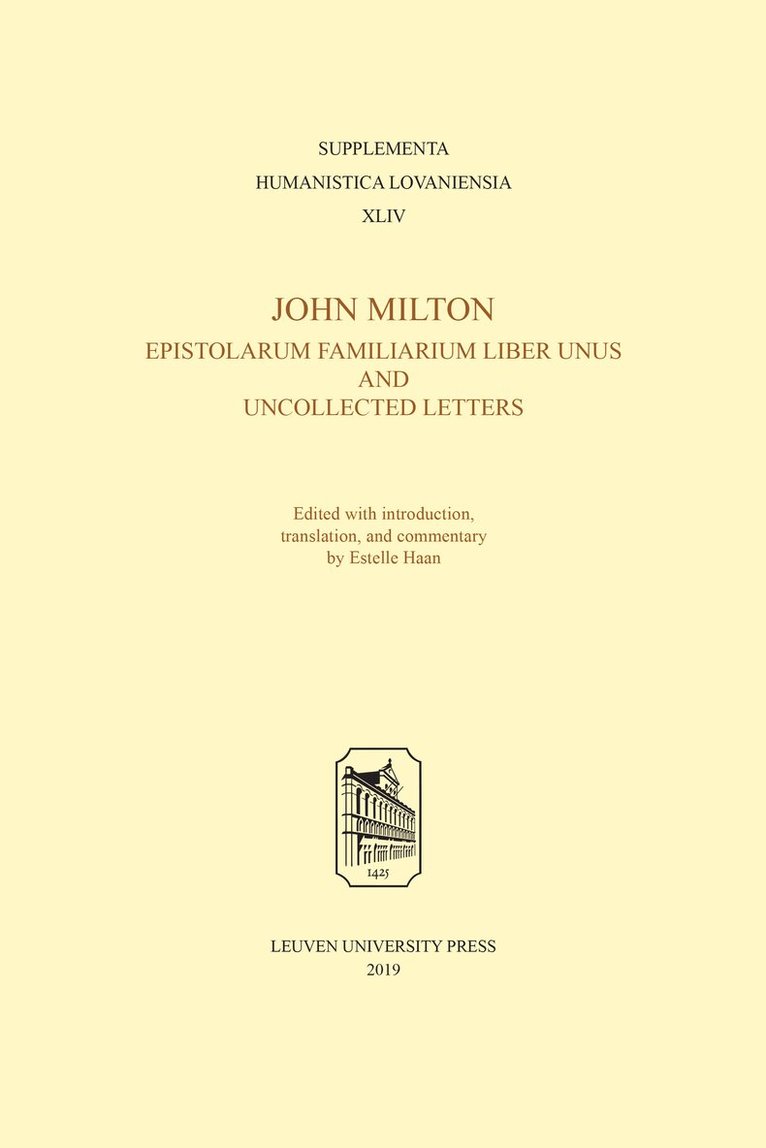
John Milton, Epistolarum Familiarium Liber Unus and Uncollected Letters
Häftad, Latin, 2019
1 354 kr
Skickas inom 5-8 vardagar
First full-scale edition of John Milton’s Latin and uncollected vernacular lettersJohn Milton holds an impressive place within the rich tradition of neo-Latin epistolography. His Epistolae Familiares and uncollected letters paint an invigorating portrait of the artist as a young man, offering insight into his reading programme, his views on education, friendship, poetry, his relations with continental literati, his blindness, and his role as Latin Secretary. This edition presents a modernised Latin text and a facing English translation, complemented by a detailed introduction and a comprehensive commentary. Situating Milton’s letters in relation to the classical, pedagogical, neo-Latin, and vernacular contexts at the heart of their composition, it presents fresh evidence in regard to Milton’s relationships with the Italian philologist Benedetto Buonmattei, the Greek humanist Leonard Philaras, the radical pastor Jean de Labadie, and the German diplomat Peter Heimbach. It also announces several new discoveries, most notably a manuscript of Henry Oldenburg’s transcription of Ep. Fam. 25. This volume fills an important gap in Milton scholarship, and will prove of particular use to Milton scholars, students, philologists, neo-Latinists, and those interested in the humanist reinvention of the epistolographic tradition.
Del 46 - Supplementa Humanistica Lovaniensia
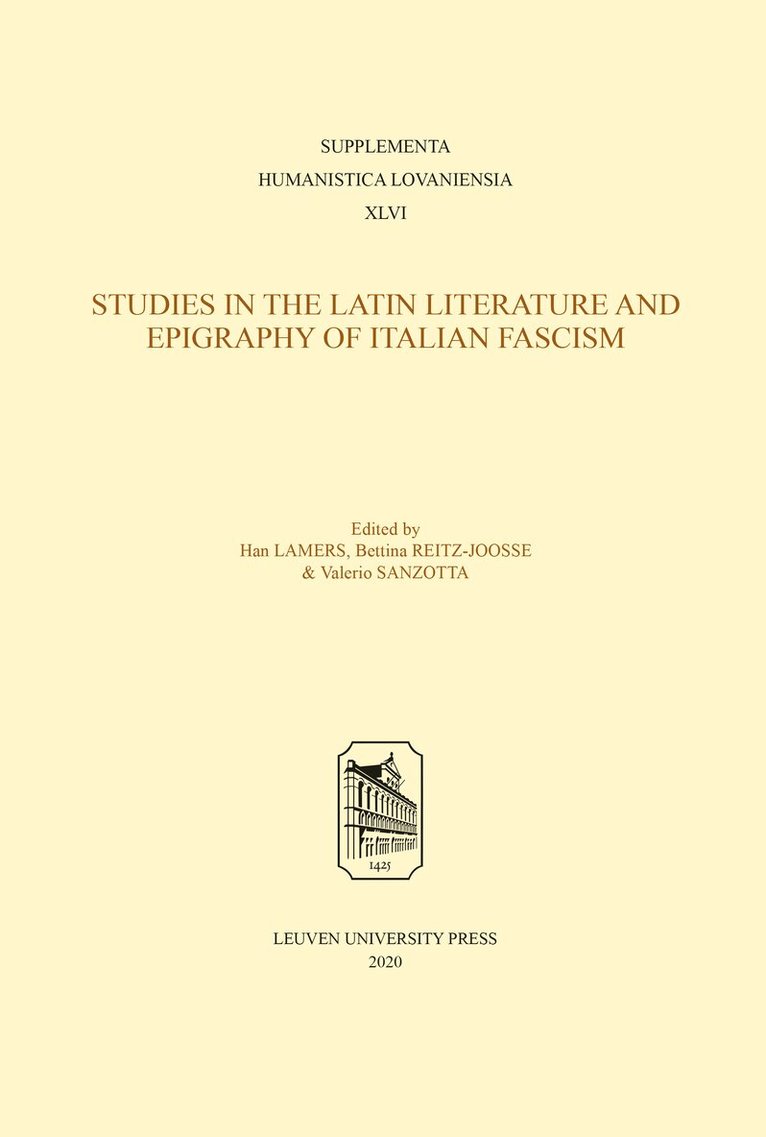
Studies in the Latin Literature and Epigraphy in Italian Fascism
Häftad, Latin, 2020
839 kr
Skickas
This book deals with the use of Latin as a literary and epigraphic language under Italian Fascism (1922-1943). The myth of Rome lay at the heart of Italian Fascist ideology, and the ancient language of Rome, too, played an important role in the regime's cultural politics. This collection deepens our understanding of 'Fascist Latinity', presents a range of previously little-known material, and opens up a number of new avenues of research. The chapters explore the pivotal role of Latin in constructing a link between ancient Rome and Fascist Italy; the different social and cultural contexts in which Latin texts functioned in the ventennio fascista; and the way in which 'Fascist Latinity' relied on, and manipulated, the 'myth of Rome' of late nineteenth- and early twentieth-century Italy.Contributors: William Barton (Ludwig Boltzmann Institute for Neo-Latin Studies), Xavier van Binnebeke (KU Leuven), Paolo Fedeli (Universita degli Studi di Bari Aldo Moro), Han Lamers (University of Oslo), Johanna Luggin (Ludwig Boltzmann Institute for Neo-Latin Studies), Antonino Nastasi (Rome), Bettina Reitz-Joosse (University of Groningen), Dirk Sacre (KU Leuven), Valerio Sanzotta (Ludwig Boltzmann Institute for Neo-Latin Studies), Wolfgang Strobl (Toblach)
Häftad, Engelska, 2002
700 kr
Tillfälligt slut
More often than not, humanist, scholarly and 'scientific' correspondences from the early modern period have been analyzed from a rather narrow point of view. They were either exploited to reveal new biographical and historical evidence or assessed as literary achievements, as precious (or not so precious) pearls of artistic prose and composition. However legitimate such an outspokenly positivist and aesthetic approach may be, it does not exhaust the various possibilities for historical and literary study that early modern correspondences offer. It may, for instance, be doubted whether the traditional approach enables us to address, let alone to answer, one of the key questions that can and should be raised when dealing with letter writing in early modern times: how did the genre function as a social practice? This question can be reformulated as follows: who was writing, what, for whom, and why?At first glance, many, if not most, of the correspondences seem to have functioned as a means to discuss business and family affairs, to express friendship (and, to a lesser extent, love), or to communicate scholarly information. If we scrutinize them more carefully, however, we will discover that epistolary exchange was far more signicifant and played a far more crucial role than this superficial enumeration of topics to be found in early modern correspondences would make us believe. It can indeed be argued that many humanists and other intellectuals wrote letters in order to define themselves as literators, scholars, or scientists. In other words, letters were used as a means of self-presentation and social identification. It is through letters that literators, scholars, and scientists presented a particular, quite often highly apologetic, self-image which they wanted to be divulged and perpetuated. It is through letters, moreover, that literators, scholars, and scientists defined themselves as belonging to a specific group of people who shared the same interests and ideals, and were engaged in similar endeavours.Although these issues have not been entirely neglected by scholars in the past, this book brings together philologists, literary historians and historians of ideas to reflect upon the phenomenon of letter writing, and concentrates on four particular issues: the rhetoric of letter writing, friendship and patronage, criticism and libel, reputation and fame. Moreover, particular attention has been given to the functioning of letter writing as a means of self-presentation and social identification, linking together more closely text and context, literature and society.
Häftad, Engelska, 2008
621 kr
Tillfälligt slut
During the sixteenth century, the traditional act of dedicating a text took on a new meaning due to the wider dissemination of the printed book. As the dedication and other paratexts thus became an almost indispensable part of the publication, they merit careful examination by those who study the presentation and impact of any printed work in its context. Paratexts bridge the gap between the outside World of the reading public and the enclosed world of the book, and often present biographical information concerning the persons involved in the making of the book. In the present volume, general reflections as well as case studies in the field of paratexts to Latin works and to musical compositions on Latin texts consider and exemplify these as well as other aspects of paratexts. The multidisciplinary perspective further enriches the insight in form, function and nature of the dedicatory act in the sixteenth century. A synthesis of the nature of the sixteenth-century dedication is thus presented, relevant not only to Neo-Latinists and musicologists, but also to (book) historians, philologists, and others.
Häftad, Engelska, 2009
651 kr
Tillfälligt slut
The 16th-century humanist Juan Maldonado in his Latin essays foreshadows the Spanish picaresque. Like Erasmus, with whom he corresponded,Maldonado advocated the use of Latin in a wide-range of activities. Maldonado’s Pastor Bonus, a lengthy open letter to a bishop, reviews in a vivid and satirical style the abuses of the churchmen in his diocese. His ludus chartarum is framed as a colloquium similar to Vives’ on the subject, entertaining while teaching a Latin terminology for card playing. His Bacchanalia, written for student actors, is a spirited play pitting the forces of Lent against those of Bacchus, as in the Libro de buen amor. These works have been edited and translated into English by Warren Smith and Clark Colahan for the first time, with illustrations of scenes from each work, and of 16th-century cards, by Richard Simmons and Caleb Smith.
Häftad, Engelska, 2009
1 271 kr
Tillfälligt slut
This collective volume has been dedicated to two distinguished scholars of Neo-Latin Studies on the occasion of their retirement after a long and fruitful academic career, one at the Université catholique Louvain-la-Neuve, the other at the internationally renowned Seminarium Philologiae Humanisticae of Leuven University.Both the rich variety of subjects dealt with and the international diversity of the scholars authoring contributions reflect the wide interests of the celebrated Neo-Latinists, their international position, and the actual status of the discipline itself. Ranging from the Trecento to the 21st century, and embracing Latin writings from Italy, Hungary, The Netherlands, Germany, France, Poland, the New World, Spain, Scotland, Denmark and China, this volume is as rich and multifaceted as it is voluminous, for it not only offers studies on well-known figures such as Petrarch, Lorenzo Valla, Erasmus, Vives, Thomas More, Eobanus Hessus, Lipsius, Tycho Brahe, Jean de la Fontaine and Jacob Cats, but it also includes new contributions on Renaissance commentaries and editions of classical authors such as Homer, Seneca and Horace; on Neo-Latin novels, epistolography and Renaissance rhetoric; on Latin translations from the vernacular and invectives against Napoleon; on the teaching of Latin in the 19th century; and on the didactics of Neo-Latin nowadays.
Häftad, Engelska, 2011
680 kr
Tillfälligt slut
During the battle of the Teutoburg Forest, or clades Variana (9 ad), an alliance of Germanic tribes led by the German ‘hero' Arminius defeated three Roman legions and their auxiliaries led by Publius Quinctilius Varus. Despite numerous campaigns and raids by the Roman army over the Rhine in the years after the battle, the Romans were to make no more concerted attempts to conquer and hold Germania beyond the river.On the occasion of the 2000th anniversary of the clades Variana in 2009, the Academia Latinitati Fovendae (Rome) organized a congress in Regensburg, Germany. This book, based on the proceedings of that event, contains not only various contributions on the Augustan and Tiberian literature related to the German victory (Manilius, Velleius Paterculus), but also some revealing case studies on the reception of Arminius in later times, in history, and in Neo-Latin and in vernacular letters. All texts are written in Latin.
Häftad, Engelska, 2012
557 kr
Tillfälligt slut
Study of conversational Latin and ex tempore expression in LatinThe use of Latin for conversation and ex tempore discourse was a significant element in the culture of learned people in the humanist age and the early modern era.This book explores that phenomenon and the considerable amount of evidence pertaining to it in the primary sources written in the period.The author takes into account the use of spoken Latin both inside and outside the academic world. Examining disputes over pronunciation and different views about ex tempore eloquence among Latin writers active in the sixteenth and seventeenth centuries, the author shows that these 'conversations' are not unrelated to much better known discussions and debates about the nature of Latin prose style and eloquence in an age when Latin was no one's native language. The book thus reveals that understanding the role of conversation and ex tempore expression in Latin helps us to understand the early modern phenomenon of Neo-Latin in general. All texts in this volume are in Latin.
Häftad, Engelska, 2013
642 kr
Tillfälligt slut
The vitality and power of expression of Neo-Latin DramaThe essays in this collection all illustrate the vitality of Neo-Latin drama in early modern Europe, arising from its productive combination of classical models with deep-rooted vernacular traditions. While the plays were often composed in the context of a school or university setting, the dramatists seldom neglected the need to appeal to a broad audience, including non-Latinists. Yet the use of Latin, and the ambiguity of a plurivocal literary form, allowed the authors of these plays to introduce messages and ideas which could be subversive of the prevailing political and religious authorities. At the same time, humanist colleges, and their Jesuit successors, were quick to see the educational advantages to be derived from staging plays performed by pupils, which had the advantage of acting as powerful advertisements for the schools. Neo-Latin drama in all its forms offered a freedom of expression and form which is rare in other Renaissance literary genres.ContributorsJ. Pascual Barea (Universidad de Cádiz), J. Bloemendal (Huygens Institute, KNAW, The Hague), E. Borza (Université catholique de Louvain), J. De Landtsheer (University of Leuven), A. Eyffinger (Huygens Institute, KNAW, The Hague), C. Ferradou (Université de Provence), S. Knight (University of Leicester), J. Loach (Cardiff University), H. B. Norland (University of Nebraska, Lincoln), V. Coroleu Oberparleiter (University of Salzburg), O. Pédeflous (Paris IV and Institut Thiers), C. Ryan (Merton College, Oxford), M. Verweij (Royal Library of Belgium).
Häftad, Engelska, 2013
958 kr
Tillfälligt slut
Profound study of one of the most important genres within Humanist scholarshipBetween 1400 and 1700 the political, religious, intellectual, and even geographic landscape was profoundly changed by the Reformation, Humanism, the rise of empirical science, the invention of printing technology, and the discovery of the New World. The late medieval and early modern intellectuals felt an urgent need to respond to the changes they were involved in, and to come to a revision and re-authorisation of knowledge. They embarked on a scholarly programme of a quality and extent hitherto unknown in the Western world: the whole body of the literature of antiquity, including the Bible, was to be re-edited critically and furnished with commentaries. The Neo-Latin commentary became the most important genre of humanist scholarship. This book sheds light on the various ways in which classical authors and the Bible were commented on, the types of commentary, the commenting strategies that were used to approach different readerships, the various kinds of knowledge that were collected, created, and transmitted, and the usages and reading practices applied to commentaries.ContributorsK. Enenkel (Westfälische Wilhelms-Universität, Münster), S. de Beer (Leiden University Centre for the Arts in Society), C. Kallendorf (Texas A&M University), C. Pieper (Leiden University Centre for the Arts in Society), M. Pade (Aarhus University), V. Berlincourt (Université de Genève), J. Bloemendal (Huygens Institute for the History of the Netherlands), V. Wels (Berlin), W. J. Zwalve (Institute for the Interdisciplinary Study of the Law, Leiden University), B. H. Stolte (University of Groningen), B. Roling (Institut für Griechische und Lateinische Philologie, Freie Universität Berlin), H. Nellen (Huygens Institute for the History of the Netherlands), J. Touber (Utrecht University)
Häftad, Engelska, 2013
680 kr
Tillfälligt slut
Strategies and characteristics of scournful criticism and fierce debate in the Humanist traditionRenaissance humanists were often engaged in a wide variety of polemics, ranging from matter-of-fact debate to scathing invective. The programmatic nature of Renaissance humanism, intent on a fundamental reform of language, education, and society at large, led the humanists almost inevitably to conflicts with those who represented other intellectual traditions, first and foremost the Scholastics. In addition, internal competition among humanists sparked violent quarrels, in which opponents walked a thin line between defensive self-preservation and aggressive self-promotion. In the 16th century, the practice of dispute was partly reshaped by new national and confessional divides; the intensification of controversy also prompted a more conscious reflection on the potential and limits of polemical exchange. This volume sheds light on the characteristics and strategies of the humanist art of arguing through a series of case studies from representative areas. The contributors intend to show how humanists constantly remodelled the art of arguing by exploiting in ever new ways the Classical rhetoric of blame and thus paved the way for the early modern culture of dispute.ContributorsArnold Becker (University of Bonn), Christine Bénévent (Centre d’Etudes Supérieures de la Renaissance / University of Tours), Olga Anna Duhl (Lafayette College, Easton, PA), Chris L. Heesakkers (Universities of Amsterdam and Leiden), Marc Laureys (University of Bonn), Joanna Partyka (University of Warsaw / Polish Academy of Sciences), Roswitha Simons (University of Göttingen), George Hugo Tucker (University of Reading)
Häftad, Franska, 2015
568 kr
Tillfälligt slut
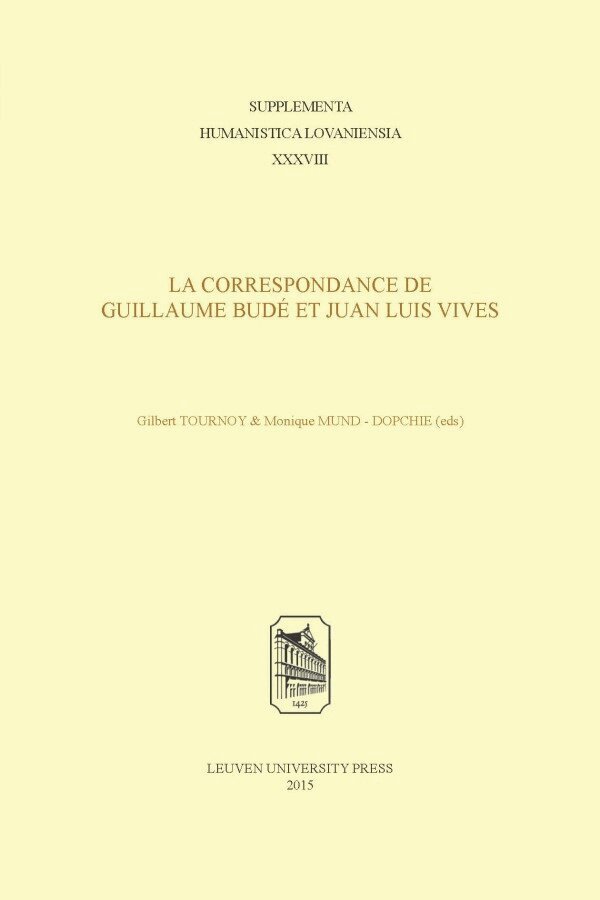
Témoignage intéressant sur la vie intellectuelle et la vie tout court des grands humanistes Le présent recueil entend apporter une nouvelle contribution à la connaissance des écrits des grands humanistes du 15ème au 16ème siècle. Certes, le volume consacré à l’échange de lettres entre Budé et Vives est mince: il ne comporte que dix lettres au total. Malgré leur petit nombre, ces lettres apportent indéniablement, à l’instar des lettres publiées précédemment, un témoignage intéressant sur la vie intellectuelle, voire, dans le cas de Budé, sur la vie tout court d’humanistes. Toutes les lettres sont accompagnées d'un commentaire exhaustif et d’une traduction française, ainsi que d’un index nominum et d’un index fontium. Interesting testimony to the intellectual life and life itself of the great humanistsThis book aims to make a new contribution to the knowledge on writings of the great humanists of the fifteenth and sixteenth centuries. Certainly, the volume on the exchange of letters between Budé and Vives is thin: it has only ten letters. Despite the small number, these letters undeniably bring an interesting testimony to the intellectual life or, in the case of Budé, on life itself of the humanists. All letters are accompanied by an exhaustive commentary and a French translation, as well as an index fontium and an index nominum.Introduction, édition critique et annotations par Gilbert Tournoy. Avant-propos et traduction française par Monique Mund-Dopchie
Häftad, Engelska, 2015
815 kr
Tillfälligt slut
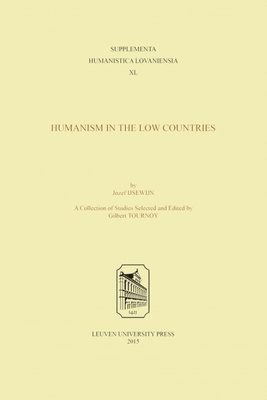
Professor Jozef IJsewijn’s most relevant essays collected in one volumeJozef IJsewijn. Humanism in the Low Countries contains twenty-one essays written by the late Professor Jozef IJsewijn during the period 1966-1996. All essays were selected by his pupil Professor Gilbert Tournoy, who collaborated with him since the foundation of the Seminarium Philologiae Humanisticae in 1966 until his untimely death in 1998. They are now published in one volume in homage to the most brilliant scholar in the field of Neo-Latin Studies of the twentieth century.A number of contributions focus on the life and/or work of a single humanist from the Netherlands, others have a more general nature and deal with the very beginning and the later blossoming of Neo-Latin literature in the Low Countries or with the relationship between humanism in the Low Countries and in other European countries.Hidden in a less-known journal or a Festschrift for a colleague, these studies are nowadays not always easy to find. This volume brings the most relevant essays of IJsewijn together and aims to contribute to the research and study of humanism and Neo-Latin literature in the Low Countries.
Häftad, Engelska, 2016
720 kr
Tillfälligt slut
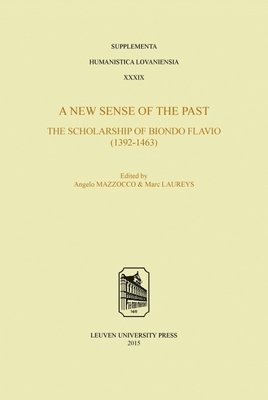
Reappraisal of the pioneering humanist scholar Biondo FlavioDuring his lifetime the historian and antiquarian Biondo Flavio (1392– 1463) struggled to obtain recognition as a major contributor to the humanistic movement of the fifteenth century. Throughout the Renaissance, fellow Italian scholars far too often condemned rather than endorsed his scholarly works. His troublesome career and mixed reputation among his peers stand in stark contrast with the highly innovative character of his learning, which proved to be ground-breaking for the further development of various strands of historical and antiquarian research in the Early Modern Age. The authors of this volume aim to contribute to a reappraisal of this pioneering humanist scholar by a fresh assessment of his major writings in the fields of historical linguistics, historiography, Roman topography, and historical geography.ContributorsAngelo Mazzocco (Mount Holyoke College), Marc Laureys (Universität Bonn), Giuseppe Marcellino (Scuola Normale Superiore di Pisa), Fulvio Delle Donne (Università della Basilicata), Fabio Della Schiava (Universität Bonn), Paolo Pontari (Università di Pisa), Catherine Castner (University of South Carolina), Jeffrey White (St. Bonaventure University), Frances Muecke (University of Sydney)