• Fri frakt över 249 kr
  • •
  • Snabba leveranser
  • •
  • Billiga böcker
Kundservice

Du är på sajten för privatpersoner.

Företag, bibliotek eller offentlig verksamhet?

Du handlar på classic.bokus.com, där alla dina funktioner finns intakta.
Till classic.bokus.com
Bokus logotyp. Gå till startsidan.
  • Erbjudanden
  • Student
  • Topplistor
  • Barn & ungdom
  • Bokus Play
  • E-böcker
  • Ljudböcker
  • Pocketböcker
  • Spel och pussel

Skapa nya rutiner – hälsoböcker upp till 50% →

Sidfot

Mina sidor

    Hjälp

    • Kundservice
    • Vanliga frågor och svar
    • Frakt och leverans
    • Retur vid ångerrätt
    • Reklamera vara
    • Betalning
    • Köpvillkor
    • Allmänna villkor
    • Information om webbplatsens tillgänglighet

    Om Bokus

    • Om oss
    • Pressrum
    • För studenter
    • För företag
    • För bibliotek och offentlig verksamhet
    • För leverantörer
    • Hållbarhet

    Populärt

    • Aktuella erbjudanden
    • Presentkort
    • Studentlitteratur
    • Nya böcker
    • Topplistor
    • Signerade böcker
    • Engelska böcker

    Inspiration

    • Boktips
    • BookTok
    • Barnbokskaraktärer
    • Populära författare
    Logotyp för Bokus
    Följ oss på Facebook (extern länk)Följ oss på Instagram (extern länk)Följ oss på YouTube (extern länk)Följ oss på TikTok (extern länk)
    bokus @ CookiesAnpassa cookiesIntegritetspolicyKöpvillkor
    Till Citymail hemsida (extern länk)Till Budbee hemsida (extern länk)Till Postnord hemsida (extern länk)Till Schenker hemsida (extern länk)Till Early Bird hemsida (extern länk)Till Walleys hemsida (extern länk)
    1. Språk och ordböcker
    2. Språkvetenskap och lingvistik

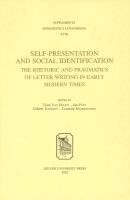
    Self-Presentation and Social Identification

    The Rhetoric and Pragmatics of Letter Writing in Early Modern Times

    AvToon van Houdt,Jan Papy

    Häftad, Engelska, 2002

    Del i serien Supplementa Humanistica Lovaniensia

    722 kr

    Tillfälligt slut

    Beskrivning

    More often than not, humanist, scholarly and 'scientific' correspondences from the early modern period have been analyzed from a rather narrow point of view. They were either exploited to reveal new biographical and historical evidence or assessed as literary achievements, as precious (or not so precious) pearls of artistic prose and composition. However legitimate such an outspokenly positivist and aesthetic approach may be, it does not exhaust the various possibilities for historical and literary study that early modern correspondences offer. It may, for instance, be doubted whether the traditional approach enables us to address, let alone to answer, one of the key questions that can and should be raised when dealing with letter writing in early modern times: how did the genre function as a social practice? This question can be reformulated as follows: who was writing, what, for whom, and why?At first glance, many, if not most, of the correspondences seem to have functioned as a means to discuss business and family affairs, to express friendship (and, to a lesser extent, love), or to communicate scholarly information. If we scrutinize them more carefully, however, we will discover that epistolary exchange was far more signicifant and played a far more crucial role than this superficial enumeration of topics to be found in early modern correspondences would make us believe. It can indeed be argued that many humanists and other intellectuals wrote letters in order to define themselves as literators, scholars, or scientists. In other words, letters were used as a means of self-presentation and social identification. It is through letters that literators, scholars, and scientists presented a particular, quite often highly apologetic, self-image which they wanted to be divulged and perpetuated. It is through letters, moreover, that literators, scholars, and scientists defined themselves as belonging to a specific group of people who shared the same interests and ideals, and were engaged in similar endeavours.Although these issues have not been entirely neglected by scholars in the past, this book brings together philologists, literary historians and historians of ideas to reflect upon the phenomenon of letter writing, and concentrates on four particular issues: the rhetoric of letter writing, friendship and patronage, criticism and libel, reputation and fame. Moreover, particular attention has been given to the functioning of letter writing as a means of self-presentation and social identification, linking together more closely text and context, literature and society.

    Produktinformation

    • Utgivningsdatum:2002-05-22
    • Mått:160 x 236 x 33 mm
    • Vikt:765 g
    • Format:Häftad
    • Språk:Engelska, Franska, Tyska, Italienska
    • Serie:Supplementa Humanistica Lovaniensia
    • Antal sidor:478
    • Förlag:Leuven University Press
    • ISBN:9789058672124

    Utforska kategorier

    • Språkvetenskap och lingvistik inom Språk och ordböcker
    • Sociologi och antropologi inom Samhälle och politik

    Mer om författaren

    Toon Van Houdt is associate professor of Latin at KU Leuven. His research focuses on the history of political and ethical thought in early modern times. Jan Papy is full professor of Latin and Neo-Latin literature at KU Leuven. He publishes on Renaissance Humanism in the Low Countries, intellectual history, and Lipsius and Neo-Stoic philosophy. Gilbert Tournoy is emeritus professor of Classical, Mediaeval and Renaissance Latin at KU Leuven.

    Innehållsförteckning

    • IntroductionToon Van Houdt & Jan PapyPART I : The Rhetoric of Letter WritingJudith Rice HendersonHumanist Letter Writing: Private Conversation or Public Forum?Charles FantazziVives versus Erasmus on the Art of Letter WritingChristine BénéventErasme en sa correspondance: conquête(s) et défaite(s) du langageTim MarkeyStyle and Tradition in Ben Jonson's Verse EpistlesKristine HaugenImaginary Correspondence: Epistolary Rhetoric and the Hermeneutics of DisbeliefPART II : Friendship and PatronageWarren V. BoutcherLiterature, Thought or Fact? Past and Present Directions in the Study of the Early Modern LetterJacqueline GlomskiCareerism at Cracow: The Dedicatory Letters of Rudolf Agricola Junior, Valentin Eck, and Leonard Cox (1510-1530)Mark MorfordLipsius' Letters of RecommendationElisabet GöranssonLetters, Learning and Learned Ladies. An Analysis of Otto Sperling, Jr.'s (1634-1715) Correspondence with Scandinavian WomenPart III : Exchanging Letters in the Republic of LettersHenk J.M. NellenIn Strict Confidence: Grotius' Correspondence with his Socinian FriendsCorinna VermeulenStrategies and Slander in the Protestant Part of the Republic of Letters: Image, Friendship and Patronage in Etienne de Courcelles' CorrespondenceAntonio IurilliLa crisi del sapere rinascimentale in un carteggio italiano di primo SettecentoPART IV : 'Programming', criticizing and libellingErika RummelArgumentis, non contumeliis: The Humanistic Model for Religious Debate and Erasmus' Apologetic LettersJane GriffithsThe Grammarian as 'Poeta' and 'Vates': Self-Presentation in the AntibossiconIordan AvramovLetter Writing and the Management of Scientific Controversy: The Correspondence of Henry Oldenburg (1661-1677)PART V : Literary Fame and Scientific ReputationKarl A. E. EnenkelDie Grundlegung humanistischer Selbstpräsentation im Brief-Corpus: Francesco Petrarcas Familiarium rerum libri XXIVLisa JardineBefore Clarissa: Erasmus, 'Letters of Obscure Men', and Epistolary FictionsEdward V. GeorgeConceal or Disclose? The Limits of Self-Representation in the Letters of Juan Luis VivesPhilip J. FordSelf-Presentation in the Published Correspondence of George BuchananAdam MosleyTycho Brahe's Epistolae Astronomicae: A ReappraisalIndex nominum
    Hoppa över listan

    Du kanske också är intresserad av

    Jozef Ijsewijn - Companion to Neo-Latin Studies, Häftad

    Companion to Neo-Latin Studies

    Jozef Ijsewijn

    Häftad, 2010

    638 kr

    Clark Colahan, Warren S. Smith, Warren Smith, C. Clark - Spanish Humanism on the Verge of the Picaresque, Häftad

    Spanish Humanism on the Verge of the Picaresque

    Clark Colahan, Warren S. Smith, Warren Smith, C. Clark

    Häftad, 2009

    672 kr

    Terence O. Tunberg - De rationibus quibus homines docti artem Latine colloquendi et ex tempore dicendi saeculis XVI et XVII coluerunt, Häftad

    De rationibus quibus homines docti artem Latine colloquendi et ex tempore dicendi saeculis XVI et XVII coluerunt

    Terence O. Tunberg

    Häftad, 2012

    575 kr

    Jan Papy, Dirk Sacré - Syntagmatia, Häftad

    Syntagmatia

    Jan Papy, Dirk Sacré

    Häftad, 2009

    1 313 kr

    Marc Laureys, Roswitha Simons - Art of Arguing in the World of Renaissance Humanism, Häftad

    Art of Arguing in the World of Renaissance Humanism

    Marc Laureys, Roswitha Simons

    Häftad, 2013

    702 kr

    Tuomo Pekkanen - Passio secundum Matthaeum, Requiem Latinum aliaque carmina Latina, Häftad

    Passio secundum Matthaeum, Requiem Latinum aliaque carmina Latina

    Tuomo Pekkanen

    Häftad, 2017

    899 kr

    Ignace Bossuyt, Ignace Bossuyt, Nele Gabriëls, Dirk Sacré, Demmy Verbeke - "Cui dono lepidum novum libellum?", Häftad

    "Cui dono lepidum novum libellum?"

    Ignace Bossuyt, Ignace Bossuyt, Nele Gabriëls, Dirk Sacré, Demmy Verbeke

    Häftad, 2008

    632 kr

    Dirk Sacré, Gilbert Tournoy, Monique Mund-Dopchie, Jan Papy, Lambert Isebaert - Humanistica Lovaniensia, Häftad

    Humanistica Lovaniensia

    Dirk Sacré, Gilbert Tournoy, Monique Mund-Dopchie, Jan Papy, Lambert Isebaert

    Häftad, 2010

    1 052 kr

    Dirk Sacré, Gilbert Tournoy, Monique Mund-Dopchie, Jan Papy, Lambert Isebaert - Humanistica Lovaniensia, Häftad

    Humanistica Lovaniensia

    Dirk Sacré, Gilbert Tournoy, Monique Mund-Dopchie, Jan Papy, Lambert Isebaert

    Häftad, 2015

    1 134 kr

    Dirk Sacré, Gilbert Tournoy, Monique Mund-Dopchie, Jan Papy, Lambert Isebaert - Humanistica Lovaniensia, Häftad

    Humanistica Lovaniensia

    Dirk Sacré, Gilbert Tournoy, Monique Mund-Dopchie, Jan Papy, Lambert Isebaert

    Häftad, 2012

    1 052 kr