• Fri frakt över 249 kr
  • •
  • Snabba leveranser
  • •
  • Billiga böcker
Kundservice

Du är på sajten för privatpersoner.

Företag, bibliotek eller offentlig verksamhet?

Du handlar på classic.bokus.com, där alla dina funktioner finns intakta.
Till classic.bokus.com
Bokus logotyp. Gå till startsidan.
  • Erbjudanden
  • Nyheter
  • Student
  • Topplistor
  • Barn & ungdom
  • Bokus Play
  • E-böcker
  • Pocketböcker
  • Spel & pussel

10% rabatt på allt med kod NYSTART10 →

Sidfot

Mina sidor

    Hjälp

    • Kundservice
    • Vanliga frågor och svar
    • Frakt och leverans
    • Retur vid ångerrätt
    • Reklamera vara
    • Betalning
    • Köpvillkor
    • Allmänna villkor
    • Information om webbplatsens tillgänglighet

    Om Bokus

    • Om oss
    • Pressrum
    • För studenter
    • För företag
    • För bibliotek och offentlig verksamhet
    • För leverantörer
    • Hållbarhet

    Populärt

    • Aktuella erbjudanden
    • Presentkort
    • Studentlitteratur
    • Nya böcker
    • Topplistor
    • Signerade böcker
    • Engelska böcker

    Inspiration

    • Boktips
    • BookTok
    • Populära bokserier
    • Barnbokskaraktärer
    • Populära författare
    Logotyp för Bokus
    Följ oss på Facebook (extern länk)Följ oss på Instagram (extern länk)Följ oss på YouTube (extern länk)Följ oss på TikTok (extern länk)
    bokus @ CookiesAnpassa cookiesIntegritetspolicyKöpvillkor
    Till Citymail hemsida (extern länk)Till Budbee hemsida (extern länk)Till Postnord hemsida (extern länk)Till Schenker hemsida (extern länk)Till Early Bird hemsida (extern länk)Till Walleys hemsida (extern länk)
    1. Naturvetenskap och teknik
    2. Matematik och naturvetenskap
    3. Kemi
    4. Fysikalisk kemi

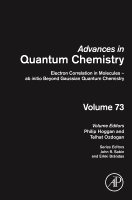
    Electron Correlation in Molecules - ab initio Beyond Gaussian Quantum Chemistry

    AvPhilip Hoggan,Telhat Ozdogan

    Inbunden, Engelska, 2016

    Del 73 i serien Advances in Quantum Chemistry

    2 847 kr

    Beställningsvara. Skickas inom 10-15 vardagar. Fri frakt över 249 kr.

    Beskrivning

    Electron Correlation in Molecules - ab initio Beyond Gaussian Quantum Chemistry presents a series of articles concerning important topics in quantum chemistry, including surveys of current topics in this rapidly-developing field that has emerged at the cross section of the historically established areas of mathematics, physics, chemistry, and biology.

    • Presents surveys of current topics in this rapidly-developing field that has emerged at the cross section of the historically established areas of mathematics, physics, chemistry, and biology
    • Features detailed reviews written by leading international researchers
    • The volume includes review on all the topics treated by world renown authors and cutting edge research contributions.

    Produktinformation

    • Utgivningsdatum:2016-02-01
    • Mått:152 x 229 x 29 mm
    • Vikt:860 g
    • Format:Inbunden
    • Språk:Engelska
    • Serie:Advances in Quantum Chemistry
    • Antal sidor:440
    • Förlag:Elsevier Science
    • ISBN:9780128030608

    Utforska kategorier

    • Fysikalisk kemi inom Naturvetenskap och teknik

    Mer om författaren

    Born in Aberystwyth, Wales and educated at Trinity College Cambridge, Philip Hoggan has always been French and British. After a mathematical chemistry background, he has studied a number of theoretical systems, with a DSc by research obtained in 1991 at Nancy, France on the way physical interaction between molecules and solid surfaces is a precursor to catalysis. This was treated entirely on the basis of Quantum Mechanics and applied, first to cis-trans butadiene isomerization on alumina and then a number of ‘organic’ reactions. The first lectureship was at Caen, Normandy from 1992. This period led to some fundamental research of ab initio Slater electronic structure calculations for more than 3 atoms. The first related code STOP was published in February 1996 after much work by a postdoctoral fellow A. Bouferguène, now Professor at U Alberta. After continuing to study catalytic systems at Caen, from a theoretical viewpoint, Philip Hoggan was appointed to the Chair of Theoretical Chemistry in Clermont from May 1998. This is still essentially his teaching position, although research interests have switched to solid-state (surface) physics joining the Pascal Institute for physics in Clermont from 2005. This followed a visiting professor stay of 18 months at Tallahassee, Florida in Theoretical Physics. Research emphasis has shifted from the STOP era (where the problem was solved by Coulomb Resolution in 2008) to Quantum Monte Carlo (QMC). The CNRS paid leave for a couple of years for Philip Hoggan to learn about this technique from Cyrus Umrigar, Julien Toulouse, Michel Caffarel and others. Of course, it eventually led to a project to calculate catalytic reactions on metal surfaces that was initiated by G-J Kroes (Leiden, NL) and his ERC in 2014. K Doblhoff-Dier arrived in Clermont for a ground-breaking research fellowship and each of us continues to produce very accurate work e.g. on hydrogen (production and dissociation on metals), as a clean fuel for renewable energy. Now, in 2023 we enter the 400th anniversary of Blaise Pascal’s birth. He invented calculators, some of which are in the Clermont museum. It is wonderful to work in the institute that bears his name conducting QMC on catalytic hydrogen synthesis on super-calculators: the tools that trace their roots to his ‘Pascaline’. Philip Hoggan is married and has twin daughters. I was born in 1971 in Tatvan/Turkey, where I studied my primary and secondary education. In 1994, I graduated from the Physics Department of Faculty of Education in 19 Mayis University and in 1997, I completed my master dissertation named “Investigation of DEPT and 2D DEPT J-Resolved NMR of Some Spin Systems by Product Operator Theory”. I finished my doctoral thesis named “Combined Theory of Electric Multipole Moment Tensors and Application to Polyatomic Molecules” in 2000. I have been in Erlangen University in Germany as a researcher for 3 months and after this I was assigned to the Rize Faculty of Arts and Sciences in Black Sea Technical University as an Assist. Proffessor. In 2007, I became Assoc. Professor in Department of Physics in Atomic and Molecular Physics in Recep Tayyip Erdoğan University and worked in the same position until 2013. Same year, I became a Professor and started to work at Amasya University, Computer and Instructional Technologies Education Program of Faculty of Education and I am still working at the same university and department.

    Innehållsförteckning

    • Section I: Exponential Type Basis Quantum Chemistry1. A Sturmian Approach to Photoionization of Molecules2. General Coalescence Conditions for the Exact Wave Functions: Higher-Order Relations for Coulombic and Non-Coulombic Systems3. Exponentially Correlated Wave Functions for Four-Body Systems4. Analytic Formulas for Two-Center Two-Electron Integrals with Exponential Functions5. Singlet and Triplet Bound State Spectra in the Four-Electron Be-Like Atomic Systems6. An Application of the Gaussian Transform for Approximating Some Bessel Functions and Multicenter Integrals Involving 1s Slater-Type Orbitals7. Size-Extensivity Corrections in Single- and Multireference Configuration Interaction Calculations8. Introducing a Polynomial Expression of Molecular Integrals for Algebraic the Molecular Orbital (MO) Equation9. Analytic Calculation of Momentum Distribution and Compton Profiles of Atoms Using Hartree–Fock–Roothaan Method: Applications to Atoms 2 ≤ Z ≤ 1010. Evaluation of One-Electron Basic Integrals of Irregular Solid Harmonics and Slater-Type Orbitals Using Fourier Transforms Section II: Electron Correlation in Molecules and Solids 11. Excitation Energies of Molecules from Ensemble Density Functional Theory: Multiconfiguration Approaches12. Application of the Space-Pseudo-Time Method to Density Functional Theory13. Potential Energy Curves of NaK Molecule from All-Electron Multireference-Coupled Cluster Calculations14. The Correlation Effects in Density Functional Theory Along the Dissociation Path15. Introduction to the Variational and Diffusion Monte Carlo Methods16. Configuration Interaction Monte Carlo with Coupled Clusters Wave Functions17. X-Ray Constrained Wave Functions: Fundamentals and Effects of the Molecular Orbitals Localization18. Electron Impact Atomic and Ionic Ionization: Analytical, Semiempirical, and Semiclassical Methods