• Fri frakt över 249 kr
  • •
  • Snabba leveranser
  • •
  • Billiga böcker
Kundservice

Du är på sajten för privatpersoner.

Företag, bibliotek eller offentlig verksamhet?

Du handlar på classic.bokus.com, där alla dina funktioner finns intakta.
Till classic.bokus.com
Bokus logotyp. Gå till startsidan.
  • Erbjudanden
  • Nyheter
  • Student
  • Topplistor
  • Barn & ungdom
  • Bokus Play
  • E-böcker
  • Pocketböcker
  • Spel & pussel

10% studentrabatt med kod TERM26

Sidfot

Mina sidor

    Hjälp

    • Kundservice
    • Vanliga frågor och svar
    • Frakt och leverans
    • Retur vid ångerrätt
    • Reklamera vara
    • Betalning
    • Köpvillkor
    • Allmänna villkor
    • Information om webbplatsens tillgänglighet

    Om Bokus

    • Om oss
    • Pressrum
    • För studenter
    • För företag
    • För bibliotek och offentlig verksamhet
    • För leverantörer
    • Hållbarhet

    Populärt

    • Aktuella erbjudanden
    • Presentkort
    • Studentlitteratur
    • Nya böcker
    • Topplistor
    • Signerade böcker
    • Engelska böcker

    Inspiration

    • Boktips
    • BookTok
    • Populära bokserier
    • Barnbokskaraktärer
    • Populära författare
    Logotyp för Bokus
    Följ oss på Facebook (extern länk)Följ oss på Instagram (extern länk)Följ oss på YouTube (extern länk)Följ oss på TikTok (extern länk)
    bokus @ CookiesAnpassa cookiesIntegritetspolicyKöpvillkor
    Till Citymail hemsida (extern länk)Till Budbee hemsida (extern länk)Till Postnord hemsida (extern länk)Till Schenker hemsida (extern länk)Till Early Bird hemsida (extern länk)Till Walleys hemsida (extern länk)
    1. Historia och arkeologi
    2. Historia
    3. Forntidens historia

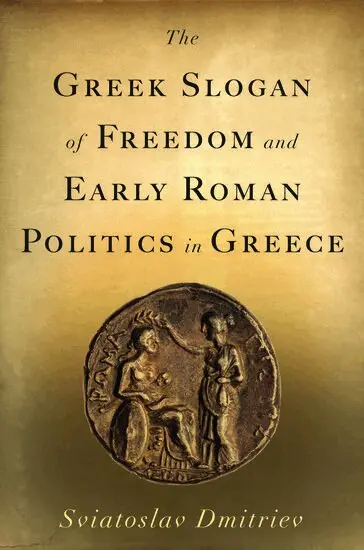
    The Greek Slogan of Freedom and Early Roman Politics in Greece

    AvSviatoslav Dmitriev

    Inbunden, Engelska, 2011

    Del i serien Academic

    2 163 kr

    Beställningsvara. Skickas inom 5-8 vardagar. Fri frakt över 249 kr.

    Beskrivning

    The Greek Slogan of Freedom and Early Roman Politics in Greece elucidates the main steps and ways in which the slogan of freedom emerged and developed into the fundamental principle of Greek diplomacy and politics, long before the Romans appropriated and used this slogan to establish their domination over the Mediterranean.Originally employed by the Spartans and Athenians, who used it to subvert each other's military alliances before and during the Peloponnesian war, the slogan of freedom helped to maintain political and military balance among the major Greek powers during the classical period, putting a check on their aspirations. After Philip II and Alexander III (the Great) established Macedonian rule over Greece, and in the subsequent Hellenistic period, the slogan of freedom not only continued to be an important tool for undermining rival military alliances and vindicating aggressions on behalf of those whose freedom was allegedly violated or endangered, but also served to determine the status of individual Greek communities.Once Rome became involved in Greek affairs, she made the slogan of freedom part of her policy in Greece. The Romans' claim of protecting Greek freedom was their only justification for interfering in Greek affairs. Individual Greek cities preserved their status, including freedom, by pledging loyalty and good faith to Rome. This network of mutual obligations and responsibilities evolved into a system of political control over the Greeks, which came to be known as the Roman Peace (pax Romana). This book argues, therefore, that the Roman Mediterranean empire was built not only on military might, but also on diplomacy, including a skillful Roman adaptation to local political practices and vocabulary.

    Produktinformation

    • Utgivningsdatum:2011-03-24
    • Mått:239 x 165 x 43 mm
    • Vikt:839 g
    • Format:Inbunden
    • Språk:Engelska
    • Serie:Academic
    • Antal sidor:544
    • Förlag:OUP USA
    • ISBN:9780195375183

    Utforska kategorier

    • Forntidens historia inom Historia och arkeologi
    • Politik och statsskick inom Samhälle och politik

    Mer om författaren

    Sviatoslav Dmitriev is Associate Professor of History, Ball State University

    Recensioner i media

    Dmitriev's study is a well-produced and often persuasive addition to the scholarship on the Roman conquest of Greece.

    Innehållsförteckning

    • AbbreviationsIntroduction PART ONE. The Slogan of Freedom from the Peloponnesian War to the Coming of Rome Chapter 1. From the Peloponnesian War to the Enthronement of Philip II of MacedoniaChapter 2. The Macedonian Peace of Philip II and Alexander the Great Chapter 3. The Slogan of Freedom Under and After the Successors PART TWO. Early Roman Politics in Greece Chapter 4. Rome and the Greeks from 229 to the Declaration of FlamininusChapter 5. The Origin of the Roman slogan of Greek Freedom Chapter 6. The Roman Slogan of Greek Freedom Against Nabis and Antiochos III PART THREE. The Aftermath: from the Defeat of Antiochos III to the Destruction of Corinth Chapter 7. Rome and Greek CitiesChapter 8. Rhodes between Rome and Perseus Chapter 9. The Downfall of the Achaean League and Polybios's History Epilogue: The Slogan of Freedom from the King's Peace to the pax Romana Appendix 1. The End of the Theban Affiliation with the Second Athenian Confederacy Appendix 2. Sparta's Alleged Participation in the Athens Peace Appendix 3. The "Peace of 367" (the Peace of Pelopidas) and Diodoros Appendix 4. The Content of the King's Peace and the "Territorial Clause" Appendix 5. Philip's Leadership of the Thessalians Appendix 6. Demosthenes's Macedonian Diplomacy in the Reign of Alexander Appendix 7. Alexander's Treatment of Individual Greek Cities of Asia Minor Appendix 8. The Expeditions of Heracleides and Dicaearchos Appendix 9. Fides and (Roman and Foreign) clientelae Select Bibliography Index of Inscriptions, Papyri, and Coins Index of Ancient Authors and Texts Index of Names and Subjects