• Fri frakt över 249 kr
  • •
  • Snabba leveranser
  • •
  • Billiga böcker
Kundservice

Du är på sajten för privatpersoner.

Företag, bibliotek eller offentlig verksamhet?

Du handlar på classic.bokus.com, där alla dina funktioner finns intakta.
Till classic.bokus.com
Bokus logotyp. Gå till startsidan.
  • Erbjudanden
  • Nyheter
  • Student
  • Topplistor
  • Barn & ungdom
  • Bokus Play
  • E-böcker
  • Pocketböcker
  • Spel & pussel

10% studentrabatt med kod TERM26

Sidfot

Mina sidor

    Hjälp

    • Kundservice
    • Vanliga frågor och svar
    • Frakt och leverans
    • Retur vid ångerrätt
    • Reklamera vara
    • Betalning
    • Köpvillkor
    • Allmänna villkor
    • Information om webbplatsens tillgänglighet

    Om Bokus

    • Om oss
    • Pressrum
    • För studenter
    • För företag
    • För bibliotek och offentlig verksamhet
    • För leverantörer
    • Hållbarhet

    Populärt

    • Aktuella erbjudanden
    • Presentkort
    • Studentlitteratur
    • Nya böcker
    • Topplistor
    • Signerade böcker
    • Engelska böcker

    Inspiration

    • Boktips
    • BookTok
    • Populära bokserier
    • Barnbokskaraktärer
    • Populära författare
    Logotyp för Bokus
    Följ oss på Facebook (extern länk)Följ oss på Instagram (extern länk)Följ oss på YouTube (extern länk)Följ oss på TikTok (extern länk)
    bokus @ CookiesAnpassa cookiesIntegritetspolicyKöpvillkor
    Till Citymail hemsida (extern länk)Till Budbee hemsida (extern länk)Till Postnord hemsida (extern länk)Till Schenker hemsida (extern länk)Till Early Bird hemsida (extern länk)Till Walleys hemsida (extern länk)
    1. Språk och ordböcker
    2. Språk: referensverk och allmänt
    3. Kreativt skrivande

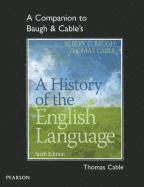
    A Companion to Baugh & Cable's A History of the English Language

    AvThomas Cable,Albert Baugh

    Häftad, Engelska, 2012

    1 229 kr

    Beställningsvara. Skickas inom 7-10 vardagar. Fri frakt över 249 kr.

    Beskrivning

    In the spirit of the main text, the Companion pays attention to the linguistic effects of social, political, and literary events. The maps are designed to set the geographical contexts for these cultural influences during the Indo-European period, the Middle Ages, and the eras of the British Empire and of American ascendancy. The pre-chapter on "The Sounds of English" contains phonetic information and exercises that should be helpful in most of the chapters that follow. The "Questions for Review" that begin each chapter give an overview of the most important topics in each period and serve as a checklist of items that should be familiar in any discussion of the history of English. Now that we are into the second decade of the twenty-first century, a twelfth chapter has been added to the main text. Because English as a global language is a central issue in its history at this point, the questions for review in Chapter 12 raise topics for discussion concerning the major languages of the world, prospects for the future, and less obvious issues such as the relative "complexity" of languages. The headings for most sections are followed by a corresponding section number in the History.On many topics the amount of exposition preceding the exercises varies more or less inversely with the amount in the History, the idea being to have a full discussion of important topics without a duplication between the two books.

    Produktinformation

    • Utgivningsdatum:2012-11-29
    • Mått:100 x 100 x 100 mm
    • Vikt:100 g
    • Format:Häftad
    • Språk:Engelska
    • Antal sidor:168
    • Upplaga:4
    • Förlag:Pearson Education
    • ISBN:9780205230754

    Utforska kategorier

    • Kreativt skrivande inom Språk och ordböcker
    • Språkundervisning och språkinlärning inom Språk och ordböcker

    Innehållsförteckning

    • Preface 0 The Sounds of English0.1 Phonetic Symbols0.2 The Vocal Tract0.3 English Consonants0.4 English Vowels0.5 Transcription 1 English Present and Future 1.1 Questions for Review 2 The Indo-European Family of Languages 2.1 Questions for Review 2.2 Grimm’s Law (§14) 2.3 The Indo-European Family (§§15–24) 2.4 The Indo-Europeans (§26) 3 Old English 3.1 Questions for Review 3.2 Old English Consonants (§38) 3.3 Old English Vowels (§38) 3.4 Old English Suprasegmentals 3.5 Old English Cases (§40) 3.6 Old English Nouns (§§41–42) 3.7 Nouns in Sentences (§41) 3.8 Old English Adjectives (§43) 3.9 Old English Pronouns (§45) 3.10 Old English Strong Verbs (§46) 3.11 Old English Syntax and Meter (§51) 3.12 The Language Illustrated (§47) Ælfric, West Saxon Gospels, Ohthere’s Voyage, 4 Foreign Influences on Old English 4.1 Questions for Review 4.2 Dating Latin Loanwords through Sound Changes (§57) i-Umlaut, Breaking, 4.3 Scandinavian Loanwords (§§72, 75–76) 5 The Norman Conquest and the Subjection of English, 1066–1200 5.1 Questions for Review 6 The Reestablishment of English, 1200–1500 6.1 Questions for Review 7 Middle English 7.1 Questions for Review 7.2 From Old to Middle English: Vowels (§112) 7.2.1 Changes in the Old English Vowels, 7.2.2 Formation of New Diphthongs, 7.2.3 Lengthening and Shortening, 7.3 From Old to Middle English: Consonants (§112) 7.4 From Old English to Middle English: Vowel Reduction, Morphology,and Syntax in the Peterborough Chronicle (§§113, 123) 7.5 Chaucer’s Pronunciation 7.6 Middle English Nouns (§114) 7.7 Middle English Adjectives (§115) 7.8 Middle English Personal Pronouns (§116) 7.9 Strong and Weak Verbs in Middle English (§§117–121) 7.10 Middle English Verbal Inflections (§117) 7.11 Middle English Dialects (§148 and Appendix A) 7.12 A Middle English Manuscript 7.13 The Language IllustratedThe Wycliffe Bible, Chaucer, Sir Gawain and the Green Knight, 8 The Renaissance, 1500–1650 8.1 Questions for Review 8.2 The Great Vowel Shift (§154) 8.3 Dictionaries of Hard Words (§174) 8.4 Shakespeare’s Pronunciation (§177) 8.5 Nouns (§180) 8.6 Adjectives (§181) 8.7 Pronouns (§182) 8.8 Prepositions (§184) 8.9 Strong and Weak Verbs (§183) 8.10 Questions, Negatives, and the Auxiliary Do (§183) 8.11 The Language Illustrated King James Bible, Shakespeare, 9 The Appeal to Authority, 1650–1800 9.1 Questions for Review 9.2 Johnson’s Dictionary (§197) 9.3 Universal Grammar (§198) 10 The Nineteenth and Twentieth Centuries 10.1 Questions for Review 10.2 Self-Explaining Compounds (§217) 10.3 Coinages (§220) 10.4 Slang (§225) 10.5 English World-Wide (§229) 10.6 Pidgins and Creoles (§230) 10.7 Gender Issues and Pronominal Change (§233) 10.8 The Language Illustrated (§§228–229) Geordie, Scots, Jamaican English, English in Asia and Africa, 11 The English Language in America 11.1 Questions for Review 11.2 The American Dialects (§250) 11.3 African American Vernacular English: Phonology (§250) 11.4 African American Vernacular English: Grammar (§250) 11.5 Present Differentiation of Vocabulary (§253) 11.6 Dictionary of American Regional English, DARE (§255) 11.7 The Language Illustrated (§250) Appalachian English, African American Vernacular English, Hawaiian English, 12 The Twenty-First Century 12.1 Questions for Review