• Fri frakt över 249 kr
  • •
  • Snabba leveranser
  • •
  • Billiga böcker
Kundservice

Du är på sajten för privatpersoner.

Företag, bibliotek eller offentlig verksamhet?

Du handlar på classic.bokus.com, där alla dina funktioner finns intakta.
Till classic.bokus.com
Bokus logotyp. Gå till startsidan.
  • Erbjudanden
  • Nyheter
  • Student
  • Topplistor
  • Barn & ungdom
  • Bokus Play
  • E-böcker
  • Pocketböcker
  • Spel & pussel

10% studentrabatt med kod TERM26

Sidfot

Mina sidor

    Hjälp

    • Kundservice
    • Vanliga frågor och svar
    • Frakt och leverans
    • Retur vid ångerrätt
    • Reklamera vara
    • Betalning
    • Köpvillkor
    • Allmänna villkor
    • Information om webbplatsens tillgänglighet

    Om Bokus

    • Om oss
    • Pressrum
    • För studenter
    • För företag
    • För bibliotek och offentlig verksamhet
    • För leverantörer
    • Hållbarhet

    Populärt

    • Aktuella erbjudanden
    • Presentkort
    • Studentlitteratur
    • Nya böcker
    • Topplistor
    • Signerade böcker
    • Engelska böcker

    Inspiration

    • Boktips
    • BookTok
    • Populära bokserier
    • Barnbokskaraktärer
    • Populära författare
    Logotyp för Bokus
    Följ oss på Facebook (extern länk)Följ oss på Instagram (extern länk)Följ oss på YouTube (extern länk)Följ oss på TikTok (extern länk)
    bokus @ CookiesAnpassa cookiesIntegritetspolicyKöpvillkor
    Till Citymail hemsida (extern länk)Till Budbee hemsida (extern länk)Till Postnord hemsida (extern länk)Till Schenker hemsida (extern länk)Till Early Bird hemsida (extern länk)Till Walleys hemsida (extern länk)
    1. Ekonomi och Ledarskap
    2. Företagsekonomi
    3. Redovisning och finansiering
    4. Finansiering

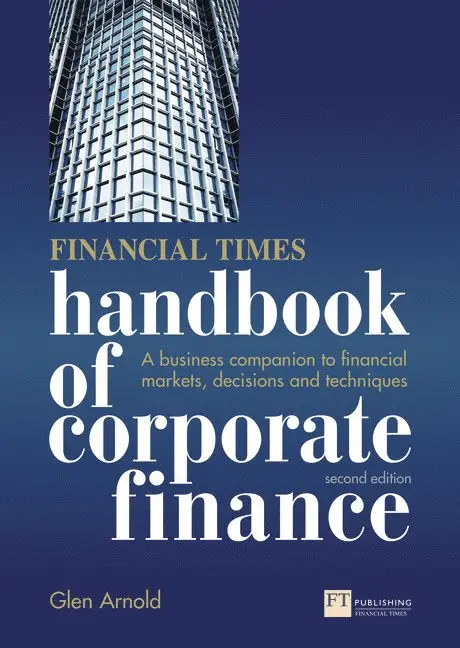
    Financial Times Handbook of Corporate Finance, The

    A Business Companion to Financial Markets, Decisions and Techniques

    AvGlen Arnold

    Häftad, Engelska, 2010

    537 kr

    Beställningsvara. Skickas inom 7-10 vardagar. Fri frakt över 249 kr.

    Beskrivning

    The Financial Times Handbook of Corporate Finance is the authoritative introduction to the principles and practices of corporate finance and the financial markets. Whether you are an experienced manager or finance officer, or you’re new to financial decision making, this handbook identifies all those things that you really need to know:


    ·        An explanation of value-based management

    ·        Mergers and the problem of merger failures

    ·        Investment appraisal techniques

    ·        How to enhance shareholder value

    ·        How the finance and money markets really work

    ·        Controlling foreign exchange rate losses

    ·        How to value a company


    The second edition of this bestselling companion to finance has been thoroughly updated to ensure that your decisions continue to be informed by sound business principles. New sections include corporate governance, the impact of taxation on investment strategies, using excess return as a new value metric, up-to-date statistics which reflect the latest returns on shares, bonds and merger activities and a jargon-busting glossary to help you understand words, phrases and concepts.

    Corporate finance touches every aspect of your business, from deciding which capital expenditure projects are worth backing, through to the immediate and daily challenge of share holder value, raising finance or managing risk.


    The Financial Times Handbook  of Corporate Finance will help you and your business back the right choices, make the right decisions and deliver improved financial performance. It covers the following areas:


    ·        Evaluating your firm’s objectives

    ·        Assessment techniques for investment

    ·        Traditional finance appraisal techniques

    ·        Investment decision-making in companies

    ·        Shareholder value

    ·        Value through strategy

    ·        The cost of capital

    ·        Mergers: failures and success

    ·        Merger processes

    ·        How to value companies

    ·        Pay outs to shareholders

    ·        Debt finance

    ·        Raising equity capital

    ·        Managing risk

    ·        Options

    ·        Futures, forwards and swaps

    ·        Exchange rate risk

    Produktinformation

    • Utgivningsdatum:2010-09-02
    • Mått:172 x 241 x 38 mm
    • Vikt:1 166 g
    • Format:Häftad
    • Språk:Engelska
    • Antal sidor:816
    • Upplaga:2
    • Förlag:Pearson Education
    • ISBN:9780273726562

    Utforska kategorier

    • Finansiering inom Ekonomi och Ledarskap

    Mer om författaren

    Glen Arnold is a businessman, investor and a professor of finance at Salford University. He’s the author of Corporate Financial Management, now  in its fourth edition, Essentials of Corporate Financial Management, The Financial Times Guide to Value Investing, now in its second edition, and the market leading, The Financial Times Guide to Investing also in its second edition.

    Innehållsförteckning

    • Table of ContentsCONTENTSIntroduction·         Some of the financial issues covered·         The scope of corporate finance  Chapter 1. What is the firm’s objective? A common purposeThe assumed objective of finance Why should we aim for shareholder wealth? What is shareholder wealth? Profit maximisation is not the same as shareholder wealth maximisation Getting manager’s objectives aligned with shareholder’s objectives What happens if control over directors is weak?Conclusion    PART 1 – IINVESTING IN PROJECTS?   Chapter 2. State-of-the-art project assessment techniques How do you know whether an investment generates value for shareholders? State-of-the-art technique 1: net present value State-of-the-art technique 2: internal rate of returnChoosing between NPV and IRRAppendix 2.1 Mathematical tools for finance  Chapter 3. Traditional appraisal techniques  What appraisal techniques businesses actually use Payback Accounting rate of return Internal rate of return: reason for continued popularity  Chapter 4. Investment decision-making in companies  The managerial art of investment selection More tricky issues in real world project appraisalThe stages of investment decision making  Chapter 5. Allowing for risk in project appraisal  What is risk? Adjusting for risk through the discount rate Sensitivity analysis Scenario analysis Probability analysisProblems with using probability analysisEvidence of risk analysis in practice  PART 2 SHAREHOLDER VALUE Chapter 6. Value managed companies versus earnings managed companies The pervasiveness of the value approach Case studies: FT100 companies creating value and destroying value Why shareholder value? Three steps to valueEarnings-based management’s failings ROCE has failings Focusing on earnings is not the same as value How a business creates value The five actions to create value  Chapter 7. Value through strategy Value principles touch every corner of the businessStrategic business unit managementThe firm’s objectiveStrategic assessment Strategic choice Strategy implementation What use is the head office? Targets and motivation  Chapter 8. Value creation within strategic business units·         Using cash flow to measure value ·         Shareholder value analysis ·         Economic profit ·         Economic value added (EVA) ·         Cash flow return on investment  Chapter 9. Entire firm value measurement  Total shareholder return Wealth added index Market added value Market to book ratio  Chapter 10. What is the company’s cost of capital? A word of warningThe required rate of return Two sides of the same coinThe weighted average cost of capitalThe cost of equity capital The cost of retained earnings Debt capital The cost of preference share capitalHybrid secu