• Fri frakt över 249 kr
  • •
  • Snabba leveranser
  • •
  • Billiga böcker
Kundservice

Du är på sajten för privatpersoner.

Företag, bibliotek eller offentlig verksamhet?

Du handlar på classic.bokus.com, där alla dina funktioner finns intakta.
Till classic.bokus.com
Bokus logotyp. Gå till startsidan.
  • Erbjudanden
  • Nyheter
  • Student
  • Topplistor
  • Barn & ungdom
  • Bokus Play
  • E-böcker
  • Pocketböcker
  • Spel & pussel

10% rabatt på allt med kod NYSTART10 →

Sidfot

Mina sidor

    Hjälp

    • Kundservice
    • Vanliga frågor och svar
    • Frakt och leverans
    • Retur vid ångerrätt
    • Reklamera vara
    • Betalning
    • Köpvillkor
    • Allmänna villkor
    • Information om webbplatsens tillgänglighet

    Om Bokus

    • Om oss
    • Pressrum
    • För studenter
    • För företag
    • För bibliotek och offentlig verksamhet
    • För leverantörer
    • Hållbarhet

    Populärt

    • Aktuella erbjudanden
    • Presentkort
    • Studentlitteratur
    • Nya böcker
    • Topplistor
    • Signerade böcker
    • Engelska böcker

    Inspiration

    • Boktips
    • BookTok
    • Populära bokserier
    • Barnbokskaraktärer
    • Populära författare
    Logotyp för Bokus
    Följ oss på Facebook (extern länk)Följ oss på Instagram (extern länk)Följ oss på YouTube (extern länk)Följ oss på TikTok (extern länk)
    bokus @ CookiesAnpassa cookiesIntegritetspolicyKöpvillkor
    Till Citymail hemsida (extern länk)Till Budbee hemsida (extern länk)Till Postnord hemsida (extern länk)Till Schenker hemsida (extern länk)Till Early Bird hemsida (extern länk)Till Walleys hemsida (extern länk)
    1. Naturvetenskap och teknik
    2. Matematik och naturvetenskap
    3. Fysik
    4. Materietillstånd

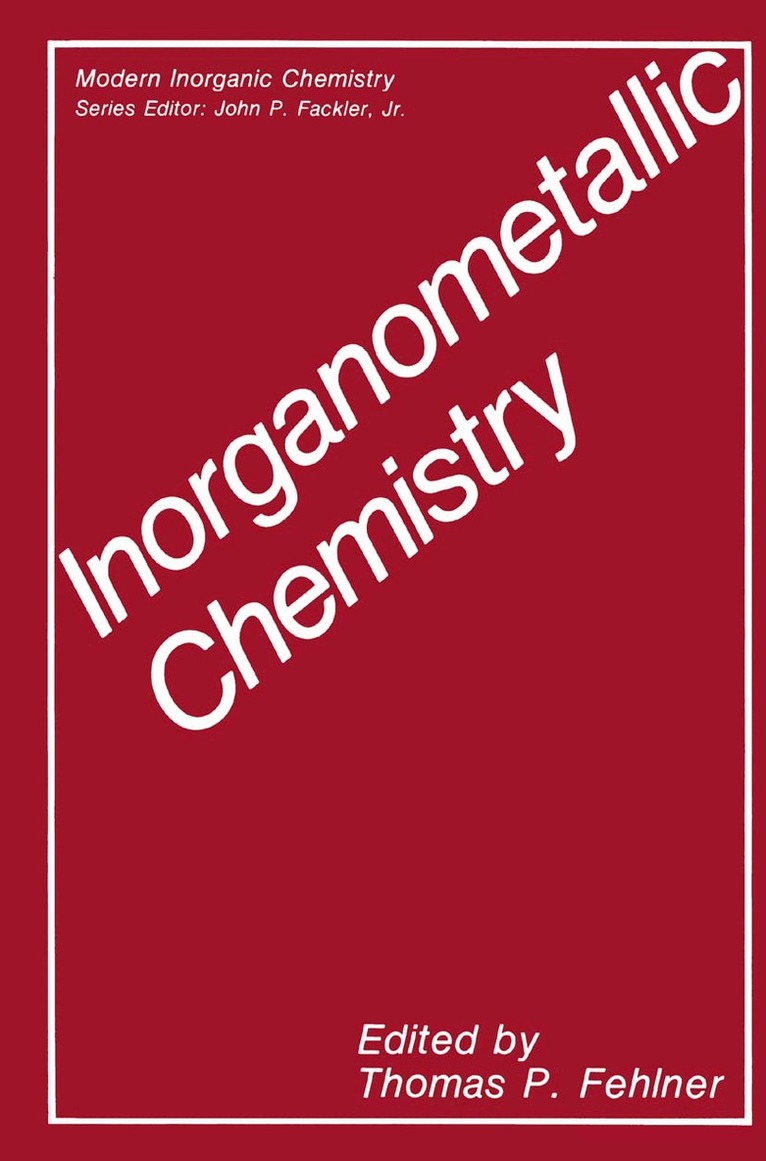
    Inorganometallic Chemistry

    AvThomas P. Fehlner

    Inbunden, Engelska, 1992

    Del i serien Modern Inorganic Chemistry

    1 625 kr

    Beställningsvara. Skickas inom 10-15 vardagar. Fri frakt över 249 kr.

    Beskrivning

    There is a certain fascination associated with words. The manipulation of strings of symbols according to mutually accepted rules allows a language to express history as well as to formulate challenges for the future. But language changes as old words are used in a new context and new words are created to describe changing situations. How many words has the computer revolution alone added to languages? "Inorganometallic" is a word you probably have never encountered before. It is one created from old words to express a new presence. A strange sounding word, it is also a term fraught with internal contradiction caused by the accepted meanings of its constituent parts. "In­ organic" is the name of a discipline of chemistry while "metallic" refers to a set of elements constituting a subsection of that discipline. Why then this Carrollian approach to entitling a set of serious academic papers? Organic, the acknowledged doyenne of chemistry, is distinguished from her brother, inorganic, by the prefix "in," i. e. , he gets everything not organic. Organometallic refers to compounds with carbon-metal bonds. It is simple! Inorganometallic is everything else, i. e. , compounds with noncarbon-metal element bonds. But why a new term? Is not inorganic sufficient? By virtue of training, limited time, resources, co-workers, and so on, chemists tend to work on a specific element class, on a particular compound type, or in a particular phase. Thus, one finds element-oriented chemists (e. g.

    Produktinformation

    • Utgivningsdatum:1992-06-30
    • Mått:155 x 235 x 27 mm
    • Vikt:758 g
    • Format:Inbunden
    • Språk:Engelska
    • Serie:Modern Inorganic Chemistry
    • Antal sidor:401
    • Upplaga:1992
    • Förlag:Springer Science+Business Media
    • ISBN:9780306439865

    Utforska kategorier

    • Materietillstånd inom Naturvetenskap och teknik
    • Oorganisk kemi inom Naturvetenskap och teknik

    Innehållsförteckning

    • 1. Introduction.- 2. Main Group Fragments as Ligands to Transition Metals.- 3. Transition Metal-Main Group Cluster Compounds.- 4. Bonding Connections and Interrelationships.- 5. Experimental Comparison of the Bonding in Inorganometallic and Organometallic Complexes by Photoelectron Spectroscopy.- 6. Transition Metal-Promoted Reactions of Main Group Species and Main Group-Promoted Reactions of Transition Metal Species.- 7. The Metal-Nonmetal Bond in the Solid State.- 8. Molecular Precursors to Thin Films.- 9. Ceramics.