• Fri frakt över 249 kr
  • •
  • Snabba leveranser
  • •
  • Billiga böcker
Kundservice

Du är på sajten för privatpersoner.

Företag, bibliotek eller offentlig verksamhet?

Du handlar på classic.bokus.com, där alla dina funktioner finns intakta.
Till classic.bokus.com
Bokus logotyp. Gå till startsidan.
  • Erbjudanden
  • Nyheter
  • Student
  • Topplistor
  • Barn & ungdom
  • Bokus Play
  • E-böcker
  • Pocketböcker
  • Spel & pussel

10% rabatt på allt med kod NYSTART10 →

Sidfot

Mina sidor

    Hjälp

    • Kundservice
    • Vanliga frågor och svar
    • Frakt och leverans
    • Retur vid ångerrätt
    • Reklamera vara
    • Betalning
    • Köpvillkor
    • Allmänna villkor
    • Information om webbplatsens tillgänglighet

    Om Bokus

    • Om oss
    • Pressrum
    • För studenter
    • För företag
    • För bibliotek och offentlig verksamhet
    • För leverantörer
    • Hållbarhet

    Populärt

    • Aktuella erbjudanden
    • Presentkort
    • Studentlitteratur
    • Nya böcker
    • Topplistor
    • Signerade böcker
    • Engelska böcker

    Inspiration

    • Boktips
    • BookTok
    • Populära bokserier
    • Barnbokskaraktärer
    • Populära författare
    Logotyp för Bokus
    Följ oss på Facebook (extern länk)Följ oss på Instagram (extern länk)Följ oss på YouTube (extern länk)Följ oss på TikTok (extern länk)
    bokus @ CookiesAnpassa cookiesIntegritetspolicyKöpvillkor
    Till Citymail hemsida (extern länk)Till Budbee hemsida (extern länk)Till Postnord hemsida (extern länk)Till Schenker hemsida (extern länk)Till Early Bird hemsida (extern länk)Till Walleys hemsida (extern länk)
    1. Data och IT
    2. Nätverk och kommunikation

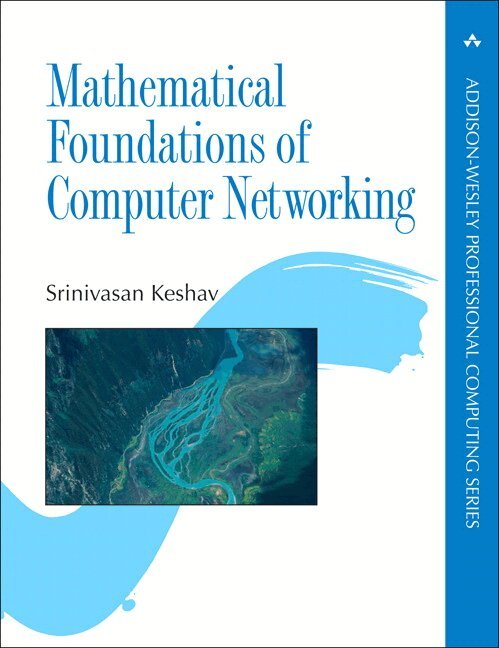
    Mathematical Foundations of Computer Networking

    AvSrinivasan Keshav

    Häftad, Engelska, 2012

    Del i serien Addison-Wesley Professional Computing Series

    583 kr

    Beställningsvara. Skickas inom 7-10 vardagar. Fri frakt över 249 kr.

    Beskrivning

    “To design future networks that are worthy of society’s trust, we must put the ‘discipline’ of computer networking on a much stronger foundation. This book rises above the considerable minutiae of today’s networking technologies to emphasize the long-standing mathematical underpinnings of the field.”

    –Professor Jennifer Rexford, Department of Computer Science, Princeton University

    “This book is exactly the one I have been waiting for the last couple of years. Recently, I decided most students were already very familiar with the way the net works but were not being taught the fundamentals–the math. This book contains the knowledge for people who will create and understand future communications systems."

    –Professor Jon Crowcroft, The Computer Laboratory, University of Cambridge

    The Essential Mathematical Principles Required to Design, Implement, or Evaluate Advanced Computer Networks

    Students, researchers, and professionals in computer networking require a firm conceptual understanding of its foundations. Mathematical Foundations of Computer Networking provides an intuitive yet rigorous introduction to these essential mathematical principles and techniques.

    Assuming a basic grasp of calculus, this book offers sufficient detail to serve as the only reference many readers will need. Each concept is described in four ways: intuitively; using appropriate mathematical notation; with a numerical example carefully chosen for its relevance to networking; and with a numerical exercise for the reader.

    The first part of the text presents basic concepts, and the second part introduces four theories in a progression that has been designed to gradually deepen readers’ understanding. Within each part, chapters are as self-contained as possible.

    The first part covers probability; statistics; linear algebra; optimization; and signals, systems, and transforms. Topics range from Bayesian networks to hypothesis testing, and eigenvalue computation to Fourier transforms.

    These preliminary chapters establish a basis for the four theories covered in the second part of the book: queueing theory, game theory, control theory, and information theory. The second part also demonstrates how mathematical concepts can be applied to issues such as contention for limited resources, and the optimization of network responsiveness, stability, and throughput.

    Produktinformation

    • Utgivningsdatum:2012-05-10
    • Mått:180 x 230 x 25 mm
    • Vikt:779 g
    • Format:Häftad
    • Språk:Engelska
    • Serie:Addison-Wesley Professional Computing Series
    • Antal sidor:496
    • Upplaga:1
    • Förlag:Pearson Education
    • ISBN:9780321792105

    Utforska kategorier

    • Nätverk och kommunikation inom Data och IT

    Mer om författaren

    Srinivasan Keshav is a Professor and a Canada Research Chair at the David R. Cheriton School of Computer Science, University of Waterloo, Ontario, Canada.

    Innehållsförteckning

    • Preface xvChapter 1: Probability 11.1 Introduction 1 1.2 Joint and Conditional Probability 71.3 Random Variables 141.4 Moments and Moment Generating Functions 211.5 Standard Discrete Distributions 251.6 Standard Continuous Distributions 291.7 Useful Theorems 351.8 Jointly Distributed Random Variables 421.8.1 Bayesian Networks 441.9 Further Reading 471.10 Exercises 47Chapter 2: Statistics 532.1 Sampling a Population 53 2.2 Describing a Sample Parsimoniously 572.3 Inferring Population Parameters from Sample Parameters 662.4 Testing Hypotheses about Outcomes of Experiments 702.5 Independence and Dependence: Regression and Correlation 862.6 Comparing Multiple Outcomes Simultaneously: Analysis of Variance 952.7 Design of Experiments 992.8 Dealing with Large Data Sets 1002.9 Common Mistakes in Statistical Analysis 1032.10 Further Reading 1052.11 Exercises 105Chapter 3: Linear Algebra 1093.1 Vectors and Matrices 109 3.2 Vector and Matrix Algebra 1113.3 Linear Combinations, Independence, Basis, and Dimension 1143.4 Using Matrix Algebra to Solve Linear Equations 1173.5 Linear Transformations, Eigenvalues, and Eigenvectors 1253.6 Stochastic Matrices 1383.7 Exercises 143Chapter 4: Optimization 1474.1 System Modeling and Optimization 147 4.2 Introduction to Optimization 1494.3 Optimizing Linear Systems 1524.4 Integer Linear Programming 1574.5 Dynamic Programming 1624.6 Nonlinear Constrained Optimization 1644.7 Heuristic Nonlinear Optimization 1674.8 Exercises 170Chapter 5: Signals, Systems, and Transforms 1735.1 Background 173 5.2 Signals 1855.3 Systems 1885.4 Analysis of a Linear Time-Invariant System 1895.5 Transforms 1955.6 The Fourier Series 1965.7 The Fourier Transform and Its Properties 2005.8 The Laplace Transform 2095.9 The Discrete Fourier Transform and Fast Fourier Transform 2165.10 The Z Transform 2265.11 Further Reading 2335.12 Exercises 234Chapter 6: Stochastic Processes and Queueing Theory 2376.1 Overview 237 6.2 Stochastic Processes 2406.3 Continuous-Time Markov Chains 2526.4 Birth-Death Processes 2556.5 The M/M/1 Queue 2626.6 Two Variations on the M/M/1 Queue 2666.7 Other Queueing Systems 2706.8 Further Reading 2726.9 Exercises 272Chapter 7: Game Theory 2777.1 Concepts and Terminology 278 7.2 Solving a Game 2917.3 Mechanism Design 3017.4 Limitations of Game Theory 3147.5 Further Reading 3157.6 Exercises 316Chapter 8: Elements of Control Theory 3198.1 Overview of a Controlled System 320 8.2 Modeling a System 3238.3 A First-Order System 3298.4 A Second-Order System 3318.5 Basics of Feedback Control 3368.6 PID Control 3418.7 Advanced Control Concepts 3468.8 Stability 3508.9 State Space–Based Modeling and Control 3608.10 Digital Control 3648.11 Partial Fraction Expansion 3678.12 Further Reading 3708.13 Exercises 370Chapter 9: Information Theory 3739.1 Introduction 373 9.2 A Mathematical Model for Communication 3749.3 From Messages to Symbols 3789.4 Source Coding 3799.5 The Capacity of a Communication Channel 3869.6 The Gaussian Channel 3999.7 Further Reading 4079.8 Exercises 407Solutions to Exercises 411Index 457