• Fri frakt över 249 kr
  • •
  • Snabba leveranser
  • •
  • Billiga böcker
Kundservice

Du är på sajten för privatpersoner.

Företag, bibliotek eller offentlig verksamhet?

Du handlar på classic.bokus.com, där alla dina funktioner finns intakta.
Till classic.bokus.com
Bokus logotyp. Gå till startsidan.
  • Erbjudanden
  • Nyheter
  • Student
  • Topplistor
  • Barn & ungdom
  • Bokus Play
  • E-böcker
  • Pocketböcker
  • Spel & pussel

10% rabatt på allt med kod NYSTART10 →

Sidfot

Mina sidor

    Hjälp

    • Kundservice
    • Vanliga frågor och svar
    • Frakt och leverans
    • Retur vid ångerrätt
    • Reklamera vara
    • Betalning
    • Köpvillkor
    • Allmänna villkor
    • Information om webbplatsens tillgänglighet

    Om Bokus

    • Om oss
    • Pressrum
    • För studenter
    • För företag
    • För bibliotek och offentlig verksamhet
    • För leverantörer
    • Hållbarhet

    Populärt

    • Aktuella erbjudanden
    • Presentkort
    • Studentlitteratur
    • Nya böcker
    • Topplistor
    • Signerade böcker
    • Engelska böcker

    Inspiration

    • Boktips
    • BookTok
    • Populära bokserier
    • Barnbokskaraktärer
    • Populära författare
    Logotyp för Bokus
    Följ oss på Facebook (extern länk)Följ oss på Instagram (extern länk)Följ oss på YouTube (extern länk)Följ oss på TikTok (extern länk)
    bokus @ CookiesAnpassa cookiesIntegritetspolicyKöpvillkor
    Till Citymail hemsida (extern länk)Till Budbee hemsida (extern länk)Till Postnord hemsida (extern länk)Till Schenker hemsida (extern länk)Till Early Bird hemsida (extern länk)Till Walleys hemsida (extern länk)
    1. Samhälle och politik
    2. Politik och statsskick

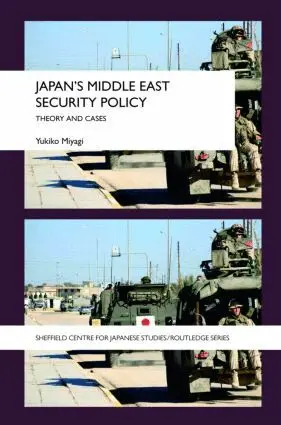
    Japan's Middle East Security Policy

    Theory and Cases

    AvYukiko Miyagi

    Inbunden, Engelska, 2008

    Del i serien University of Sheffield/Routledge Japanese Studies Series

    2 422 kr

    Beställningsvara. Skickas inom 10-15 vardagar. Fri frakt över 249 kr.

    Fler format och utgåvor

    Häftad

    723 kr

    E-bok

    855 kr

    E-bok

    858 kr

    Beskrivning

    This study examines how Japanese policy toward Middle East security issues is shaped by the need to both maintain Japan’s security alliance with the US and its oil relationship with states in the Middle East. Yukiko Miyagi introduces the historic roots of Japan’s policy, and then focuses on the major contemporary cases – the Iraq war, the Iranian nuclear crisis, and the Arab-Israeli conflict, to expose and explain how clashing interests and dilemmas were negotiated to arrive at policy outcomes.The author also sheds light on the utility of mainstream International Relations theories for understanding Japan’s behaviour. How do we understand the policy of a self-declared ‘anti-militarist’ state forced to operate in a realist world and for whom energy supplies are a matter of vital national security? This study shows how neither realism nor its rivals, such as constructivism, can wholly explain Japan’s behaviour and suggests a theoretical framework for doing so. Filling a major gap in our understanding of an increasingly important area of study Japan’s Middle East Security Policy is an essential read for those interested in Japan’s International Relations, Middle East politics, security studies and foreign policy.

    Produktinformation

    • Utgivningsdatum:2008-09-05
    • Mått:156 x 234 x 18 mm
    • Vikt:520 g
    • Format:Inbunden
    • Språk:Engelska
    • Serie:University of Sheffield/Routledge Japanese Studies Series
    • Antal sidor:224
    • Förlag:Taylor & Francis Ltd
    • ISBN:9780415458788

    Utforska kategorier

    • Politik och statsskick inom Samhälle och politik

    Mer om författaren

    Dr. Yukiko Miyagi is CASAW Fellow in Middle East Security in the School of Government and International Affairs, University of Durham, U.K.

    Recensioner i media

    "Yukiko Miyagi's volume fills a major gap in the literature on Japan's relations with the Middle East. This volume makes a major contribution in expanding our theoretical understanding of Japan's engagement of the region, by providing an integrated framework of analysis combining international systemic factors, US-Japan alliance considerations, and domestic norms and policy processes. It provides splendid and up-to-date empirical detail on Japan's reaction to security issues in the Middle East involving energy, nuclear and other security issues. This book is an essential read for scholars and students interested in Japan's ties with the Middle East and its emerging global security role."Dr Christopher W. Hughes, Reader (Associate Professor). University of Warwick, UK"This is the first work seriously undertaken on Japan's policy toward the Middle East. Miyagi's book is the best work ever in this field, showing how various patterns of Japan's policy are shaped in the condition when it is torn between the Middle East and the US, with deep theoretical analysis and rich empirical data. Her work contributes greatly to understand Japan-Middle East relations and opens a new frontier to study the Japanese foreign policy."Keiko SAKAI, Professor, Tokyo University of Foreign Studies, Japan"This book is a valuable addition to the study of Japanese foreign policy making. It offers comprehensive analyses of the shift in Japan's Middle East policy from the traditional pro-Arab attitude based on its energy-vulnerability to the proactive support to the United States with historical, theoretical and policy-process perspectives."Tomohito Shinoda, Professor of International Relations International University of Japan"Clearly and concisely written, this volume is an excellent example of a qualitative study integrating elements of diverse theories within a specific context to arrive at a richer understanding of practical policy making. Summing Up: Recommended. All readership levels." - CHOICE, Aug. 2009 Vol. 46 No. 11

    Innehållsförteckning

    • 1.Introduction: Aims, Debates and Theoretical Framework 2. Japan's Policy Towards Middle East Security Issues: An Overview 3. Policy Determinants and the Policy-making Process 4. The Iraq War 5. The Iranian Nuclear Crisis 6. Syria Under US Hostility 7. Conclusion: Findings and Implications