• Fri frakt över 249 kr
  • •
  • Snabba leveranser
  • •
  • Billiga böcker
Kundservice

Du är på sajten för privatpersoner.

Företag, bibliotek eller offentlig verksamhet?

Du handlar på classic.bokus.com, där alla dina funktioner finns intakta.
Till classic.bokus.com
Bokus logotyp. Gå till startsidan.
  • Erbjudanden
  • Nyheter
  • Student
  • Topplistor
  • Barn & ungdom
  • Bokus Play
  • E-böcker
  • Pocketböcker
  • Spel & pussel

10% rabatt på allt med kod: NYSTART10 →

Sidfot

Mina sidor

    Hjälp

    • Kundservice
    • Vanliga frågor och svar
    • Frakt och leverans
    • Retur vid ångerrätt
    • Reklamera vara
    • Betalning
    • Köpvillkor
    • Allmänna villkor
    • Information om webbplatsens tillgänglighet

    Om Bokus

    • Om oss
    • Pressrum
    • För studenter
    • För företag
    • För bibliotek och offentlig verksamhet
    • För leverantörer
    • Hållbarhet

    Populärt

    • Aktuella erbjudanden
    • Presentkort
    • Studentlitteratur
    • Nya böcker
    • Topplistor
    • Signerade böcker
    • Engelska böcker

    Inspiration

    • Boktips
    • BookTok
    • Populära bokserier
    • Barnbokskaraktärer
    • Populära författare
    Logotyp för Bokus
    Följ oss på Facebook (extern länk)Följ oss på Instagram (extern länk)Följ oss på YouTube (extern länk)Följ oss på TikTok (extern länk)
    bokus @ CookiesAnpassa cookiesIntegritetspolicyKöpvillkor
    Till Citymail hemsida (extern länk)Till Budbee hemsida (extern länk)Till Postnord hemsida (extern länk)Till Schenker hemsida (extern länk)Till Early Bird hemsida (extern länk)Till Walleys hemsida (extern länk)
    1. Naturvetenskap och teknik
    2. Matematik och naturvetenskap
    3. Fysik
    4. Tillämpad fysik

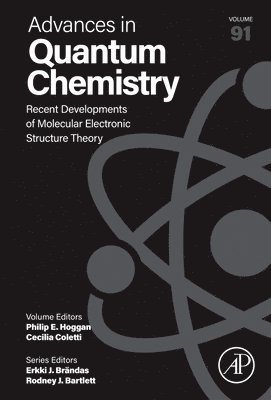
    Recent Developments of Molecular Electronic Structure Theory

    AvHoggan,Philip E

    Inbunden, Engelska, 2025

    Del 91 i serien Advances in Quantum Chemistry

    2 674 kr

    Beställningsvara. Skickas inom 10-15 vardagar. Fri frakt över 249 kr.

    Beskrivning

    New Insights into Molecular Electronic Structure Theory, Volume 91 in the Advances in Quantum Chemistry series, highlights new advances in the field, with this new volume presenting interesting chapters written by an international board of authors.

    • Provides the authority and expertise of leading contributors from an international board of authors
    • Presents the latest release in Advances in Quantum Chemistry series
    • Updated release includes the latest information on this timely topic

    Produktinformation

    • Utgivningsdatum:2025-07-28
    • Mått:152 x 229 x 21 mm
    • Vikt:720 g
    • Format:Inbunden
    • Språk:Engelska
    • Serie:Advances in Quantum Chemistry
    • Antal sidor:356
    • Förlag:Elsevier Science
    • ISBN:9780443343575

    Utforska kategorier

    • Tillämpad fysik inom Naturvetenskap och teknik
    • Fysikalisk kemi inom Naturvetenskap och teknik
    • Fysik inom Naturvetenskap och teknik

    Mer om författaren

    Born in Aberystwyth, Wales and educated at Trinity College Cambridge, Philip Hoggan has always been French and British. After a mathematical chemistry background, he has studied a number of theoretical systems, with a DSc by research obtained in 1991 at Nancy, France on the way physical interaction between molecules and solid surfaces is a precursor to catalysis. This was treated entirely on the basis of Quantum Mechanics and applied, first to cis-trans butadiene isomerization on alumina and then a number of ‘organic’ reactions. The first lectureship was at Caen, Normandy from 1992. This period led to some fundamental research of ab initio Slater electronic structure calculations for more than 3 atoms. The first related code STOP was published in February 1996 after much work by a postdoctoral fellow A. Bouferguène, now Professor at U Alberta. After continuing to study catalytic systems at Caen, from a theoretical viewpoint, Philip Hoggan was appointed to the Chair of Theoretical Chemistry in Clermont from May 1998. This is still essentially his teaching position, although research interests have switched to solid-state (surface) physics joining the Pascal Institute for physics in Clermont from 2005. This followed a visiting professor stay of 18 months at Tallahassee, Florida in Theoretical Physics. Research emphasis has shifted from the STOP era (where the problem was solved by Coulomb Resolution in 2008) to Quantum Monte Carlo (QMC). The CNRS paid leave for a couple of years for Philip Hoggan to learn about this technique from Cyrus Umrigar, Julien Toulouse, Michel Caffarel and others. Of course, it eventually led to a project to calculate catalytic reactions on metal surfaces that was initiated by G-J Kroes (Leiden, NL) and his ERC in 2014. K Doblhoff-Dier arrived in Clermont for a ground-breaking research fellowship and each of us continues to produce very accurate work e.g. on hydrogen (production and dissociation on metals), as a clean fuel for renewable energy. Now, in 2023 we enter the 400th anniversary of Blaise Pascal’s birth. He invented calculators, some of which are in the Clermont museum. It is wonderful to work in the institute that bears his name conducting QMC on catalytic hydrogen synthesis on super-calculators: the tools that trace their roots to his ‘Pascaline’. Philip Hoggan is married and has twin daughters.

    Innehållsförteckning

    • 1. Comprehensive Characterization of the Gemfibrozil Molecule: DFT UV NMR ELF Fukui Function Analysis Thermochemistry2. Multistate Density Functional Theory and Applications3. A first step towards the development of exchange-correlation functionals from X-ray diffraction data4. A complex Gaussian representation of continuum wavefunctions respectful of their asymptotic behaviour5. On the sign problem of Auxiliary-Field Quantum Monte Carlo (AFQMC)6. Intermolecular Interactions: Interplay of Quantum Chemistry and Machine Learning7. Towards a quantum treatment of DNA G-quadruplex: the FMO method elucidates interactions with alkali metal ions8. Enhancing the Computational Efficiency of the DoNOF Code with a New Orbital Sorting Scheme and Additional Improvements9. Spectrally accurate numerical quadrature formulas for periodic Hadamard Finite Part integrals10. Electron-nucleus cusps and jump discontinuities11. Holomorphic Hartree-Fock and Density Functional Theories as a basis for multireference electronic structure12. Analytical Evaluation of Hylleraas-CI Coulomb and Hybrid Two-Center Integrals over Slater Orbitals. II. Angular Integration13. Methods for Evaluating DFT Results to Identify Degenerate States in Organic Small Molecules14. Frozen-Density Embedding Theory based treatment of the charge-leak problem in multi-scale simulations15. Polynomial expression of molecular integrals with parameters of orbital exponent and atomic distance over STO16. Quantum Monte Carlo method for metal catalysis: best practices to obtain chemically accurate activation barriers