• Fri frakt över 249 kr
  • •
  • Snabba leveranser
  • •
  • Billiga böcker
Kundservice

Du är på sajten för privatpersoner.

Företag, bibliotek eller offentlig verksamhet?

Du handlar på classic.bokus.com, där alla dina funktioner finns intakta.
Till classic.bokus.com
Bokus logotyp. Gå till startsidan.
  • Erbjudanden
  • Nyheter
  • Student
  • Topplistor
  • Barn & ungdom
  • Bokus Play
  • E-böcker
  • Pocketböcker
  • Spel & pussel

10% rabatt på allt med kod: NYSTART10 →

Sidfot

Mina sidor

    Hjälp

    • Kundservice
    • Vanliga frågor och svar
    • Frakt och leverans
    • Retur vid ångerrätt
    • Reklamera vara
    • Betalning
    • Köpvillkor
    • Allmänna villkor
    • Information om webbplatsens tillgänglighet

    Om Bokus

    • Om oss
    • Pressrum
    • För studenter
    • För företag
    • För bibliotek och offentlig verksamhet
    • För leverantörer
    • Hållbarhet

    Populärt

    • Aktuella erbjudanden
    • Presentkort
    • Studentlitteratur
    • Nya böcker
    • Topplistor
    • Signerade böcker
    • Engelska böcker

    Inspiration

    • Boktips
    • BookTok
    • Populära bokserier
    • Barnbokskaraktärer
    • Populära författare
    Logotyp för Bokus
    Följ oss på Facebook (extern länk)Följ oss på Instagram (extern länk)Följ oss på YouTube (extern länk)Följ oss på TikTok (extern länk)
    bokus @ CookiesAnpassa cookiesIntegritetspolicyKöpvillkor
    Till Citymail hemsida (extern länk)Till Budbee hemsida (extern länk)Till Postnord hemsida (extern länk)Till Schenker hemsida (extern länk)Till Early Bird hemsida (extern länk)Till Walleys hemsida (extern länk)
    1. Naturvetenskap och teknik
    2. Matematik och naturvetenskap
    3. Fysik
    4. Tillämpad fysik

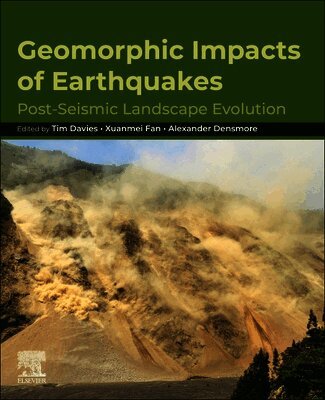
    Geomorphic Impacts of Earthquakes

    Post-Seismic Landscape Evolution

    AvTim Davies,Alexander Densmore

    Häftad, Engelska, 2026

    1 386 kr

    Kommande

    Beskrivning

    Geomorphic Impacts of Earthquakes: Post-Seismic Landscape Evolution summarizes the full range of landscape alterations that can result from large earthquakes, ranging from slope instability and river aggradation to prograded coastlines. The book underpins the consequences of major earthquakes, which are increasing as Earth’s population burgeons and climate and anthropogenic effects are ongoing. Although the damage to society that results directly from the shaking and ground rupture in large earthquakes is well known, the consequential effects of seismicity on the landscape causes earth surface deformations and hazards that are only now being fully understood.

    This book will help readers professionally engaged in the Earth sciences be better prepared to assess the full range of natural hazards that threaten particular locations, and to work out how to evaluate their contribution to societal risks.

    • Explicitly addresses the variety of processes and landforms resulting from the geomorphic cascade that is triggered by large earthquakes
    • Provides the reader with a basis of geomorphic process knowledge to underpin the ability to foresee the impacts of ground shaking and fault rupture on landscapes
    • Links seismo-geomorphic processes to hazards resulting from the impact of those processes to analyze the impacts of these processes on society

    Produktinformation

    • Utgivningsdatum:2026-09-01
    • Mått:191 x 235 x undefined mm
    • Vikt:450 g
    • Format:Häftad
    • Språk:Engelska
    • Antal sidor:506
    • Förlag:Elsevier Science
    • ISBN:9780443403750

    Utforska kategorier

    • Tillämpad fysik inom Naturvetenskap och teknik
    • Geologi inom Naturvetenskap och teknik
    • Geovetenskap inom Naturvetenskap och teknik

    Mer om författaren

    Tim Davies is a Professor in the School of Earth and Environment at the University of Canterbury (NZ). His research focusses on the application of geomorphology in prediction of landform response to disturbance, in particular in the context of natural hazard assessment and disaster impact reduction. Prof Alexander Densmore, Deputy Head of the Department of Geography at Durham University, UK, is a leading expert in the dynamic processes shaping Earth's surface. Raised on the tectonically active west coast of North America, his fascination with mountain-building and erosion has driven his academic pursuits. After earning a PhD from the University of California, Santa Cruz, he held prestigious positions at Trinity College Dublin and ETH Zurich before joining Durham University in 2006. Currently, his research delves into the aftermath of earthquakes on mass wasting and sediment transfer in Nepal and China. He also focuses on utilizing scientific data to mitigate earthquake and monsoon-induced hazards, particularly in Nepal. Furthermore, his work extends to comprehending sediment routing systems, employing both field studies in northern India and advanced numerical modeling techniques. Professor Densmore's multidisciplinary approach enriches our understanding of geological phenomena and their societal impacts.Prof. Xuanmei Fan, an esteemed expert in geological hazards and risk assessment, is currently affiliated with Chengdu University of Technology. With a background at the United Nations Institute for Training and Research (UNITAR) and as a Full Professor at the State Key Laboratory of Geohazard Prevention and Geoenvironment Protection in China, her research focuses on earthquake-induced geological hazards, particularly in the Tibetan Plateau. Notably, Prof. Fan's studies on the causes and effects of earthquake-induced landslides following the 2008 Wenchuan earthquake have been extensive. She has made significant contributions to the development of early warning systems for post-earthquake debris flows, resulting in numerous lives saved. Her exceptional achievements have garnered recognition, including the 2016 Richard Wolters Prize from the International Association for Engineering Geology and the Environment (IAEG). Prof. Xuanmei Fan's remarkable contributions to science and technology have earned her acclaim as one of China's top female geologists, receiving national and provincial prizes in honor of her accomplishments.

    Innehållsförteckning

    • Section A - Fundamentals1. Introduction: Tectonics, Earthquakes, and Landforms: The Big Picture2. Large Earthquakes – Spatio-Temporal Distribution and Aftershocks3. Coseismic Ground Motion4. Rock Fracture and Ground Failure5. Earth Surface Processes6. Seismotectonic-Geomorphic Event CascadesSection B – Tectonic Processes and Morphologies7. Fault Trace Processes8. Slope Failure Processes9. Coseismic Landslides and Rockfalls, Paraseismic Landslides, Source and Deposit Morphologies10. Liquefaction and lateral spreading11. Fluvial Responses to Fault Offset and Uplift, and to Sediment Inputs12. Glacial Processes and Impacts13. Coastal Processes and Impacts14. Marine Processes15. Post-Earthquake Sediment and Fluxes16. Geomorphic Indicators of Past Earthquakes17. Climate Change Influences on Earthquake Geomorphology18. Anthropic Influences on Earthquake GeomorphologySection C - Case Studies19. 1999 Chichi earthquake, Taiwan (remote sensing and analysis, and fluvial impacts)20. 2008 Wenchuan earthquake, China (remote sensing and analysis, post-seismic debris flows, and river aggradation)21. 2011 Tohoku earthquake (unexpected magnitude, geomorphic evidence of prior events, and tsunami)22. 2015 Gorka earthquake, Nepal (mass movements and societal impacts)23. 2016 Kaikoura earthquake (multiple fault ruptures, landslides and fluvial impacts)Section D – Conclusion24. Implications for Natural Hazard Risk Analysis, Risk Assessment, Impacts And Mitigation – Examples25. Summary and Future Perspectives