• Fri frakt över 249 kr
  • •
  • Snabba leveranser
  • •
  • Billiga böcker
Kundservice

Du är på sajten för privatpersoner.

Företag, bibliotek eller offentlig verksamhet?

Du handlar på classic.bokus.com, där alla dina funktioner finns intakta.
Till classic.bokus.com
Bokus logotyp. Gå till startsidan.
  • Erbjudanden
  • Student
  • Topplistor
  • Barn & ungdom
  • Bokus Play
  • E-böcker
  • Ljudböcker
  • Pocketböcker
  • Spel & pussel

10% rabatt på allt med kod NYSTART10 →

Sidfot

Mina sidor

    Hjälp

    • Kundservice
    • Vanliga frågor och svar
    • Frakt och leverans
    • Retur vid ångerrätt
    • Reklamera vara
    • Betalning
    • Köpvillkor
    • Allmänna villkor
    • Information om webbplatsens tillgänglighet

    Om Bokus

    • Om oss
    • Pressrum
    • För studenter
    • För företag
    • För bibliotek och offentlig verksamhet
    • För leverantörer
    • Hållbarhet

    Populärt

    • Aktuella erbjudanden
    • Presentkort
    • Studentlitteratur
    • Nya böcker
    • Topplistor
    • Signerade böcker
    • Engelska böcker

    Inspiration

    • Boktips
    • BookTok
    • Populära bokserier
    • Barnbokskaraktärer
    • Populära författare
    Logotyp för Bokus
    Följ oss på Facebook (extern länk)Följ oss på Instagram (extern länk)Följ oss på YouTube (extern länk)Följ oss på TikTok (extern länk)
    bokus @ CookiesAnpassa cookiesIntegritetspolicyKöpvillkor
    Till Citymail hemsida (extern länk)Till Budbee hemsida (extern länk)Till Postnord hemsida (extern länk)Till Schenker hemsida (extern länk)Till Early Bird hemsida (extern länk)Till Walleys hemsida (extern länk)
    1. Ekonomi och Ledarskap
    2. Företagsekonomi
    3. Redovisning och finansiering
    4. Finansiering

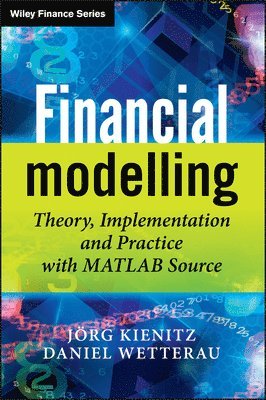
    Financial Modelling

    Theory, Implementation and Practice with MATLAB Source

    AvJoerg Kienitz,Daniel Wetterau

    Inbunden, Engelska, 2012

    Del i serien Wiley Finance Series

    1 081 kr

    Beställningsvara. Skickas inom 5-8 vardagar. Fri frakt över 249 kr.

    Beskrivning

    Financial modellingTheory, Implementation and Practice with MATLAB Source Jörg Kienitz and Daniel Wetterau Financial Modelling - Theory, Implementation and Practice with MATLAB Source is a unique combination of quantitative techniques, the application to financial problems and programming using Matlab. The book enables the reader to model, design and implement a wide range of financial models for derivatives pricing and asset allocation, providing practitioners with complete financial modelling workflow, from model choice, deriving prices and Greeks using (semi-) analytic and simulation techniques, and calibration even for exotic options. The book is split into three parts. The first part considers financial markets in general and looks at the complex models needed to handle observed structures, reviewing models based on diffusions including stochastic-local volatility models and (pure) jump processes. It shows the possible risk-neutral densities, implied volatility surfaces, option pricing and typical paths for a variety of models including SABR, Heston, Bates, Bates-Hull-White, Displaced-Heston, or stochastic volatility versions of Variance Gamma, respectively Normal Inverse Gaussian models and finally, multi-dimensional models. The stochastic-local-volatility Libor market model with time-dependent parameters is considered and as an application how to price and risk-manage CMS spread products is demonstrated. The second part of the book deals with numerical methods which enables the reader to use the models of the first part for pricing and risk management, covering methods based on direct integration and Fourier transforms, and detailing the implementation of the COS, CONV, Carr-Madan method or Fourier-Space-Time Stepping. This is applied to pricing of European, Bermudan and exotic options as well as the calculation of the Greeks. The Monte Carlo simulation technique is outlined and bridge sampling is discussed in a Gaussian setting and for Lévy processes. Computation of Greeks is covered using likelihood ratio methods and adjoint techniques. A chapter on state-of-the-art optimization algorithms rounds up the toolkit for applying advanced mathematical models to financial problems and the last chapter in this section of the book also serves as an introduction to model risk. The third part is devoted to the usage of Matlab, introducing the software package by describing the basic functions applied for financial engineering. The programming is approached from an object-oriented perspective with examples to propose a framework for calibration, hedging and the adjoint method for calculating Greeks in a Libor market model. Source code used for producing the results and analysing the models is provided on the author's dedicated website, http://www.mathworks.de/matlabcentral/fileexchange/authors/246981.

    Produktinformation

    • Utgivningsdatum:2012-09-21
    • Mått:175 x 252 x 46 mm
    • Vikt:1 383 g
    • Format:Inbunden
    • Språk:Engelska
    • Serie:Wiley Finance Series
    • Antal sidor:736
    • Förlag:John Wiley & Sons Inc
    • ISBN:9780470744895

    Utforska kategorier

    • Finansiering inom Ekonomi och Ledarskap

    Mer om författaren

    About the authors JÖRG KIENITZ is the head of Quantitative Analytics at Deutsche Postbank AG. He is primarily involved in developing and implementing models for pricing complex derivatives structures and for asset allocation. He also lectures at university level on advanced financial modelling and implementation including the University of Oxford's part-time Masters of Finance course. Jörg works as an independent consultant for model development and validation as well as giving seminars for finance professionals. He is a speaker at the major financial conferences including Global Derivatives, WBS Fixed Income and RISK. Jörg is a member of the editorial board of International Review of Applied Financial Issues and Economics and holds a Ph.D. in stochastic analysis from the University of Bielefeld. DANIEL WETTERAU is a specialist in the Quantitative Analytics team of Deutsche Postbank AG. He is responsible for the implementation of term structure models, advanced numerical methods, optimization algorithms and methods for advanced quantitative asset allocation. Further to his work he teaches finance courses for market professionals. Daniel received a Masters in financial mathematics from the University of Wuppertal and was awarded the Barmenia mathematics award for his thesis.

    Innehållsförteckning

    • Introduction 11 Introduction and Management Summary 12 Why We Have Written this Book 23 Why You Should Read this Book 34 The Audience 35 The Structure of this Book 46 What this Book Does Not Cover 57 Credits 68 Code 6Part I Financial Markets and Popular Models1 Financial Markets – Data, Basics and Derivatives 91.1 Introduction and Objectives 91.2 Financial Time-Series, Statistical Properties of Market Data and Invariants 101.2.1 Real World Distribution 151.3 Implied Volatility Surfaces and Volatility Dynamics 171.3.1 Is There More than just a Volatility? 191.3.2 Implied Volatility 221.3.3 Time-Dependent Volatility 221.3.4 Stochastic Volatility 231.3.5 Volatility from Jumps 231.3.6 Traders’ Rule of Thumb 241.3.7 The Risk Neutral Density 241.4 Applications 261.4.1 Asset Allocation 261.4.2 Pricing, Hedging and Risk Management 271.5 General Remarks on Notation 301.6 Summary and Conclusions 311.7 Appendix – Quotes 322 Diffusion Models 352.1 Introduction and Objectives 352.2 Local Volatility Models 352.2.1 The Bachelier and the Black–Scholes Model 372.2.2 The Hull–White Model 402.2.3 The Constant Elasticity of Variance Model 462.2.4 The Displaced Diffusion Model 502.2.5 CEV and DD Models 532.3 Stochastic Volatility Models 542.3.1 Pricing European Options 552.3.2 Risk Neutral Density 562.3.3 The Heston Model (and Extensions) 572.3.4 The SABR Model 672.3.5 SABR – Further Remarks 732.4 Stochastic Volatility and Stochastic Rates Models 812.4.1 The Heston–Hull–White Model 812.5 Summary and Conclusions 903 Models with Jumps 933.1 Introduction and Objectives 933.2 Poisson Processes and Jump Diffusions 943.2.1 Poisson Processes 943.2.2 The Merton Model 953.2.3 The Bates Model 993.2.4 The Bates–Hull–White Model 1043.3 Exponential L´evy Models 1053.3.1 The Variance Gamma Model 1073.3.2 The Normal Inverse Gaussian Model 1123.4 Other Models 1183.4.1 Exponential L´evy Models with Stochastic Volatility 1223.4.2 Stochastic Clocks 1223.5 Martingale Correction 1293.6 Summary and Conclusions 1344 Multi-Dimensional Models 1374.1 Introduction and Objectives 1374.2 Multi-Dimensional Diffusions 1374.2.1 GBM Baskets 1374.2.2 Libor Market Models 1394.3 Multi-Dimensional Heston and SABR Models 1414.3.1 Stochastic Volatility Models 1414.4 Parameter Averaging 1434.4.1 Applications to CMS Spread Options 1444.5 Markovian Projection 1594.5.1 Baskets with Local Volatility 1624.5.2 Markovian Projection on Local Volatility and Heston Models 1624.5.3 Markovian Projection onto DD SABR Models 1644.6 Copulae 1724.6.1 Measures of Concordance and Dependency 1744.6.2 Examples 1754.6.3 Elliptical Copulae 1754.6.4 Archimedean Copulae 1774.6.5 Building New Copulae from Given Copulae 1794.6.6 Asymmetric Copulae 1794.6.7 Applying Copulae to Option Pricing 1804.6.8 Applying Copulae to Asset Allocation 1804.7 Multi-Dimensional Variance Gamma Processes 1874.8 Summary and Conclusions 193Part II Numerical Methods and Recipes5 Option Pricing by Transform Techniques and Direct Integration 1975.1 Introduction and Objectives 1975.2 Fourier Transform 1975.2.1 Discrete Fourier Transform 1995.2.2 Fast Fourier Transform 2005.3 The Carr–Madan Method 2025.3.1 The Optimal α 2075.4 The Lewis Method 2105.4.1 Application to Other Payoffs 2145.5 The Attari Method 2155.6 The Convolution Method 2165.7 The Cosine Method 2205.8 Comparison, Stability and Performance 2285.8.1 Other Issues 2335.9 Extending the Methods to Forward Start Options 2355.9.1 Forward Characteristic Function for L´evy Processes and CIR Time Change 2385.9.2 Forward Characteristic Function for L´evy Processes and Gamma-OU Time Change 2395.9.3 Results 2425.10 Density Recovery 2455.11 Summary and Conclusions 2506 Advanced Topics Using Transform Techniques 2536.1 Introduction and Objectives 2536.2 Pricing Non-Standard Vanilla Options 2536.2.1 FFT with Lewis Method 2546.3 Bermudan and American Options 2546.3.1 The Convolution Method 2576.3.2 The Cosine Method 2586.3.3 Numerical Results 2666.3.4 The Fourier Space Time-Stepping 2706.4 The Cosine Method and Barrier Options 2776.5 Greeks 2786.6 Summary and Conclusions 2877 Monte Carlo Simulation and Applications 2897.1 Introduction and Objectives 2897.2 Sampling Diffusion Processes 2897.2.1 The Exact Scheme 2907.2.2 The Euler Scheme 2907.2.3 The Predictor-Corrector Scheme 2907.2.4 The Milstein Scheme 2917.2.5 Implementation and Results 2917.3 Special Purpose Schemes 2927.3.1 Schemes for the Heston Model 2947.3.2 Unbiased Scheme for the SABR Model 3007.4 Adding Jumps 3137.4.1 Jump Models – Poisson Processes 3137.4.2 Fixed Grid Sampling (FGS) 3157.4.3 Stochastic Grid Sampling (SGS) 3157.4.4 Simulation – L´evy Models 3227.4.5 Schemes for L´evy Models with Stochastic Volatility 3307.5 Bridge Sampling 3397.6 Libor Market Model 3467.7 Multi-Dimensional L´evy Models 3517.8 Copulae 3527.8.1 Distributional Sampling Approach (DSA) 3537.8.2 Conditional Sampling Approach (CSA) 3567.8.3 Simulation from Other Copulae 3587.9 Summary and Conclusions 3598 Monte Carlo Simulation – Advanced Issues 3618.1 Introduction and Objectives 3618.2 Monte Carlo and Early Exercise 3618.2.1 Longstaff–Schwarz Regression 3628.2.2 Policy Iteration Methods 3698.2.3 Upper Bounds 3748.2.4 Problems of the Method 3768.2.5 Financial Examples and Numerical Results 3788.3 Greeks with Monte Carlo 3828.3.1 The Finite Difference Method (FDM) 3838.3.2 The Pathwise Method 3858.3.3 The Affine Recursion Problem (ARP) 3898.3.4 Adjoint Method 3918.3.5 Bermudan ARPs 3938.4 Euler Schemes and General Greeks 3968.4.1 SDE of Diffusions 3968.4.2 Approximation by Euler Schemes 3978.4.3 Approximating General Greeks Using ARP 3978.4.4 Greeks 4048.5 Application to Trigger Swap 4078.5.1 Mathematical Modelling 4088.5.2 Numerical Results 4108.5.3 The Likelihood Ratio Method (LRM) 4138.5.4 Likelihood Ratio for Finite Differences – Proxy Simulation 4168.5.5 Numerical Results 4198.6 Summary and Conclusions 4338.7 Appendix – Trees 4349 Calibration and Optimization 4359.1 Introduction and Objectives 4359.2 The Nelder–Mead Method 4379.2.1 Implementation 4429.2.2 Calibration Examples 4449.3 The Levenberg–Marquardt Method 4499.3.1 Implementation 4539.3.2 Calibration Examples 4559.4 The L-BFGS Method 4609.4.1 Implementation 4639.4.2 Calibration Examples 4649.5 The SQP Method 4689.5.1 The Modified and Globally Convergent SQP Iteration 4739.5.2 Implementation 4759.5.3 Calibration Examples 4779.6 Differential Evolution 4829.6.1 Implementation 4879.6.2 Calibration Examples 4889.7 Simulated Annealing 4939.7.1 Implementation 4979.7.2 Calibration Examples 5009.8 Summary and Conclusions 50510 Model Risk – Calibration, Pricing and Hedging 50710.1 Introduction and Objectives 50710.2 Calibration 50810.2.1 Similarities – Heston and Bates Models 50810.2.2 Parameter Stability 51110.3 Pricing Exotic Options 52110.3.1 Exotic Options and Different Models 52810.4 Hedging 52810.4.1 Hedging – The Basics 53110.4.2 Hedging in Incomplete Markets 53310.4.3 Discrete Time Hedging 54110.4.4 Numerical Examples 54410.5 Summary and Conclusions 550Part III Implementation, Software Design and Mathematics11 Matlab – Basics 55311.1 Introduction and Objectives 55311.2 General Remarks 55311.3 Matrices, Vectors and Cell Arrays 55611.3.1 Matrices and Vectors 55611.3.2 Cell Arrays 56211.4 Functions and Function Handles 56411.4.1 Functions 56411.4.2 Function Handles 56711.5 Toolboxes 57011.5.1 Financial 57011.5.2 Financial Derivatives 57111.5.3 Fixed-Income 57111.5.4 Optimization 57311.5.5 Global Optimization 57711.5.6 Statistics 57811.5.7 Portfolio Optimization 58111.6 Useful Functions and Methods 58911.6.1 FFT 58911.6.2 Solving Equations and ODE 58911.6.3 Useful Functions 59111.7 Plotting 59311.7.1 Two-Dimensional Plots 59311.7.2 Three-Dimensional Plots – Surfaces 59511.8 Summary and Conclusions 59712 Matlab – Object Oriented Development 59912.1 Introduction and Objectives 59912.2 The Matlab OO Model 59912.2.1 Classes 59912.2.2 Handling Classes in Matlab 60612.2.3 Inheritance, Base Classes and Superclasses 60712.2.4 Handle and Value Classes 60912.2.5 Overloading 61012.3 A Model Class Hierarchy 61112.4 A Pricer Class Hierarchy 61312.5 An Optimizer Class Hierarchy 61812.6 Design Patterns 62012.6.1 The Builder Pattern 62112.6.2 The Visitor Pattern 62412.6.3 The Strategy Pattern 62612.7 Example – Calibration Engine 62912.7.1 Calibrating a Data Set or a History 63112.8 Example – The Libor Market Model and Greeks 63412.8.1 An Abstract Class for LMM Derivatives 63412.8.2 A Class for Bermudan Swaptions 63712.8.3 A Class for Trigger Swaps 63912.9 Summary and Conclusions 64113 Math Fundamentals 64313.1 Introduction and Objectives 64313.2 Probability Theory and Stochastic Processes 64313.2.1 Probability Spaces 64413.2.2 Random Variables 64413.2.3 Important Results 64513.2.4 Distributions 64913.2.5 Stochastic Processes 65413.2.6 L´evy Processes 65513.2.7 Stochastic Differential Equations 66013.3 Numerical Methods for Stochastic Processes 66513.3.1 Random Number Generation 66513.3.2 Methods for Computing Variates 67013.4 Basics on Complex Analysis 67113.4.1 Complex Numbers 67113.4.2 Complex Differentiation and Integration along Paths 67213.4.3 The Complex Exponential and Logarithm 67313.4.4 The Residual Theorem 67413.5 The Characteristic Function and Fourier Transform 67513.6 Summary and Conclusions 679List of Figures 681List of Tables 691Bibliography 695Index 705