• Fri frakt över 249 kr
  • •
  • Snabba leveranser
  • •
  • Billiga böcker
Kundservice

Du är på sajten för privatpersoner.

Företag, bibliotek eller offentlig verksamhet?

Du handlar på classic.bokus.com, där alla dina funktioner finns intakta.
Till classic.bokus.com
Bokus logotyp. Gå till startsidan.
  • Erbjudanden
  • Nyheter
  • Student
  • Topplistor
  • Barn & ungdom
  • Bokus Play
  • E-böcker
  • Pocketböcker
  • Spel & pussel

10% rabatt på allt med kod NYSTART10 →

Sidfot

Mina sidor

    Hjälp

    • Kundservice
    • Vanliga frågor och svar
    • Frakt och leverans
    • Retur vid ångerrätt
    • Reklamera vara
    • Betalning
    • Köpvillkor
    • Allmänna villkor
    • Information om webbplatsens tillgänglighet

    Om Bokus

    • Om oss
    • Pressrum
    • För studenter
    • För företag
    • För bibliotek och offentlig verksamhet
    • För leverantörer
    • Hållbarhet

    Populärt

    • Aktuella erbjudanden
    • Presentkort
    • Studentlitteratur
    • Nya böcker
    • Topplistor
    • Signerade böcker
    • Engelska böcker

    Inspiration

    • Boktips
    • BookTok
    • Populära bokserier
    • Barnbokskaraktärer
    • Populära författare
    Logotyp för Bokus
    Följ oss på Facebook (extern länk)Följ oss på Instagram (extern länk)Följ oss på YouTube (extern länk)Följ oss på TikTok (extern länk)
    bokus @ CookiesAnpassa cookiesIntegritetspolicyKöpvillkor
    Till Citymail hemsida (extern länk)Till Budbee hemsida (extern länk)Till Postnord hemsida (extern länk)Till Schenker hemsida (extern länk)Till Early Bird hemsida (extern länk)Till Walleys hemsida (extern länk)
    1. Data och IT
    2. Nätverk och kommunikation

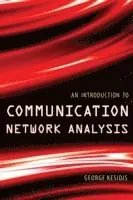
    Introduction to Communication Network Analysis

    AvGeorge Kesidis

    Inbunden, Engelska, 2007

    Del i serien IEEE Press

    1 394 kr

    Beställningsvara. Skickas inom 5-8 vardagar. Fri frakt över 249 kr.

    Fler format och utgåvor

    E-bok

    1 560 kr

    Beskrivning

    A self-contained text on modeling and performance evaluation of communication networks This quantitative book focuses on the real issues behind modeling and analysis of communication networks. The author covers a wide variety of topical networking subject matter based on the provided background material in probability, Markov chains, and queues. Leveraging this material, the author explores topics in local multiplexing and routing over three successive chapters, stressing both continuous-time and discrete-time contexts. The remaining chapters focus more directly on networking, such as traffic shaping and multiplexing, static routing, dynamic routing, and peer-to-peer file sharing systems. Providing more rigorous and technically deep coverage than most commonly used networking textbooks, An Introduction to Communication Network Analysis covers classical (e.g., queuing theory) and modern (e.g., pricing) aspects of networking in a clear, accessible manner. Chapters include:* Review of Elementary Probability Theory* Markov Chains* Introduction to Queuing Theory* Local Multiplexing* Queuing Networks with Static Routing* Dynamic Routing with Incentives* Peer-to-Peer File Sharing with Incentives Appendices include additional background information, solutions, and references for selected problems, making this an invaluable text for graduate-level students and networking researchers alike.

    Produktinformation

    • Utgivningsdatum:2007-08-31
    • Mått:183 x 260 x 17 mm
    • Vikt:581 g
    • Format:Inbunden
    • Språk:Engelska
    • Serie:IEEE Press
    • Antal sidor:248
    • Förlag:John Wiley & Sons Inc
    • ISBN:9780471371410

    Utforska kategorier

    • Nätverk och kommunikation inom Data och IT

    Mer om författaren

    George Kesidis, PhD, is a Professor at the Pennsylvania State University. He is a senior member of the IEEE and TCP co-chair of INFOCOM 2007.

    Recensioner i media

    "This book provides valuable information on the application of analytical techniques to model communication networks." (Computing Reviews, February 29, 2008)

    Innehållsförteckning

    • Preface. 1. Review of Elementary Probability Theory. 1.1 Sample space, events and probabilities. 1.2 Random variables. 1.3 Cumulative distribution functions, expectation and moment generating functions. 1.4 Discretely distributed random variables. 1.5 Continuously distributed random variables. 1.6 Some useful inequalities. 1.7 Joint distribution functions. 1.8 Conditional expectation. 1.9 Independent random variables. 1.10 Conditional independence. 1.11 A law of large numbers. 1.12 First order autoregressive estimators. 1.13 Measures of separation between distributions. 1.14 Statistical confidence. 1.15 Deciding between two alternative claims. Problems. 2. Markov Chains. 2.1 Memoryless property of the exponential distribution. 2.2 Finite dimensional distributions and stationarity. 2.3 The Poisson (counting) process on R+. 2.4 Continuous-time, time-homogeneous, Markov processes with countable. state-space. Markov chain. 2.5 Birth-death Markov chains. 2.6 Modeling time-series data using a Markov chain. 2.7 Simulating a Markov chain. 2.8 Overview of discrete-time Markov chains. 2.9 Martingales adapted to discrete-time Markov chains. Problems. 3. Introduction to Queueing Theory. 3.1 Arrivals, departures and queue occupancy. 3.2 Lossless queues. 3.3 A queue described by an underlying Markov chain. 3.4 Stationary queues. 3.5 Erlang's blocking formula for the M/M/K/K queue. 3.6 Overview of discrete-time queues. Problems. 4. Local Multiplexing. 4.1 Internet router architecture. 4.2 Token (leaky) buckets for packet-traffic regulation. 4.3 Multiplexing flows of variable-length packets. 4.4 Service curves. 4.5 Connection multiplexing on a single trunk. 4.6 A game-theoretic framework for multiplexing packet flows. 4.7 Discussion: local medium access control of a single wireless channel. Problems. 5. Queueing networks with static routing. 5.1 Loss Networks. 5.2 Stable open networks of queues. Problems. 6. Dynamic Routing and Routing with Incentives. 6.1 General routing issues. 6.2 Unconstrained optimization. 6.3 Revenue maximization for loss networks. 6.4 Constrained optimization and duality. 6.5 A distributed pricing and resource management framework. 6.6 Discussion: joint scheduling and routing in multihop wireless networks. 6.7 Multipath load balancing. Problems. 7. Peer-to-Peer File Sharing with Incentives. 7.1 Summary of query resolution. 7.2 Unstructured query resolution. forwarding. 7.3 Structured query resolution. 7.4 Discussion: security issues. 7.5 Incentives for cooperation when downloading. Problems. References. Appendix A: Additional Background on Routing. A.1 Network graph terminology. A.2 Link-state algorithms. A.3 The Bellman-Ford approach. Appendix B: Solutions or References for Selected Problems. References.