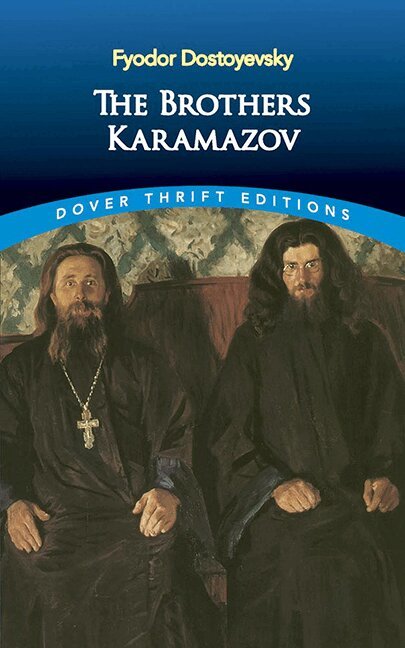
Brothers Karamazov
146 kr
Beställningsvara. Skickas inom 5-8 vardagar. Fri frakt över 249 kr.
Fler format och utgåvor
Beskrivning
Produktinformation
- Utgivningsdatum:2005-08-26
- Mått:135 x 210 x 45 mm
- Vikt:520 g
- Format:Häftad
- Språk:Engelska
- Serie:Dover Thrift Editions
- Antal sidor:736
- Förlag:Dover Publications Inc.
- ISBN:9780486437910
- Översättare:Constance Garnett
Utforska kategorier
Mer om författaren
The brilliant Russian novelist Fyodor Dostoyevsky (1821-81) is celebrated for such classics as Crime and Punishment and The Brothers Karamazov whose psychological examinations of the human soul had a profound effect on the 20th-century novel. His influence resonates in the works of such latter-day authors as Proust, Faulkner, Hemingway, and Kafka. Dostoyevsky also wrote many shorter works that are masterpieces in their own right.
Innehållsförteckning
- Part OneBook I: The History of a Family1. Fyodor Pavlovich Karamazov2. He Gets Rid of His Eldest Son3. The Second Marriage and the Second Family4. The third Son, Alyosha5. EldersBook II: An Unfortunate Gathering1. They Arrive at the Monastery2. The Old Buffoon3. Peasant Women Who Have Faith4. A Lady of Little Faith5. So Be It! So Be It!6. Why Is Such a Man Alive?7. A Young Man Bent on a Career8. The Scandalous SceneBook III: The Sensualists1. In the Servants' Quarters2. Lizaveta3. The Confession of a Passionate Heart--in Verse4. The Confession of a Passionate Heart--in Anecdote5. The Confession of a Passionate Heart--"Heels Up"6. Smerdyakov7. The Controversy8. Over the Brandy9. The Sensualists10. Both Together11. Another Reputation RuinedPart TwoBook IV: Lacerations1. Father Ferapont2. At His Father's3. A Meeting with the Schoolboys4. At the Hohlakovs'5. A Laceration in the Drawing Room6. A Laceration in the Cottage7. And in the Open AirBook V: Pro and Contra1. The Engagement2. Smerdyakov with a Guitar3. The Brothers Make Friends4. Rebellion5. The Grand Inquisitor6. For a While a Very Obscure One7. "It's Always Worth While Speaking to a Clever Man"Book VI: The Russian Monk1. Father Zosima and His Visitors2. Notes of the Life of the Deceased Priest and Monk, the Elder Zosima, Taken from His Own Words by Alexey Fyodorovich Karamazov3. Conversations and Exhortations of Father ZosimaPart ThreeBook VII: Alyosha1. The Breath of Corruption2. A Critical Moment3. An Onion4. Cana of GalileeBook VIII: Mitya1. Kuzma Samsonov2. Lyagavy3. Gold Mines4. In the Dark5. A Sudden Resolution6. "I Am Coming, Too!"7. The First and Rightful Lover8. DeliriumBook IX: The Preliminary Investigation1. The Beginning of Perhotin's Official Career2. The Alarm3. The Sufferings of a Soul. The First Ordeal4. The Second Ordeal5. The Third Ordeal6. The Prosecutor Catches Mitya7. Mitya's Great Secret. Received with Hisses8. The Evidence of the Witnesses. The Babe9. They Carry Mitya AwayPart FourBook X: The Boys1. Kolya Krasotkin2. Children3. The Schoolboy4. The Lost Dog5. By Ilyusha's Bedside6. Precocity7. IlyushaBook XI: Ivan1. At Grushenka's2. The Injured Foot3. A Little Demon4. A Hymn and a Secret5. Not You, Not You!6. The First Interview with Smerdyakov7. The Second Visit to Smerdyakov8. The Third and Last Interview with Smerdyakov9. The Devil. Ivan's Nightmare10. "It Was He who Said That"Book XII: A Judicial Error1. The Fatal Day2. Dangerous Witnesses3. The Medical Experts and a Pound of Nuts4. Fortune Smiles on Mitya5. A Sudden Catastrophe6. The Prosecutor's Speech. Sketches of Character7. A Historical Survey8. A Treatise on Smerdyakov9. The Galloping Troika. The End of the Prosecutor's Speech10. The Speech for the Defense. An Argument That Cuts Both Ways11. There Was No Money. There Was No Robbery12. And There Was No Murder Either13. A Corrupter of Thought14. The Peasants Stand FirmEpilogue1. Plans for Mitya's Escape2. For a Moment the Lie Becomes Truth3. Ilyusha's Funeral. The Speech at the Stone
Betyg & recensioner
5/5
Betyg & recensioner
- 5/5
Dostoyevskian talkative tirades
As a late teenager I read all the novels and short stories by Dostoyevskij, some of them I've re-read several times, especially "Crime and Punishment" and "Notes from the Underground", but now 40 years later I re-read The Brothers Karamazov once again. It seems that I've forgotten the novel was overfilled with incredibly talkative characters. Some are buffoons, as the father, others are hysterical, bi-polar and hyperactive as Dmitri, still others, if not all..., are half-psychopaths or fulltime psychopaths keeping themselves out of sight and concealed behind the scenes in one way or another. Even the goodhearted personages, as the elder monk Zosima and the youngest brother Alosha, are illustrated with their human shortcomings. Some of the characters are overmuch demanding and ruthlessly calculating their own becoming benefits, others are portrayed as simpleminded, stupid, or naïve. The gallery of characters is fascinating, extremely amusing, and really hilarious. The narrative has no short oneliners whatsoever, instead, the never-ending pretentious and mansplaining monologues (hidden as dialogues as narratives within a narrative) could eventually be summarized as boring - as they all talk a whole lot of shit - but in some peculiar way Dostoyevskij is making art, psychology and philosophy out of all this existential personal nonsense, vendettas, and their often perverted and distorted motifs. Perhaps the way of talking is cultural and mirrors the 19th century of Russia, but if one occasionally has to meet one or two of these talkative crazy characters in real life, it would be hard to take it, and hard to really listen to all bullshit. But on the contrary, the Dostoyevskian talkative tirades are a philosophical master piece of art, as a noticeably short example, is when the wise elder monk, Zosima told Fyodor Pavlovich Karamazov, the brother's father, (who is really mad and dangerous): "The man who lies to himself and listens to his own lie comes to such a pass that he cannot distinguish the truth within him, or around him, and so loses all respect for himself and for others. And having no respect he ceases to love, and in order to occupy and distract himself without love he gives way to passions and course pleasures, and sinks to bestiality in his vices, all from continual lying to other men and to himself. The man who lies to himself can be more easily offended than anyone. You know it is sometimes very pleasant to take offense, isn't it? A man may know that nobody has insulted him, but that he has invented the insult for himself, has lied and exaggerated to make it picturesque, has caught at a word and made a mountain out of a molehill - he knows that himself, yet he will be the first to take offense, and will revel in his resentment till he feels great pleasure in it, an so pass to genuine vindictiveness." (p.36 in the Dover edition)."
Barry
Mer från samma författare
Notes from Underground, White Nights, The Dream of a Ridiculous Man and House of the Dead
Fyodor Dostoyevsky
Häftad, 2004
99 kr
Demons
Fyodor Dostoyevsky, Ronald Meyer
Häftad, 2008
169 kr
Crime and Punishment
Fyodor Dostoyevsky
Inbunden, 2018
299 kr
Mer från samma serie
Beyond Good and Evil
Friedrich Nietzsche
Häftad, 2000
65 kr
Overcoat and Other Short Stories
Nikolai Gogol
Häftad, 2000
83 kr
Theory of the Leisure Class
Thorstein Veblen
Häftad, 2000
88 kr