• Fri frakt över 249 kr
  • •
  • Snabba leveranser
  • •
  • Billiga böcker
Kundservice

Du är på sajten för privatpersoner.

Företag, bibliotek eller offentlig verksamhet?

Du handlar på classic.bokus.com, där alla dina funktioner finns intakta.
Till classic.bokus.com
Bokus logotyp. Gå till startsidan.
  • Erbjudanden
  • Nyheter
  • Student
  • Topplistor
  • Barn & ungdom
  • Bokus Play
  • E-böcker
  • Pocketböcker
  • Spel & pussel

10% rabatt på allt med kod NYSTART10 →

Sidfot

Mina sidor

    Hjälp

    • Kundservice
    • Vanliga frågor och svar
    • Frakt och leverans
    • Retur vid ångerrätt
    • Reklamera vara
    • Betalning
    • Köpvillkor
    • Allmänna villkor
    • Information om webbplatsens tillgänglighet

    Om Bokus

    • Om oss
    • Pressrum
    • För studenter
    • För företag
    • För bibliotek och offentlig verksamhet
    • För leverantörer
    • Hållbarhet

    Populärt

    • Aktuella erbjudanden
    • Presentkort
    • Studentlitteratur
    • Nya böcker
    • Topplistor
    • Signerade böcker
    • Engelska böcker

    Inspiration

    • Boktips
    • BookTok
    • Populära bokserier
    • Barnbokskaraktärer
    • Populära författare
    Logotyp för Bokus
    Följ oss på Facebook (extern länk)Följ oss på Instagram (extern länk)Följ oss på YouTube (extern länk)Följ oss på TikTok (extern länk)
    bokus @ CookiesAnpassa cookiesIntegritetspolicyKöpvillkor
    Till Citymail hemsida (extern länk)Till Budbee hemsida (extern länk)Till Postnord hemsida (extern länk)Till Schenker hemsida (extern länk)Till Early Bird hemsida (extern länk)Till Walleys hemsida (extern länk)
    1. Samhälle och politik
    2. Politik och statsskick

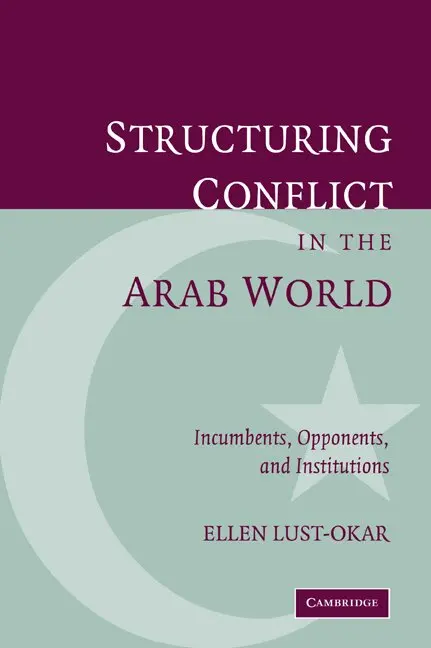
    Structuring Conflict in the Arab World

    Incumbents, Opponents, and Institutions

    AvEllen Lust-Okar

    Häftad, Engelska, 2007

    463 kr

    Beställningsvara. Skickas inom 10-15 vardagar. Fri frakt över 249 kr.

    Fler format och utgåvor

    Inbunden

    1 214 kr

    Beskrivning

    This book examines how ruling elites manage and manipulate their political opposition in the Middle East. In contrast to discussions of government-opposition relations that focus on how rulers either punish or co-opt opponents, this book focuses on the effect of institutional rules governing the opposition. It argues rules determining who is and is not allowed to participate in the formal political arena affect not only the relationships between opponents and the state, but also between various opposition groups. This affects the dynamics of opposition during prolonged economic crises. It also shapes the informal strategies that ruling elites use toward opponents. The argument is presented using a formal model of government-opposition relations. It is demonstrated in the cases of Egypt under Presidents Nasir, Sadat and Mubarek; Jordan under King Husayn; and Morocco under King Hasan II.

    Produktinformation

    • Utgivningsdatum:2007-01-25
    • Mått:151 x 229 x 17 mm
    • Vikt:448 g
    • Format:Häftad
    • Språk:Engelska
    • Antal sidor:296
    • Förlag:Cambridge University Press
    • ISBN:9780521032865

    Utforska kategorier

    • Politik och statsskick inom Samhälle och politik

    Mer om författaren

    Ellen Lust-Okar is an assistant professor in the Department of Political Science at Yale University. She received her M.A. in Middle Eastern Studies and her Ph.D. in Political Science from the University of Michigan. She has studied and conducted research in Jordan, Morocco, Israel, Palestine and Syria, and her work examining the relationships between states and oppositions has appeared in Comparative Politics, Comparative Political Studies, International Journal of Middle East Studies, Middle Eastern Studies and other volumes. She is currently working on a second manuscript, Linking Domestic and International Conflict: The Case of Middle East Rivalries, with Paul Huth at the University of Michigan.

    Recensioner i media

    'For more than a decade, observers have been puzzled by the failure of the opposition in the Arab world to take advantage of timid regime liberalizations to push harder for genuine democratic reform. Now we have the answer. In this remarkable - indeed, almost unique - marriage of thorough field research in the Arab world and rigorous formal modelling, Lust-Okar explains how regimes write rules that discourage opposition groups from mobilization, even when they have the resources to do so. This book is an all too-rare treat, a work that deploys real science to illuminate real politics.' Lisa Anderson, Columbia University

    Innehållsförteckning

    • List of figures and tables; Acknowledgments; A note on the use of language; Abbreviations; Introduction; 1. The manipulation of political opposition; 2. Structures of contestation; 3. Playing by the rules: the inclusion and exclusion of political oppositions; 4. Dynamics of opposition in unified SoCs; 5. Opposition dynamics in divided SoCs; 6. Formal SoCs and informal political manipulation; Conclusion; Appendix: political forces in Egypt, Jordan and Morocco; Notes; Bibliography; Index.