• Fri frakt över 249 kr
  • •
  • Snabba leveranser
  • •
  • Billiga böcker
Kundservice

Du är på sajten för privatpersoner.

Företag, bibliotek eller offentlig verksamhet?

Du handlar på classic.bokus.com, där alla dina funktioner finns intakta.
Till classic.bokus.com
Bokus logotyp. Gå till startsidan.
  • Erbjudanden
  • Nyheter
  • Student
  • Topplistor
  • Barn & ungdom
  • Bokus Play
  • E-böcker
  • Pocketböcker
  • Spel & pussel

10% rabatt på allt med kod: NYSTART10 →

Sidfot

Mina sidor

    Hjälp

    • Kundservice
    • Vanliga frågor och svar
    • Frakt och leverans
    • Retur vid ångerrätt
    • Reklamera vara
    • Betalning
    • Köpvillkor
    • Allmänna villkor
    • Information om webbplatsens tillgänglighet

    Om Bokus

    • Om oss
    • Pressrum
    • För studenter
    • För företag
    • För bibliotek och offentlig verksamhet
    • För leverantörer
    • Hållbarhet

    Populärt

    • Aktuella erbjudanden
    • Presentkort
    • Studentlitteratur
    • Nya böcker
    • Topplistor
    • Signerade böcker
    • Engelska böcker

    Inspiration

    • Boktips
    • BookTok
    • Populära bokserier
    • Barnbokskaraktärer
    • Populära författare
    Logotyp för Bokus
    Följ oss på Facebook (extern länk)Följ oss på Instagram (extern länk)Följ oss på YouTube (extern länk)Följ oss på TikTok (extern länk)
    bokus @ CookiesAnpassa cookiesIntegritetspolicyKöpvillkor
    Till Citymail hemsida (extern länk)Till Budbee hemsida (extern länk)Till Postnord hemsida (extern länk)Till Schenker hemsida (extern länk)Till Early Bird hemsida (extern länk)Till Walleys hemsida (extern länk)
    1. Naturvetenskap och teknik
    2. Teknik och industri
    3. Agronomi och lantbruk

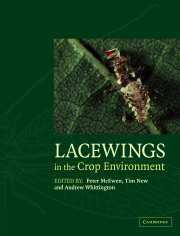
    Lacewings in the Crop Environment

    AvP. K. McEwen,T. R. New

    Häftad, Engelska, 2007

    812 kr

    Beställningsvara. Skickas inom 10-15 vardagar. Fri frakt över 249 kr.

    Beskrivning

    Lacewings are predatory insects which attack and kill large numbers of insect pests. Lacewings in the Crop Environment addresses both the theoretical and practical aspects of lacewing biology and their use in crop protection. The book opens with a section on lacewing systematics and ecology. Next, lacewings as predators in a wide variety of commercially important crops are reviewed and this is followed by a section on the principles of using lacewings in pest control. The possible impact of genetically modified crops on lacewing populations is also discussed. Finally, a fascinating array of case studies of lacewing use in many crops from around the world is presented, and future uses of lacewings speculated upon. Lacewings in the Crop Environment is an essential reference work and practical handbook for students, researchers of biological control, integrated pest management and agricultural science, and for field workers using lacewings in pest management programmes worldwide.

    Produktinformation

    • Utgivningsdatum:2007-07-05
    • Mått:188 x 246 x 30 mm
    • Vikt:1 007 g
    • Format:Häftad
    • Språk:Engelska
    • Antal sidor:568
    • Förlag:Cambridge University Press
    • ISBN:9780521037297

    Utforska kategorier

    • Agronomi och lantbruk inom Naturvetenskap och teknik
    • Fjärilar, insekter, spindlar inom Djur och Natur
    • Insekter inom Naturvetenskap och teknik

    Mer om författaren

    Andrew Whittington is an entomologist specialised in the identification and naming of insects, most particularly, but not exclusively, dealing with flies (Diptera). He has more than a dozen years' experience as a fly taxonomist, has written approximately 50 scientific papers and described and named more than 60 new species. Andrew has collected extensively in the field, in countries as widespread as Finland, Germany, Hungary, Kenya, Lesotho, Namibia, Scotland, South Africa, Swaziland and Switzerland. During the course of research, he has examined thousands of specimens from all over the world, mainly in the orders (in decreasing magnitude) Diptera, Coleoptera, Neuroptera, Plecoptera, Odonata, Hemiptera, Mecoptera and Hymenoptera. The breadth of knowledge obtained during this broad range of research has been applied previously to forensic, medical, public health and environmental work in South Africa. Andrew is an instructor for online distance learning with global forensic education.

    Recensioner i media

    'In conclusion, I commend the authors and editors for the tremendous effort that must have gone into producing this magnificent review. This book is likely to be indispensable to neuropterists and the biological control community for many years to come.' American Entomology

    Innehållsförteckning

    • List of contributors; Preface; Part I. Lacewing Systematics and Ecology: 1. Introduction to the Neuroptera: what are they and how do they operate? T. R. New; 2. Introduction to the systematics and distribution of Coniopterygidae, Hemerobiidae and Chrysopidae used in pest management T. R. New; 3. The common green lacewing (Chrysoperla carnea s. lat.) and the sibling species problem C. S. Henry, S. J. Brooks, D. Thierry, P. Duelli and J. B. Johnson; 4. Recognition of larval Neuroptera V. J. Monserrat, J. D. Oswald, C. A. Tauber and L. M. Díaz-Aranda; 5. Ecology and habitat relationships F. Szentkirályi; 6. Natural food and feeding habits of lacewings M. Canard; 7. Outlines of lacewing development M. Canard and T. A. Volkovich; Part II. Lacewings in Crops: Introduction; 8. Lacewings in field crops P. Duelli; 9. Lacewings in fruit and nut crops F. Szentkirályi; 10. Lacewings in vegetables, forests and other crops F. Szentkirályi; Part III. Principles: Introduction; 11. The use of lacewings in biological control L. J. Senior and P. K. McEwen; 12. Mass-rearing, release techniques and augmentation D. A. Nordlund, A. C. Cohen and R. A. Smith; 13. Features of the nutrition of Chrysopidae larvae and larval artificial diets I. G. Yazlovetsky; 14. Ecological studies of released lacewings in crops K. M. Daane; 15. Sampling and studying lacewings in crops T. R. New and A. E. Whittington; 16. Interactions with plant management strategies H. Vogt, E. Viñuela, A. Bozsik, A. Hilbeck and F. Bigler; 17. Lacewings, biological control and conservation T. R. New; Part IV. Case Studies: Introduction; 18. Micromus tasmaniae: a key predator on aphids on field crops on Australasia? P. A. Horne, P. M. Ridland and T. R. New; 19. Preliminary notes on Mallada signatus (Chrysopidae) as a predator in field crops in Australia P. A. Horne, T. R. New and D. Papacek; 20. An evaluation of lacewing releases in North America K. M. Daane and K. S. Hagen; 21. Chrysoperla externa and Ceraeochrysa spp.: potential for biological control in the New World tropics and subtropics G. S. Albuquerque, C. A. Tauber and M. J. Tauber; 22. Comparative plant substrate specificity of Iberian Hemerobiidae, Coniopterygidae and Chrysopidae V. J. Monserrat and F. Marin; 23. Lacewings in Sardinian olive groves R. A. Pantaleoni, A. Lentini and G. Delrio; 24. Lacewing occurrence in the agricultural landscape of Pianura Padana R. A . Panataleoni; 25. Lacewings and snake-flies in Piedmont vineyards (northwestern Italy) R. A. Pantaleoni and A. Alma; 26. Control of aphids by Chrysoperla carnea on strawberry in Italy M. G. Tommasini and M. Mosti; 27. Artificial overwintering chambers for Chrysoperla carnea and their application in pest control P. K. McEwen and Ç. Sengonca; 28. Lacewings in Andalusian olive orchards M. Campos; 29. The green lacewings of Romania, their ecological patterns and occurrence in some agricultural crops M. Paulian; 30. Biological control with Chrysoperla lucasina against Aphis fabae on artichoke in Brittany (France) J. C. Maisonneuve; Part V. Conclusion: 31. Lacewings in crops: towards the future P. K. McEwen, T. R. New and A. E. Whittington; Taxonomic index; General index.