• Fri frakt över 249 kr
  • •
  • Snabba leveranser
  • •
  • Billiga böcker
Kundservice

Du är på sajten för privatpersoner.

Företag, bibliotek eller offentlig verksamhet?

Du handlar på classic.bokus.com, där alla dina funktioner finns intakta.
Till classic.bokus.com
Bokus logotyp. Gå till startsidan.
  • Erbjudanden
  • Nyheter
  • Student
  • Topplistor
  • Barn & ungdom
  • Bokus Play
  • E-böcker
  • Pocketböcker
  • Spel & pussel

10% rabatt på allt med kod: NYSTART10 →

Sidfot

Mina sidor

    Hjälp

    • Kundservice
    • Vanliga frågor och svar
    • Frakt och leverans
    • Retur vid ångerrätt
    • Reklamera vara
    • Betalning
    • Köpvillkor
    • Allmänna villkor
    • Information om webbplatsens tillgänglighet

    Om Bokus

    • Om oss
    • Pressrum
    • För studenter
    • För företag
    • För bibliotek och offentlig verksamhet
    • För leverantörer
    • Hållbarhet

    Populärt

    • Aktuella erbjudanden
    • Presentkort
    • Studentlitteratur
    • Nya böcker
    • Topplistor
    • Signerade böcker
    • Engelska böcker

    Inspiration

    • Boktips
    • BookTok
    • Populära bokserier
    • Barnbokskaraktärer
    • Populära författare
    Logotyp för Bokus
    Följ oss på Facebook (extern länk)Följ oss på Instagram (extern länk)Följ oss på YouTube (extern länk)Följ oss på TikTok (extern länk)
    bokus @ CookiesAnpassa cookiesIntegritetspolicyKöpvillkor
    Till Citymail hemsida (extern länk)Till Budbee hemsida (extern länk)Till Postnord hemsida (extern länk)Till Schenker hemsida (extern länk)Till Early Bird hemsida (extern länk)Till Walleys hemsida (extern länk)
    1. Skönlitteratur
    2. Litteraturvetenskap
    3. Litteraturvetenskap

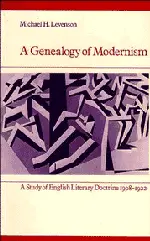
    A Genealogy of Modernism

    A Study of English Literary Doctrine 1908-1922

    AvMichael Levenson

    Häftad, Engelska, 1986

    687 kr

    Beställningsvara. Skickas inom 10-15 vardagar. Fri frakt över 249 kr.

    Beskrivning

    A Geneology of Modernism is a study of literary transition in the first two decades of the twentieth-century, a period of extraordinary ferment and great accomplishment, during which the avant-garde gradually consolidated a secure place within English culture. Michael Levenson analyses that complex process by following the successive phases of a literary movement - Impressionist, Imagist, Vorticist, Classicist - as it attempted to formulate the principles on which a new aesthetic might be founded. The emphasis here falls on the ideology of modernism, but throughout the book the ideological question is tied on the one hand to specific literary works and on the other to general movements in philosophy and the fine arts. The major figures under discussion, Joseph Conrad, Ford Madox Ford, Ezra Pound, Wyndham Lewis, and T. S. Elliot, are placed in relation to thinkers who have been largely neglected in the history of modernism: Max Stirner, Wilhelm Worringer, Pierre Lasserre, Allen Upward, and Hilaire Belloc. Levenson thus situates the emergence of a modernist aesthetic within the context of literary theory, literary practice, and cultural history.

    Produktinformation

    • Utgivningsdatum:1986-06-27
    • Mått:137 x 222 x 16 mm
    • Vikt:350 g
    • Format:Häftad
    • Språk:Engelska
    • Antal sidor:268
    • Förlag:Cambridge University Press
    • ISBN:9780521338004

    Utforska kategorier

    • Litteraturvetenskap inom Skönlitteratur

    Recensioner i media

    'Without such exact studies of a limited terrain the larger map of modernism can never be drawn.' A. Walton Litz, The Times Literary Supplement

    Innehållsförteckning

    • Part I. Progenitors: 1. Consciousness: The modernist narrator on the Victorian sailing ship: Arnold, Huxley, Pater: toward a small world and a large self; 2. Authority: Arnold and Babbitt: the best self and the new humanism: Conrad: physis and psyche; Part II. Provocation, 1908–1914: 3. Dating Hulme/parsing modernism; 4. Ford: the passing of great figures: The Victorian sage in retirement: Little moderns; 5. Egoists and imagists: The Ego and His Own: Pound/Upward: Poets rampant; 6. Hulme: the progress of reaction: The classical phase: Husserl, Frege, Moore: The making of an anti-humanist; 7. Symbol, impression, image, vortex: The problem with Imagism: Impressionism and the prose tradition: In search of a primary pigment; Part III. Conclusion: 8. The war among the moderns: The avant-garde in retreat: Pound and Eliot, a counter-current; 9. The Waste Land: Speakers and ghosts: The theory of points of view: The painful task of unifying: Myth, tradition, classicism; Epilogue. The editor and the loathed disturber.