• Fri frakt över 249 kr
  • •
  • Snabba leveranser
  • •
  • Billiga böcker
Kundservice

Du är på sajten för privatpersoner.

Företag, bibliotek eller offentlig verksamhet?

Du handlar på classic.bokus.com, där alla dina funktioner finns intakta.
Till classic.bokus.com
Bokus logotyp. Gå till startsidan.
  • Erbjudanden
  • Nyheter
  • Student
  • Topplistor
  • Barn & ungdom
  • Bokus Play
  • E-böcker
  • Pocketböcker
  • Spel & pussel

10% rabatt på allt med kod NYSTART10 →

Sidfot

Mina sidor

    Hjälp

    • Kundservice
    • Vanliga frågor och svar
    • Frakt och leverans
    • Retur vid ångerrätt
    • Reklamera vara
    • Betalning
    • Köpvillkor
    • Allmänna villkor
    • Information om webbplatsens tillgänglighet

    Om Bokus

    • Om oss
    • Pressrum
    • För studenter
    • För företag
    • För bibliotek och offentlig verksamhet
    • För leverantörer
    • Hållbarhet

    Populärt

    • Aktuella erbjudanden
    • Presentkort
    • Studentlitteratur
    • Nya böcker
    • Topplistor
    • Signerade böcker
    • Engelska böcker

    Inspiration

    • Boktips
    • BookTok
    • Populära bokserier
    • Barnbokskaraktärer
    • Populära författare
    Logotyp för Bokus
    Följ oss på Facebook (extern länk)Följ oss på Instagram (extern länk)Följ oss på YouTube (extern länk)Följ oss på TikTok (extern länk)
    bokus @ CookiesAnpassa cookiesIntegritetspolicyKöpvillkor
    Till Citymail hemsida (extern länk)Till Budbee hemsida (extern länk)Till Postnord hemsida (extern länk)Till Schenker hemsida (extern länk)Till Early Bird hemsida (extern länk)Till Walleys hemsida (extern länk)
    1. Språk och ordböcker
    2. Språkvetenskap och lingvistik

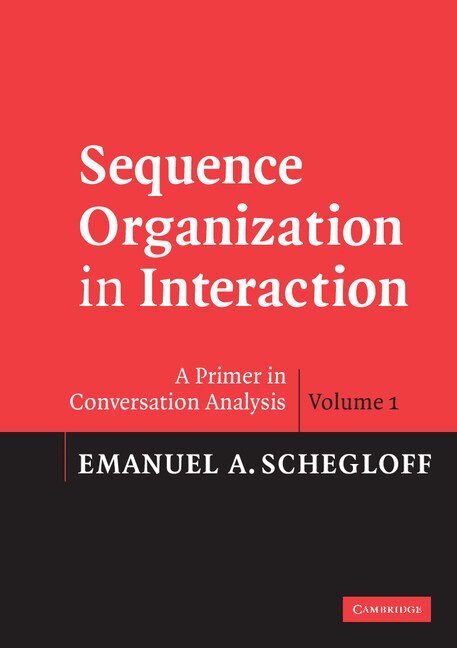
    Sequence Organization in Interaction: Volume 1

    A Primer in Conversation Analysis

    AvEmanuel A. Schegloff

    Häftad, Engelska, 2007

    654 kr

    Beställningsvara. Skickas inom 10-15 vardagar. Fri frakt över 249 kr.

    Fler format och utgåvor

    Inbunden

    1 448 kr

    Beskrivning

    Much of our daily lives are spent talking to one another, in both ordinary conversation and more specialized settings such as meetings, interviews, classrooms, and courtrooms. It is largely through conversation that the major institutions of our society - economy, religion, politics, family and law - are implemented. This book Emanuel Schegloff, the first in a series and first published in 2007, introduces the findings and theories of conversation analysis. Together, the volumes in the series constitute a complete and authoritative 'primer' in the subject. The topic of this first volume is 'sequence organization' - the ways in which turns-at-talk are ordered and combined to make actions take place in conversation, such as requests, offers, complaints, and announcements. Containing many examples from real-life conversations, it will be invaluable to anyone interested in human interaction and the workings of conversation.

    Produktinformation

    • Utgivningsdatum:2007-01-04
    • Mått:175 x 245 x 20 mm
    • Vikt:640 g
    • Format:Häftad
    • Språk:Engelska
    • Antal sidor:318
    • Förlag:Cambridge University Press
    • ISBN:9780521532792

    Utforska kategorier

    • Språkvetenskap och lingvistik inom Språk och ordböcker

    Mer om författaren

    Emanuel A. Schegloff is Distinguished Professor of Sociology and Applied Linguistics at the University of California, Los Angeles.

    Recensioner i media

    '… Schegloff's analysis of multiple redoings of first pair parts … is one of the most fascinating CA analyses I have read for some time. Throughout the analysis, Schegloff shows what may happen and how it may happen when one does not want to accept an offer. … Schegloff's examples are also available as audio and video files at the Cambridge University Press website, which is a great bonus for those who want to watch, listen and analyze the extracts alongside the analyses in the book.' Journal of Sociolinguistics

    Innehållsförteckning

    • 1. Introduction to sequence organization; 2. The adjacency pair as a unit for sequence construction; 3. Minimal, two-turn adjacency pair sequences; 4. Pre-expansion; 5. The organization of preference/dispreference; 6. Insert expansion; 7. Post-expansion; 8. Topic proffering sequences; 9. Sequence-closing sequences; 10. Sequences of sequences; 11. Retro-sequences; 12. Some variations in sequence organization; 13. Sequence as practice; 14. Ending, re-beginning, and how to use this book.