• Fri frakt över 249 kr
  • •
  • Snabba leveranser
  • •
  • Billiga böcker
Kundservice

Du är på sajten för privatpersoner.

Företag, bibliotek eller offentlig verksamhet?

Du handlar på classic.bokus.com, där alla dina funktioner finns intakta.
Till classic.bokus.com
Bokus logotyp. Gå till startsidan.
  • Erbjudanden
  • Student
  • Topplistor
  • Barn & ungdom
  • Bokus Play
  • E-böcker
  • Ljudböcker
  • Pocketböcker
  • Spel och pussel

Pocketfynda! Hundratals böcker för 49 kr/st →

Sidfot

Mina sidor

    Hjälp

    • Kundservice
    • Vanliga frågor och svar
    • Frakt och leverans
    • Retur vid ångerrätt
    • Reklamera vara
    • Betalning
    • Köpvillkor
    • Allmänna villkor
    • Information om webbplatsens tillgänglighet

    Om Bokus

    • Om oss
    • Pressrum
    • För studenter
    • För företag
    • För bibliotek och offentlig verksamhet
    • För leverantörer
    • Hållbarhet

    Populärt

    • Aktuella erbjudanden
    • Presentkort
    • Studentlitteratur
    • Nya böcker
    • Topplistor
    • Signerade böcker
    • Engelska böcker

    Inspiration

    • Boktips
    • BookTok
    • Barnbokskaraktärer
    • Populära författare
    Logotyp för Bokus
    Följ oss på Facebook (extern länk)Följ oss på Instagram (extern länk)Följ oss på YouTube (extern länk)Följ oss på TikTok (extern länk)
    bokus @ CookiesAnpassa cookiesIntegritetspolicyKöpvillkor
    Till Citymail hemsida (extern länk)Till Budbee hemsida (extern länk)Till Postnord hemsida (extern länk)Till Schenker hemsida (extern länk)Till Early Bird hemsida (extern länk)Till Walleys hemsida (extern länk)
    1. Språk och ordböcker
    2. Språkvetenskap och lingvistik

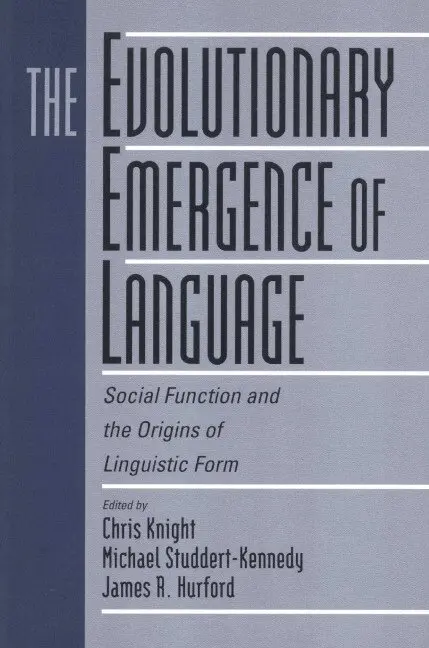
    The Evolutionary Emergence of Language

    Social Function and the Origins of Linguistic Form

    AvChris Knight,Michael Studdert-Kennedy

    Häftad, Engelska, 2000

    720 kr

    Beställningsvara. Skickas inom 7-10 vardagar. Fri frakt över 249 kr.

    Beskrivning

    Language has no counterpart in the animal world. Unique to Homo sapiens, it appears inseparable from human nature. But how, when and why did it emerge? The contributors to this volume - linguists, anthropologists, cognitive scientists, and others - adopt a modern Darwinian perspective which offers a bold synthesis of the human and natural sciences. As a feature of human social intelligence, language evolution is driven by biologically anomalous levels of social cooperation. Phonetic competence correspondingly reflects social pressures for vocal imitation, learning, and other forms of social transmission. Distinctively human social and cultural strategies gave rise to the complex syntactical structure of speech. This book, presenting language as a remarkable social adaptation, testifies to the growing influence of evolutionary thinking in contemporary linguistics. It will be welcomed by all those interested in human evolution, evolutionary psychology, linguistic anthropology, and general linguistics.

    Produktinformation

    • Utgivningsdatum:2000-11-20
    • Mått:154 x 229 x 26 mm
    • Vikt:586 g
    • Format:Häftad
    • Språk:Engelska
    • Antal sidor:440
    • Förlag:Cambridge University Press
    • ISBN:9780521786966

    Utforska kategorier

    • Språkvetenskap och lingvistik inom Språk och ordböcker

    Recensioner i media

    ' … a useful introduction to the social conditions of language evolution.' McDonald Institute for Archaeological Research

    Innehållsförteckning

    • Part I. The Evolution of Cooperative Communication: 1. Introduction: the evolution of cooperative communication Chris Knight; 2. Comprehension, production and conventionalization in the origins of language Robbins Burling; 3. Co-operation, competition and the evolution of pre-linguistic communication Jason Noble; 4. Language and hominid politics Jean-Louis Dessalles; 5. Secret language use at female initiation: bounding gossiping communities Camilla Power; 6. Play as precursor of phonology and syntax Chris Knight; Part II. The Emergence of Phonetic Structure: 7. Introduction: the emergence of phonetic structure Michael Studdert-Kennedy; 8. The role of mimesis in infant language development: evidence for phylogeny? Marilyn M. Vihman and Rory A. DePaolis; 9. Evolution of speech: the relation between ontogeny and phylogeny Peter J. MacNeilage and Barbara L. Davis; 10. Evolutionary implications of the particulate principle: imitation and the dissociation of phonetic form from semantic function Michael Studdert-Kennedy; 11. Emergence of sound systems through self-organisation Bart de Boer; 12. Modelling language-physiology coevolution Daniel Livingstone and Colin Fyfe; Part III. The Evolution of Syntax: 13. The emergence of syntax James R. Hurford; 14. The spandrels of the linguistic genotype David Lightfoot; 15. The distinction between sentences and noun phrases: an impediment to language evolution? Andrew Carstairs-McCarthy; 16. How protolanguage became language Derek Bickerton; 17. Holistic utterances in protolanguage: the link from primates to humans Alison Wray; 18. Syntax without natural selection: how compositionality emerges from vocabulary in a population of learners Simon Kirby; 19. Social transmission favours linguistic generalization James R. Hurford; 20. Words, memes and language evolution Robert P. Worden; 21. On the reconstruction of 'proto-world' word order Frederick J. Newmeyer; Epilogue; 22. The history, rate and pattern of world linguistic evolution Mark Pagel.