• Fri frakt över 249 kr
  • •
  • Snabba leveranser
  • •
  • Billiga böcker
Kundservice

Du är på sajten för privatpersoner.

Företag, bibliotek eller offentlig verksamhet?

Du handlar på classic.bokus.com, där alla dina funktioner finns intakta.
Till classic.bokus.com
Bokus logotyp. Gå till startsidan.
  • Erbjudanden
  • Nyheter
  • Student
  • Topplistor
  • Barn & ungdom
  • Bokus Play
  • E-böcker
  • Pocketböcker
  • Spel & pussel

10% rabatt på allt med kod: NYSTART10 →

Sidfot

Mina sidor

    Hjälp

    • Kundservice
    • Vanliga frågor och svar
    • Frakt och leverans
    • Retur vid ångerrätt
    • Reklamera vara
    • Betalning
    • Köpvillkor
    • Allmänna villkor
    • Information om webbplatsens tillgänglighet

    Om Bokus

    • Om oss
    • Pressrum
    • För studenter
    • För företag
    • För bibliotek och offentlig verksamhet
    • För leverantörer
    • Hållbarhet

    Populärt

    • Aktuella erbjudanden
    • Presentkort
    • Studentlitteratur
    • Nya böcker
    • Topplistor
    • Signerade böcker
    • Engelska böcker

    Inspiration

    • Boktips
    • BookTok
    • Populära bokserier
    • Barnbokskaraktärer
    • Populära författare
    Logotyp för Bokus
    Följ oss på Facebook (extern länk)Följ oss på Instagram (extern länk)Följ oss på YouTube (extern länk)Följ oss på TikTok (extern länk)
    bokus @ CookiesAnpassa cookiesIntegritetspolicyKöpvillkor
    Till Citymail hemsida (extern länk)Till Budbee hemsida (extern länk)Till Postnord hemsida (extern länk)Till Schenker hemsida (extern länk)Till Early Bird hemsida (extern länk)Till Walleys hemsida (extern länk)
    1. Skönlitteratur
    2. Litteraturvetenskap
    3. Litteraturvetenskap

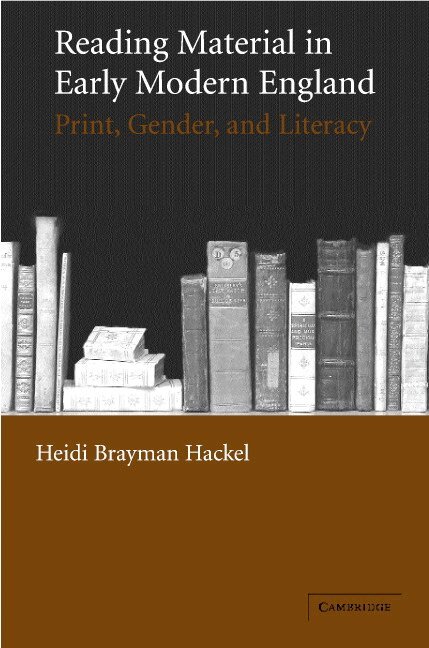
    Reading Material in Early Modern England

    Print, Gender, and Literacy

    AvHeidi Brayman Hackel

    Inbunden, Engelska, 2005

    1 535 kr

    Beställningsvara. Skickas inom 10-15 vardagar. Fri frakt över 249 kr.

    Fler format och utgåvor

    Häftad

    687 kr

    Beskrivning

    Reading Material in Early Modern England rediscovers the practices and representations of a wide range of sixteenth- and seventeenth-century English readers. Heidi Brayman Hackel argues for a history of reading centred on the traces left by merchants and maidens, gentlewomen and servants, adolescents and matrons - precisely those readers whose entry into the print marketplace provoked debate and changed the definition of literacy. By telling their stories and insisting upon their variety, Brayman Hackel displaces both the singular 'ideal' reader of literacy theory and the elite male reader of literacy history. This interdisciplinary study draws upon portraiture, prefaces, marginalia, commonplace books, inventories, diaries, letters and literature (Spenser, Shakespeare, Sidney, Greene, Dekker, Lyly, Jonson and others). A contribution to literary studies, the history of the book, cultural history and feminist criticism, this accessible book will also appeal to readers interested in our continuing engagement with print and the evolution of reading material.

    Produktinformation

    • Utgivningsdatum:2005-02-17
    • Mått:163 x 236 x 30 mm
    • Vikt:663 g
    • Format:Inbunden
    • Språk:Engelska
    • Antal sidor:336
    • Förlag:Cambridge University Press
    • ISBN:9780521842518

    Utforska kategorier

    • Litteraturvetenskap inom Skönlitteratur

    Mer om författaren

    Heidi Brayman Hackel is Assistant Professor of English at Oregon State University and author of several essays on early modern readers, literacy, and libraries.

    Recensioner i media

    "Thoroughly researched, carefully crafted and lucidly written, this fine study reviews and extends our knowledge and understanding of the materialities and rhetorics of books and the conditions and practices of readers --- especially female readers --- in early modern England." Kevin Sharpe, author of Reading Revolutions and editor with Steven N. Zwicker of Reading, Society and Politics, Queen Mary, University of London

    Innehållsförteckning

    • 1. Towards a material history of reading; 2. Impressions from a 'scribbling age': Gestures and habits of reading; 3. Framing 'gentle readers' in preliminaries and margins; 4. Noting readers of the Arcadia in marginalia and commonplace books; 5. Consuming readers: Ladies, lapdogs and libraries; Epilogue; Appendix; Bibliography; Index.