• Fri frakt över 249 kr
  • •
  • Snabba leveranser
  • •
  • Billiga böcker
Kundservice

Du är på sajten för privatpersoner.

Företag, bibliotek eller offentlig verksamhet?

Du handlar på classic.bokus.com, där alla dina funktioner finns intakta.
Till classic.bokus.com
Bokus logotyp. Gå till startsidan.
  • Erbjudanden
  • Student
  • Topplistor
  • Barn & ungdom
  • Bokus Play
  • E-böcker
  • Ljudböcker
  • Pocketböcker
  • Spel och pussel

Pocketfynda! Hundratals böcker för 49 kr/st →

Sidfot

Mina sidor

    Hjälp

    • Kundservice
    • Vanliga frågor och svar
    • Frakt och leverans
    • Retur vid ångerrätt
    • Reklamera vara
    • Betalning
    • Köpvillkor
    • Allmänna villkor
    • Information om webbplatsens tillgänglighet

    Om Bokus

    • Om oss
    • Pressrum
    • För studenter
    • För företag
    • För bibliotek och offentlig verksamhet
    • För leverantörer
    • Hållbarhet

    Populärt

    • Aktuella erbjudanden
    • Presentkort
    • Studentlitteratur
    • Nya böcker
    • Topplistor
    • Signerade böcker
    • Engelska böcker

    Inspiration

    • Boktips
    • BookTok
    • Barnbokskaraktärer
    • Populära författare
    Logotyp för Bokus
    Följ oss på Facebook (extern länk)Följ oss på Instagram (extern länk)Följ oss på YouTube (extern länk)Följ oss på TikTok (extern länk)
    bokus @ CookiesAnpassa cookiesIntegritetspolicyKöpvillkor
    Till Citymail hemsida (extern länk)Till Budbee hemsida (extern länk)Till Postnord hemsida (extern länk)Till Schenker hemsida (extern länk)Till Early Bird hemsida (extern länk)Till Walleys hemsida (extern länk)
    1. Språk och ordböcker
    2. Språkvetenskap och lingvistik

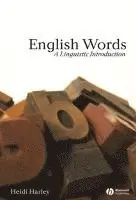
    English Words

    A Linguistic Introduction

    AvHeidi Harley

    Inbunden, Engelska, 2006

    Del 11 i serien Language Library

    1 451 kr

    Beställningsvara. Skickas inom 5-8 vardagar. Fri frakt över 249 kr.

    Fler format och utgåvor

    Häftad

    512 kr

    E-bok

    585 kr

    Beskrivning

    English Words is a comprehensive and accessible introduction to the study of English words from a theoretically informed linguistic perspective. accessibly written to give students a command of basic theory, skills in analyzing English words, and the foundation needed for more advanced study in linguistic theory or lexicologycovers basic introductory material and investigates the structure of English vocabularyintroduces students to the technical study of words from relevant areas of linguistics: phonology, morphology, syntax, semantics, historical linguistics and psycholinguistics

    Produktinformation

    • Utgivningsdatum:2006-04-18
    • Mått:160 x 238 x 22 mm
    • Vikt:572 g
    • Format:Inbunden
    • Språk:Engelska
    • Serie:Language Library
    • Antal sidor:314
    • Förlag:John Wiley and Sons Ltd
    • ISBN:9780631230311

    Utforska kategorier

    • Språkvetenskap och lingvistik inom Språk och ordböcker

    Mer om författaren

    Heidi Harley is Associate Professor in the Department of Linguistics at the University of Arizona. She specializes in lexical semantics and morphology, and has published in a wide variety of books and journals, including Linguistic Inquiry, Language, and American Speech.

    Recensioner i media

    “A very special book that captures, at an introductory level, the variety of things linguists find fascinating about the history and structure of English.” Will Leben, Stanford University

    Innehållsförteckning

    • Preface. Acknowledgments.IPA Transcription Key.1. What is a word?.1.1 Explaining word in words.1.2 Language is a secret decoder ring.1.3 Wordhood: the whole kit and caboodle.1.4 Two kinds of words.1.5 The anatomy of a listeme.1.6 What don’t you have to learn when you’re learning a word?.1.7 A scientific approach to language.2. Sound and fury: English phonology.2.1 English spelling and English pronunciation.2.2 The voice box.2.3 The building blocks of words I: Consonants in the IPA.2.4 Building blocks II: Vowels and the IPA.2.5 Families of sounds and Grimm’s law: a case in point.3. Phonological words: Calling all Scrabble players!.3.1 Guessing at words: The Scrabble problem.3.2 Building Blocks III: The Syllable.3.3 Phonotactic restrictions on English syllables.3.4 From a stream of sound into words: Speech perception.3.5 Syllables, rhythm, and stress.3.6 Using stress to parse the speech stream into words.3.7 Misparsing the speech stream, mondegreens and allophones.3.8 Allophony.3.9 What we know about phonological words.4. Where do words come from?.4.1 Getting new listemes.4.2 When do we have a new word?.4.3 New words by ‘mistake’: back-formations and folk etymologies.4.4 New words by economizing: clippings.4.5 Extreme economizing: acronyms and abbreviations.4.6 Building new words by putting listemes together: affixation and compounding.4.7 Compounding clips and mixing it up: Blends.4.8 New listemes via meaning change.4.9 But are these words really new?.5. Pre- and suf-fix-es: Engl-ish Morph-o-log-y.5.1 Listemes.5.2 Making up words.5.3 Affixal syntax: Who’s my neighbor?, Part I.5.4 Affixal phonology: Who’s my neighbor? Part II.5.5 Allomorphy.5.6 Closed-class and open-class morphemes: Reprise.6. Morphological idiosyncrasies.6.1 Different listemes, same meaning! Irregular suffixes.6.2 Root irregulars.6.3 Linguistic paleontology: fossils of older forms.6.4 Why some but not others?.6.5 How do kids figure it out?.6.6 Representing complex suffixal restrictions.6.7 Keeping Irregulars: Semantic clues to morphological classes.6.8 Irregulars III: Suppletion.6.9 Keeping Irregulars: Producing words on the fly.6.10 Productivity, blocking and Bushisms.7. Lexical semantics: The structure of meaning, the meaning of structure.7.1 Function meaning vs. Content meaning.7.2 Entailment.7.3 Function words and their meanings.7.4 Content words and their meanings.7.5 Relationships and Argument Structure: Meaning and grammar.7.6 Argument Structure.7.7 Derivational morphology and argument structure.7.8 Subtleties of argument structure.7.9 Function vs. content meanings: the showdown.7.10 How do we learn all that?.8. Children learning words.8.1 How do children learn the meanings of words?.8.2 Learning words for middle-sized observables.8.3 When the basics fail.8.4 Morphological and syntactic clues.8.5 Learning words for non-observables.8.6 Syntactic frames, theta roles and event structure.8.7 Agent-Patient Protoroles.8.8 Functional listemes interacting with content listemes.8.9 Simple co-occurrence? Or actual composition?.8.10 Yes, but where do the words come from in the first place?.9. Accidents of history: English in flux.9.1 Linguistic change, and lots of it.9.2 Layers of vocabulary and accidents of history.9.3 A brief history of England, as relevant to the English vocabulary.9.4 55 B.C. to 600 A.D. : How the English came to England.9.5 600-900 A.D. The English and the Vikings.9.6 1066-1200: Norman Rule.9.7 1200-1450: Anglicization of the Normans.9.8 1450-1600 The English Renaissance.9.9 1600 -1750: Restoration, Expansion.9.10 1750-modern day.9.11 The rise of prescriptivism: How to really speak good.9.12 English orthography: The Roman alphabet, the quill pen, the printing press and the Great Vowel Shift.9.13 Summary.List of Works Consulted.Glossary.Words Consulted.Index.