• Fri frakt över 249 kr
  • •
  • Snabba leveranser
  • •
  • Billiga böcker
Kundservice

Du är på sajten för privatpersoner.

Företag, bibliotek eller offentlig verksamhet?

Du handlar på classic.bokus.com, där alla dina funktioner finns intakta.
Till classic.bokus.com
Bokus logotyp. Gå till startsidan.
  • Erbjudanden
  • Nyheter
  • Student
  • Topplistor
  • Barn & ungdom
  • Bokus Play
  • E-böcker
  • Pocketböcker
  • Spel & pussel

10% rabatt på allt med kod NYSTART10 →

Sidfot

Mina sidor

    Hjälp

    • Kundservice
    • Vanliga frågor och svar
    • Frakt och leverans
    • Retur vid ångerrätt
    • Reklamera vara
    • Betalning
    • Köpvillkor
    • Allmänna villkor
    • Information om webbplatsens tillgänglighet

    Om Bokus

    • Om oss
    • Pressrum
    • För studenter
    • För företag
    • För bibliotek och offentlig verksamhet
    • För leverantörer
    • Hållbarhet

    Populärt

    • Aktuella erbjudanden
    • Presentkort
    • Studentlitteratur
    • Nya böcker
    • Topplistor
    • Signerade böcker
    • Engelska böcker

    Inspiration

    • Boktips
    • BookTok
    • Populära bokserier
    • Barnbokskaraktärer
    • Populära författare
    Logotyp för Bokus
    Följ oss på Facebook (extern länk)Följ oss på Instagram (extern länk)Följ oss på YouTube (extern länk)Följ oss på TikTok (extern länk)
    bokus @ CookiesAnpassa cookiesIntegritetspolicyKöpvillkor
    Till Citymail hemsida (extern länk)Till Budbee hemsida (extern länk)Till Postnord hemsida (extern länk)Till Schenker hemsida (extern länk)Till Early Bird hemsida (extern länk)Till Walleys hemsida (extern länk)
    1. Juridik
    2. Särskilda rättsområden
    3. Rättsordning

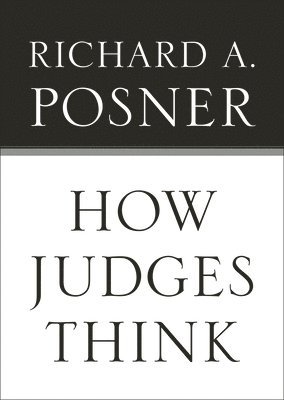
    How Judges Think

    AvRichard A. Posner

    Häftad, Engelska, 2010

    209 kr

    Beställningsvara. Skickas inom 5-8 vardagar. Fri frakt över 249 kr.

    Beskrivning

    A distinguished and experienced appellate court judge, Richard A. Posner offers in this new book a unique and, to orthodox legal thinkers, a startling perspective on how judges and justices decide cases. When conventional legal materials enable judges to ascertain the true facts of a case and apply clear pre-existing legal rules to them, Posner argues, they do so straightforwardly; that is the domain of legalist reasoning. However, in non-routine cases, the conventional materials run out and judges are on their own, navigating uncharted seas with equipment consisting of experience, emotions, and often unconscious beliefs. In doing so, they take on a legislative role, though one that is confined by internal and external constraints, such as professional ethics, opinions of respected colleagues, and limitations imposed by other branches of government on freewheeling judicial discretion. Occasional legislators, judges are motivated by political considerations in a broad and sometimes a narrow sense of that term. In that open area, most American judges are legal pragmatists. Legal pragmatism is forward-looking and policy-based. It focuses on the consequences of a decision in both the short and the long term, rather than on its antecedent logic. Legal pragmatism so understood is really just a form of ordinary practical reasoning, rather than some special kind of legal reasoning. Supreme Court justices are uniquely free from the constraints on ordinary judges and uniquely tempted to engage in legislative forms of adjudication. More than any other court, the Supreme Court is best understood as a political court.

    Produktinformation

    • Utgivningsdatum:2010-05-01
    • Mått:143 x 249 x 26 mm
    • Vikt:568 g
    • Format:Häftad
    • Språk:Engelska
    • Antal sidor:400
    • Förlag:Harvard University Press
    • ISBN:9780674048065

    Utforska kategorier

    • Rättsordning inom Juridik
    • Juridik: metod och teori inom Juridik

    Mer om författaren

    Richard A. Posner retired as a judge of the United States Court of Appeals for the Seventh Circuit in 2017. He was previously a senior lecturer at the University of Chicago Law School.

    Recensioner i media

    Posner is unique in the world of American jurisprudence, a highly regarded U.S. appellate judge and a prolific and controversial writer on legal philosophy. Opinionated, sarcastic and argumentative as ever, Posner is happy to weigh in not only on how judges think, but how he thinks they should think. When sticking to explaining the nine intellectual approaches to judging that he identifies, and to the gap between legal academics and judges, and his well-formulated pragmatic approach to judging, Posner is insightful, accessible, often funny and a model of clarity.

    Innehållsförteckning

    • * Introduction Part One: The Basic Model * Nine Theories of Judicial Behavior * The Judge as Labor-Market Participant * The Judge as Occasional Legislator * The Mind of the Legislating Judge Part Two: The Model Elaborated * The Judicial Environment: External Constraints on Judging * Altering the Environment: Tenure and Salary Issues * Judicial Method: Internal Constraints on Judging * Judges Are Not Law Professors * Is Pragmatic Adjudication Inescapable? Part Three: Justices * The Supreme Court Is a Political Court * Comprehensive Constitutional Theories * Judicial Cosmopolitanism * Conclusion * Acknowledgments * Index