• Fri frakt över 249 kr
  • •
  • Snabba leveranser
  • •
  • Billiga böcker
Kundservice

Du är på sajten för privatpersoner.

Företag, bibliotek eller offentlig verksamhet?

Du handlar på classic.bokus.com, där alla dina funktioner finns intakta.
Till classic.bokus.com
Bokus logotyp. Gå till startsidan.
  • Erbjudanden
  • Nyheter
  • Student
  • Topplistor
  • Barn & ungdom
  • Bokus Play
  • E-böcker
  • Pocketböcker
  • Spel & pussel

10% rabatt på allt med kod NYSTART10 →

Sidfot

Mina sidor

    Hjälp

    • Kundservice
    • Vanliga frågor och svar
    • Frakt och leverans
    • Retur vid ångerrätt
    • Reklamera vara
    • Betalning
    • Köpvillkor
    • Allmänna villkor
    • Information om webbplatsens tillgänglighet

    Om Bokus

    • Om oss
    • Pressrum
    • För studenter
    • För företag
    • För bibliotek och offentlig verksamhet
    • För leverantörer
    • Hållbarhet

    Populärt

    • Aktuella erbjudanden
    • Presentkort
    • Studentlitteratur
    • Nya böcker
    • Topplistor
    • Signerade böcker
    • Engelska böcker

    Inspiration

    • Boktips
    • BookTok
    • Populära bokserier
    • Barnbokskaraktärer
    • Populära författare
    Logotyp för Bokus
    Följ oss på Facebook (extern länk)Följ oss på Instagram (extern länk)Följ oss på YouTube (extern länk)Följ oss på TikTok (extern länk)
    bokus @ CookiesAnpassa cookiesIntegritetspolicyKöpvillkor
    Till Citymail hemsida (extern länk)Till Budbee hemsida (extern länk)Till Postnord hemsida (extern länk)Till Schenker hemsida (extern länk)Till Early Bird hemsida (extern länk)Till Walleys hemsida (extern länk)
    1. Naturvetenskap och teknik
    2. Matematik och naturvetenskap
    3. Fysik
    4. Materietillstånd

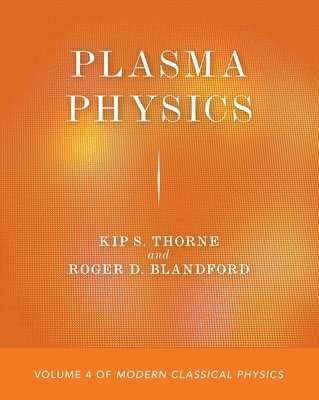
    Plasma Physics

    Volume 4 of Modern Classical Physics

    AvKip S. Thorne,Roger D. Blandford

    Häftad, Engelska, 2021

    536 kr

    Beställningsvara. Skickas inom 5-8 vardagar. Fri frakt över 249 kr.

    Beskrivning

    A groundbreaking textbook on twenty-first-century plasma physics and its applicationsKip Thorne and Roger Blandford’s monumental Modern Classical Physics is now available in five stand-alone volumes that make ideal textbooks for individual graduate or advanced undergraduate courses on statistical physics; optics; elasticity and fluid dynamics; plasma physics; and relativity and cosmology. Each volume teaches the fundamental concepts, emphasizes modern, real-world applications, and gives students a physical and intuitive understanding of the subject.Plasma Physics provides an essential introduction to the subject. A gas that is significantly ionized, usually by heating or photons, a plasma is composed of electrons and ions and sometimes has an embedded or confining magnetic field. Plasmas play a major role in many contemporary applications, phenomena, and fields, including attempts to achieve controlled thermonuclear fusion using magnetic or inertial confinement; in explanations of radio wave propagation in the ionosphere and the behavior of the solar corona and wind; and in astrophysics, where plasmas are responsible for emission throughout the electromagnetic spectrum, including from black holes, highly magnetized neutron stars, and ultrarelativistic outflows. The book also can serve as supplementary reading for many other courses, including in astrophysics, geophysics, and controlled fusion.Includes many exercise problemsFeatures color figures, suggestions for further reading, extensive cross-references, and a detailed indexOptional “Track 2” sections make this an ideal book for a one-quarter or one-semester courseAn online illustration package is available to professorsThe five volumes, which are available individually as paperbacks and ebooks, are Statistical Physics; Optics; Elasticity and Fluid Dynamics; Plasma Physics; and Relativity and Cosmology.

    Produktinformation

    • Utgivningsdatum:2021-06-15
    • Mått:203 x 254 x 20 mm
    • Vikt:703 g
    • Format:Häftad
    • Språk:Engelska
    • Antal sidor:304
    • Förlag:Princeton University Press
    • ISBN:9780691215501

    Utforska kategorier

    • Materietillstånd inom Naturvetenskap och teknik

    Mer om författaren

    Kip S. Thorne, winner of the Nobel Prize in physics, is the Feynman Professor Emeritus of Theoretical Physics at Caltech. His books include Gravitation (Princeton) and Black Holes and Time Warps: Einstein’s Outrageous Legacy. Roger D. Blandford, winner of the Crafoord and Shaw prizes in astronomy, is the Luke Blossom Professor in the School of Humanities and Sciences and founding director of the Kavli Institute for Particle Astrophysics and Cosmology at Stanford University.

    Recensioner i media

    "Kip S. Thorne, Co-Winner of the 2017 Nobel Prize in Physics"

    Innehållsförteckning

    • List of BoxesPrefaceContents of Modern Classical Physics, volumes 1–519 Magnetohydrodynamics19.1 Overview19.2 Basic Equations of MHD19.2.1 Maxwell’s Equations in the MHD Approximation19.2.2 Momentum and Energy Conservation19.2.3 Boundary Conditions19.2.4 Magnetic Field and Vorticity19.3 Magnetostatic Equilibria19.3.1 Controlled Thermonuclear Fusion19.3.2 Z-Pinch19.3.3 Θ-Pinch19.3.4 Tokamak19.4 Hydromagnetic Flows19.5 Stability of Magnetostatic Equilibria19.5.1 Linear Perturbation Theory19.5.2 Z-Pinch: Sausage and Kink Instabilities19.5.3 The Θ-Pinch and Its Toroidal Analog; Flute Instability; Motivation for Tokamak19.5.4 Energy Principle and Virial Theorems19.6 Dynamos and Reconnection of Magnetic Field Lines19.6.1 Cowling’s Theorem19.6.2 Kinematic Dynamos19.6.3 Magnetic Reconnection19.7 Magnetosonic Waves and the Scattering of Cosmic Rays19.7.1 Cosmic Rays19.7.2 Magnetosonic Dispersion Relation19.7.3 Scattering of Cosmic Rays by Alfvén WavesBibliographic NotePART VI PLASMA PHYSICS20 The Particle Kinetics of Plasma20.1 Overview20.2 Examples of Plasmas and Their Density-Temperature Regimes20.2.1 Ionization Boundary20.2.2 Degeneracy Boundary20.2.3 Relativistic Boundary20.2.4 Pair-Production Boundary20.2.5 Examples of Natural and Human-Made Plasmas20.3 Collective Effects in Plasmas—Debye Shielding and Plasma Oscillations20.3.1 Debye Shielding20.3.2 Collective Behavior20.3.3 Plasma Oscillations and Plasma Frequency20.4 Coulomb Collisions20.4.1 Collision Frequency20.4.2 The Coulomb Logarithm20.4.3 Thermal Equilibration Rates in a Plasma20.4.4 Discussion20.5 Transport Coefficients20.5.1 Coulomb Collisions20.5.2 Anomalous Resistivity and Anomalous Equilibration20.6 Magnetic Field20.6.1 Cyclotron Frequency and Larmor Radius20.6.2 Validity of the Fluid Approximation20.6.3 Conductivity Tensor20.7 Particle Motion and Adiabatic Invariants20.7.1 Homogeneous, Time-Independent Magnetic Field and No Electric Field20.7.2 Homogeneous, Time-Independent Electric and Magnetic Fields20.7.3 Inhomogeneous, Time-Independent Magnetic Field20.7.4 A Slowly Time-Varying Magnetic Field20.7.5 Failure of Adiabatic Invariants; Chaotic OrbitsBibliographic Note21 Waves in Cold Plasmas: Two-Fluid Formalism21.1 Overview21.2 Dielectric Tensor,Wave Equation, and General Dispersion Relation21.3 Two-Fluid Formalism21.4 Wave Modes in an Unmagnetized Plasma21.4.1 Dielectric Tensor and Dispersion Relation for a Cold, Unmagnetized Plasma21.4.2 Plasma Electromagnetic Modes21.4.3 Langmuir Waves and Ion-Acoustic Waves inWarm Plasmas21.4.4 Cutoffs and Resonances21.5 Wave Modes in a Cold, Magnetized Plasma21.5.1 Dielectric Tensor and Dispersion Relation21.5.2 Parallel Propagation21.5.3 Perpendicular Propagation21.5.4 Propagation of Radio Waves in the Ionosphere; Magnetoionic Theory21.5.5 CMA Diagram forWave Modes in a Cold, Magnetized Plasma21.6 Two-Stream InstabilityBibliographic Note22 Kinetic Theory ofWarm Plasmas22.1 Overview22.2 Basic Concepts of Kinetic Theory and Its Relationship to Two-Fluid Theory22.2.1 Distribution Function and Vlasov Equation22.2.2 Relation of Kinetic Theory to Two-Fluid Theory22.2.3 Jeans’ Theorem22.3 Electrostatic Waves in an Unmagnetized Plasma: Landau Damping22.3.1 Formal Dispersion Relation22.3.2 Two-Stream Instability22.3.3 The Landau Contour22.3.4 Dispersion Relation forWeakly Damped or Growing Waves22.3.5 Langmuir Waves and Their Landau Damping22.3.6 Ion-Acoustic Waves and Conditions for Their Landau Damping to BeWeak22.4 Stability of Electrostatic Waves in Unmagnetized Plasmas22.4.1 Nyquist’s Method22.4.2 Penrose’s Instability Criterion22.5 Particle Trapping22.6 𝒩-Particle Distribution Function22.6.1 BBGKY Hierarchy22.6.2 Two-Point Correlation Function22.6.3 Coulomb Correction to Plasma PressureBibliographic Note23 Nonlinear Dynamics of Plasmas23.1 Overview23.2 Quasilinear Theory in Classical Language23.2.1 Classical Derivation of the Theory23.2.2 Summary of Quasilinear Theory23.2.3 Conservation Laws23.2.4 Generalization to 3 Dimensions23.3 Quasilinear Theory in Quantum Mechanical Language23.3.1 Plasmon Occupation Number 𝜂23.3.2 Evolution of 𝜂 for Plasmons via Interaction with Electrons23.3.3 Evolution of 𝑓 for Electrons via Interaction with Plasmons23.3.4 Emission of Plasmons by Particles in the Presence of a Magnetic Field23.3.5 Relationship between Classical and Quantum Mechanical Formalisms23.3.6 Evolution of 𝜂 via Three-Wave Mixing23.4 Quasilinear Evolution of Unstable Distribution Functions—A Bump in the Tail23.4.1 Instability of Streaming Cosmic Rays23.5 Parametric Instabilities; Laser Fusion23.6 Solitons and Collisionless Shock WavesBibliographic NoteApp. A Evolution of Vorticity14.2 Vorticity, Circulation, and Their Evolution14.2.1 Vorticity Evolution14.2.2 Barotropic, Inviscid, Compressible Flows: Vortex Lines Frozen into FluidApp. B Geometric Optics7.2 Waves in a Homogeneous Medium7.2.1 Monochromatic Plane Waves; Dispersion Relation7.2.2 Wave Packets7.3 Waves in an Inhomogeneous, Time-Varying Medium: The Eikonal Approximation and Geometric Optics7.3.1 Geometric Optics for a Prototypical Wave Equation7.3.2 Connection of Geometric Optics to Quantum Theory7.3.3 Geometric Optics for a General Wave7.3.4 Examples of Geometric-Optics Wave Propagation7.3.5 Relation to Wave Packets; Limitations of the Eikonal Approximation and Geometric Optics7.3.6 Fermat’s PrincipleApp. C Distribution Function and Mean Occupation Number3.2 Phase Space and Distribution Function3.2.1 Newtonian Number Density in Phase Space, 𝒩3.2.3 Distribution Function f (x, v, t) for Particles in a Plasma3.2.5 Mean Occupation Number 𝜂ReferencesName IndexSubject IndexContents of the Unified Work, Modern Classical PhysicsPreface to Modern Classical PhysicsAcknowledgments for Modern Classical Physics