• Fri frakt över 249 kr
  • •
  • Snabba leveranser
  • •
  • Billiga böcker
Kundservice

Du är på sajten för privatpersoner.

Företag, bibliotek eller offentlig verksamhet?

Du handlar på classic.bokus.com, där alla dina funktioner finns intakta.
Till classic.bokus.com
Bokus logotyp. Gå till startsidan.
  • Erbjudanden
  • Nyheter
  • Student
  • Topplistor
  • Barn & ungdom
  • Bokus Play
  • E-böcker
  • Pocketböcker
  • Spel & pussel

10% rabatt på allt med kod: NYSTART10 →

Sidfot

Mina sidor

    Hjälp

    • Kundservice
    • Vanliga frågor och svar
    • Frakt och leverans
    • Retur vid ångerrätt
    • Reklamera vara
    • Betalning
    • Köpvillkor
    • Allmänna villkor
    • Information om webbplatsens tillgänglighet

    Om Bokus

    • Om oss
    • Pressrum
    • För studenter
    • För företag
    • För bibliotek och offentlig verksamhet
    • För leverantörer
    • Hållbarhet

    Populärt

    • Aktuella erbjudanden
    • Presentkort
    • Studentlitteratur
    • Nya böcker
    • Topplistor
    • Signerade böcker
    • Engelska böcker

    Inspiration

    • Boktips
    • BookTok
    • Populära bokserier
    • Barnbokskaraktärer
    • Populära författare
    Logotyp för Bokus
    Följ oss på Facebook (extern länk)Följ oss på Instagram (extern länk)Följ oss på YouTube (extern länk)Följ oss på TikTok (extern länk)
    bokus @ CookiesAnpassa cookiesIntegritetspolicyKöpvillkor
    Till Citymail hemsida (extern länk)Till Budbee hemsida (extern länk)Till Postnord hemsida (extern länk)Till Schenker hemsida (extern länk)Till Early Bird hemsida (extern länk)Till Walleys hemsida (extern länk)
    1. Historia och arkeologi
    2. Historia
    3. Amerikas historia

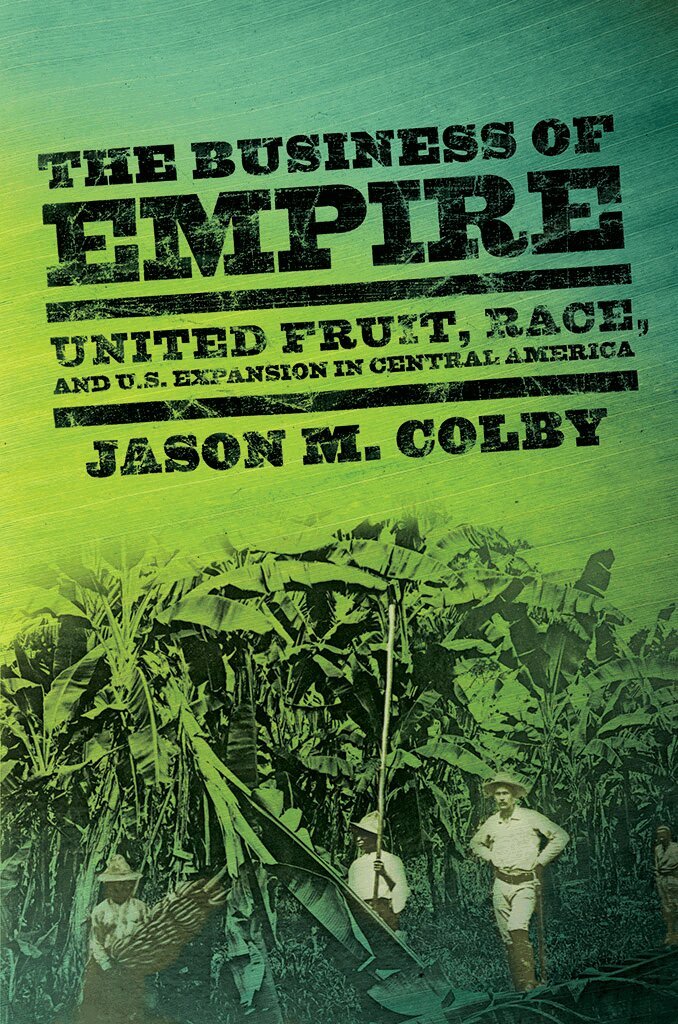
    Business of Empire

    United Fruit, Race, and U.S. Expansion in Central America

    AvJason M. Colby

    Häftad, Engelska, 2013

    Del i serien United States in the World

    293 kr

    Beställningsvara. Skickas inom 10-15 vardagar. Fri frakt över 249 kr.

    Fler format och utgåvor

    Inbunden

    622 kr

    Beskrivning

    "Jason M. Colby has researched and analyzed his topic―the business of empire―well. He exposes the intertwining of imperialism, expansion, racism, and corporate power. The Business of Empire is an insightful story about the interaction of U.S. overseas business and the U.S. and Central American governments. It will prove useful to scholars of U.S. imperialism, international business history, and U.S.–Central American relations for generations."― Journal of American HistoryThe link between private corporations and U.S. world power has a much longer history than most people realize. Transnational firms such as the United Fruit Company represent an earlier stage of the economic and cultural globalization now taking place throughout the world. Drawing on a wide range of archival sources in the United States, Great Britain, Costa Rica, and Guatemala, Colby combines "top-down" and "bottom-up" approaches to provide new insight into the role of transnational capital, labor migration, and racial nationalism in shaping U.S. expansion into Central America and the greater Caribbean. The Business of Empire places corporate power and local context at the heart of U.S. imperial history.In the early twentieth century, U.S. influence in Central America came primarily in the form of private enterprise, above all United Fruit. Founded amid the U.S. leap into overseas empire, the company initially depended upon British West Indian laborers. When its black workforce resisted white American authority, the firm adopted a strategy of labor division by recruiting Hispanic migrants. This labor system drew the company into increased conflict with its host nations, as Central American nationalists denounced not only U.S. military interventions in the region but also American employment of black immigrants. By the 1930s, just as Washington renounced military intervention in Latin America, United Fruit pursued its own Good Neighbor Policy, which brought a reduction in its corporate colonial power and a ban on the hiring of black immigrants. The end of the company's system of labor division in turn pointed the way to the transformation of United Fruit as well as the broader U.S. empire.

    Produktinformation

    • Utgivningsdatum:2013-11-07
    • Mått:152 x 229 x 21 mm
    • Vikt:454 g
    • Format:Häftad
    • Språk:Engelska
    • Serie:United States in the World
    • Antal sidor:288
    • Förlag:Cornell University Press
    • ISBN:9780801478994
    • Utmärkelser:Honorable mention, Stuart L. Bernath Book Prize gi

    Utforska kategorier

    • Amerikas historia inom Historia och arkeologi
    • Internationella relationer inom Samhälle och politik

    Mer om författaren

    Jason M. Colby is Assistant Professor of History at the University of Victoria, British Columbia.

    Recensioner i media

    Colby builds upon earlier extensive scholarship on the subject to integrate, for the first time, corporate expansion and labor migration into the story of U.S. imperialism in the region. As a result, he shows how domestic racial paradigms shaped transnational US firms, highlights connections between the U.S. government and corporate colonialism, and illustrates the pervasiveness of labor control strategies in the region.(Choice) Colby writes both a comparative and a transnational history. He presents a deeply researched, richly textured comparative study of the UFC in Costa Rica and Guatemala. The Business of Empire makes a worthwhile contribution to the social and cultural history of the UFC, the history of British Caribbean migrants in Central America, Central American labor history, and the inception of particular racialized forms of nationalism in Central America that, Colby convincingly argues, were logical reactions to U.S. 'corporate colonialism.'.(American Historical Review) Colby's tightly focused research on race adds a new layer of understanding to the subject of U.S. domination in Central America. Concentrating on the varied environments of the Panama Canal Zone, self-defined 'white' Costa Rica, and Guatemala, with its large Mayan Indian population. Colby observes the different tactics and vocabulary employed by governments and company officials. Many actions that are seen as indicative of United States foreign policy, he argues, were, in fact, creations of the United Fruit Company.(Times Literary Supplement) In the United States this book will be seen as an important contribution to the 'America in the World' approach; in Central America it will be read as an influential revision of the impact of the 'Octopus' on internal processes. Without a hint of dependency theory (it used to be mandatory to refer to dependency when writing about UFCO), Colby's perspective sheds new light on the fruit company's impact on the economies, societies, politics and foreign relations of Central American countries.- Héctor Lindo-Fuentes (Journal of Latin American Studies) Jason M. Colby has researched and analyzed his topic—the business of empire—well. He exposes the intertwining of imperialism, expansion, racism, and corporate power. The Business of Empire is an insightful story about the interaction of U.S. overseas business and the U.S. and Central American governments. It will prove useful to scholars of U.S. imperialism, international business history, and U.S.–Central American relations for generations.(Journal of American History)

    Innehållsförteckning

    • IntroductionPart I. Foundations of Empire1. Enterprise and Expansion, 1848–18852. Joining the Imperial World, 1885–1904Part II. Race and Labor3. Corporate Colonialism, 1904–19124. Divided Workers, 1912–1921Part III. Imperial Transitions5. The Rise of Hispanic Nationalism, 1921–19296. Reframing the Empire, 1929–1940EpilogueNotesBibliographyIndex