• Fri frakt över 249 kr
  • •
  • Snabba leveranser
  • •
  • Billiga böcker
Kundservice

Du är på sajten för privatpersoner.

Företag, bibliotek eller offentlig verksamhet?

Du handlar på classic.bokus.com, där alla dina funktioner finns intakta.
Till classic.bokus.com
Bokus logotyp. Gå till startsidan.
  • Erbjudanden
  • Nyheter
  • Student
  • Topplistor
  • Barn & ungdom
  • Bokus Play
  • E-böcker
  • Pocketböcker
  • Spel & pussel

10% rabatt på allt med kod: NYSTART10 →

Sidfot

Mina sidor

    Hjälp

    • Kundservice
    • Vanliga frågor och svar
    • Frakt och leverans
    • Retur vid ångerrätt
    • Reklamera vara
    • Betalning
    • Köpvillkor
    • Allmänna villkor
    • Information om webbplatsens tillgänglighet

    Om Bokus

    • Om oss
    • Pressrum
    • För studenter
    • För företag
    • För bibliotek och offentlig verksamhet
    • För leverantörer
    • Hållbarhet

    Populärt

    • Aktuella erbjudanden
    • Presentkort
    • Studentlitteratur
    • Nya böcker
    • Topplistor
    • Signerade böcker
    • Engelska böcker

    Inspiration

    • Boktips
    • BookTok
    • Populära bokserier
    • Barnbokskaraktärer
    • Populära författare
    Logotyp för Bokus
    Följ oss på Facebook (extern länk)Följ oss på Instagram (extern länk)Följ oss på YouTube (extern länk)Följ oss på TikTok (extern länk)
    bokus @ CookiesAnpassa cookiesIntegritetspolicyKöpvillkor
    Till Citymail hemsida (extern länk)Till Budbee hemsida (extern länk)Till Postnord hemsida (extern länk)Till Schenker hemsida (extern länk)Till Early Bird hemsida (extern länk)Till Walleys hemsida (extern länk)
    1. Historia och arkeologi
    2. Historia
    3. Amerikas historia

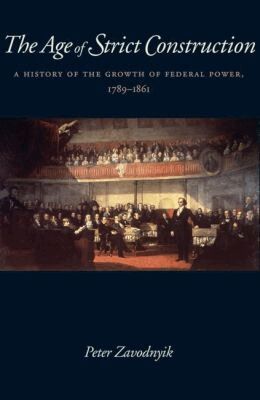
    Age of Strict Construction

    A History of the Growth of Federal Power, 1789–1861

    AvPeter Zavodnyik

    Häftad, Engelska, 2014

    393 kr

    Beställningsvara. Skickas inom 10-15 vardagar. Fri frakt över 249 kr.

    Beskrivning

    The Age of Strict Construction explores the growth of the federal government's power and influence between 1789 and 1861, and the varying reactions of Americans to that growth. The book focuses on the dispute over the spending power of Congress, the Supreme Court's expansion of the Contract Clause, and the centralizing effects of the Jacksonian spoils system. The book also surveys the conflict over constitutional interpretation--originalism v. textualism--that has divided Americans from the time of the dispute over the first Bank of the United States until the present day.The standard interpretation of American history holds that the federal government remained a weak and passive creature until the New Deal. The Age of Strict Construction argues that this interpretation is not valid--if measured against the original understanding of the powers of Congress and the Supreme Court, federal authority grew rapidly during the antebellum period. The most stunning aspect of centralization occurred with the rise of a party system heavily dependent on federal largesse for patronage.The book also details how the federal government quickly came to play an unexpectedly prominent role in the lives of citizens, as its policies in areas such as land sales and tariffs had a huge effect on the fortunes of individual Americans. It also explains how the Founders' classical ideas of a rural electorate immune to pecuniary considerations quickly succumbed to the changes brought on by the arrival of a market economy and the growth of cities.The relationship between centralization and the sectional crisis of the 1850s is also explored. The book turns the long-running argument over the cause of secession--slavery v. the growth of federal power--on its head by revealing how the two combined to cause southern states to leave the Union.

    Produktinformation

    • Utgivningsdatum:2014-07-31
    • Mått:153 x 227 x 23 mm
    • Vikt:529 g
    • Format:Häftad
    • Språk:Engelska
    • Antal sidor:382
    • Förlag:The Catholic University of America Press
    • ISBN:9780813227122

    Utforska kategorier

    • Amerikas historia inom Historia och arkeologi
    • Politik och statsskick inom Samhälle och politik

    Mer om författaren

    Peter Zavodnyik is an attorney in private practice in Chicago. He is also the author of The Rise of the Federal Colossus: The Growth of Federal Power from Lincoln to F.D.R. (Praeger).

    Recensioner i media

    “It is one of the many virtues of Peter Zavodnyik’s excellent new book to take a fresh, and insightful, look at what we tend to regard as the Executive’s quietest years, those from the Founding until the Civil War.” - National Review online“The scope of Peter Zavodnyik’s book is greater than his title may suggest. . . . Zavodnyik gives us a chronological survey of federal policy in the light of constitutional power in interaction with the politics surrounding the use of the powers. He thus gives us a very nice account of the relation between constitutional and political factors, an account often missing in studies that focus on one factor or the other. . . . Zavodnyik has produced a provocative book that not only highlights oftenneglected features of the era, but supplies intriguing insights into the coming of the Civil War.” - The Journal of American History“This work serves as a challenge to the traditional interpretation of the growth of federal power. It also provides another explanation for the secession of the southern states, a topic on which scholars will no doubt be weighing in. This interesting and provocative study, which depends heavily on secondary work, has a place in the collections of all four-year academic institutions. . . . Highly recommended.” - Choice“[A]n important addition to the literature on antebellum federalism.” - Journal of Southern History“[A]n intriguing account of the strict interpretation of the Constitution in light of the growth of federal power during the antebellum period. . .Any student of American constitutionalism will find this work useful if only for his extensive documentation of Congressional speeches highlighting the bitter contest over the Constitution’s meaning. The result is a study that challenges many of historians’ preconceived notions about who advocated strict construction and why.” - The Historian