• Fri frakt över 249 kr
  • •
  • Snabba leveranser
  • •
  • Billiga böcker
Kundservice

Du är på sajten för privatpersoner.

Företag, bibliotek eller offentlig verksamhet?

Du handlar på classic.bokus.com, där alla dina funktioner finns intakta.
Till classic.bokus.com
Bokus logotyp. Gå till startsidan.
  • Erbjudanden
  • Student
  • Topplistor
  • Barn & ungdom
  • Bokus Play
  • E-böcker
  • Ljudböcker
  • Pocketböcker
  • Spel och pussel

Pocketfynda! Hundratals böcker för 49 kr/st →

Sidfot

Mina sidor

    Hjälp

    • Kundservice
    • Vanliga frågor och svar
    • Frakt och leverans
    • Retur vid ångerrätt
    • Reklamera vara
    • Betalning
    • Köpvillkor
    • Allmänna villkor
    • Information om webbplatsens tillgänglighet

    Om Bokus

    • Om oss
    • Pressrum
    • För studenter
    • För företag
    • För bibliotek och offentlig verksamhet
    • För leverantörer
    • Hållbarhet

    Populärt

    • Aktuella erbjudanden
    • Presentkort
    • Studentlitteratur
    • Nya böcker
    • Topplistor
    • Signerade böcker
    • Engelska böcker

    Inspiration

    • Boktips
    • BookTok
    • Barnbokskaraktärer
    • Populära författare
    Logotyp för Bokus
    Följ oss på Facebook (extern länk)Följ oss på Instagram (extern länk)Följ oss på YouTube (extern länk)Följ oss på TikTok (extern länk)
    bokus @ CookiesAnpassa cookiesIntegritetspolicyKöpvillkor
    Till Citymail hemsida (extern länk)Till Budbee hemsida (extern länk)Till Postnord hemsida (extern länk)Till Schenker hemsida (extern länk)Till Early Bird hemsida (extern länk)Till Walleys hemsida (extern länk)
    1. Naturvetenskap och teknik
    2. Geovetenskap
    3. Geovetenskap
    4. Meteorologi och klimatologi

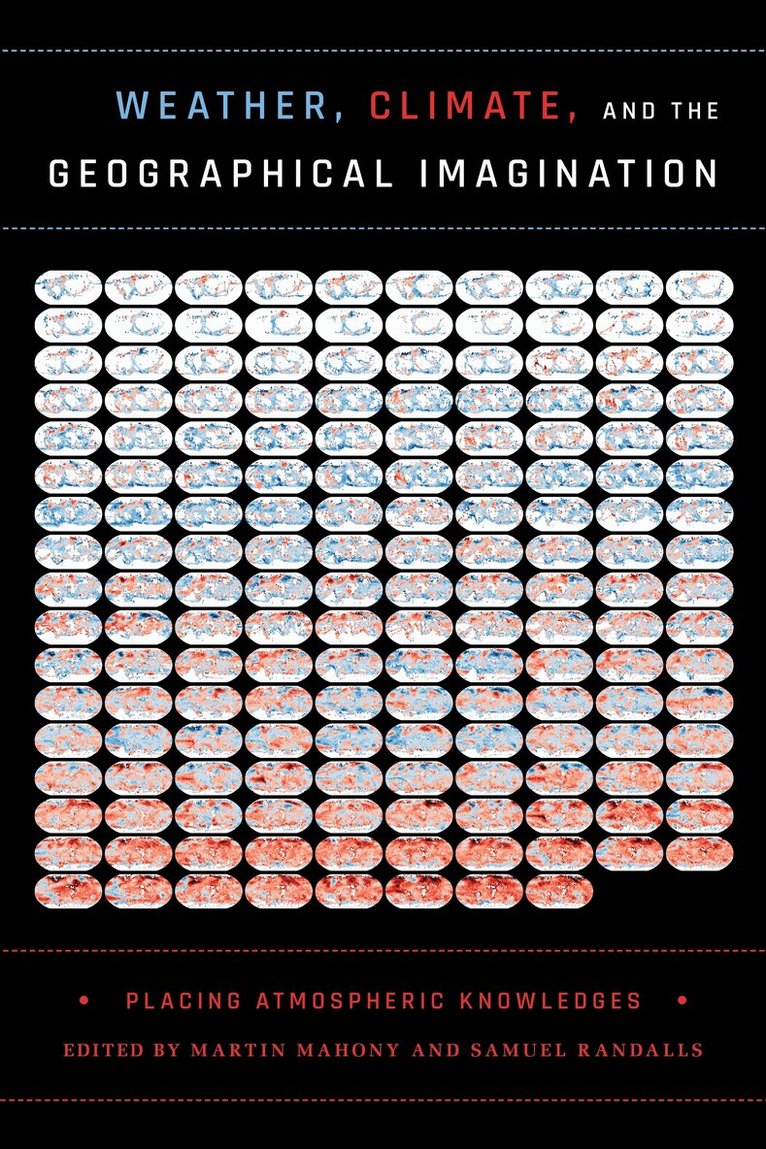
    Weather, Climate, and the Geographical Imagination

    Placing Atmospheric Knowledges

    AvMartin Mahony,Samuel Randalls

    Inbunden, Engelska, 2020

    Del i serien Intersections

    761 kr

    Beställningsvara. Skickas inom 5-8 vardagar. Fri frakt över 249 kr.

    Beskrivning

    As global temperatures rise under the forcing hand of humanity’s greenhouse gas emissions, new questions are being asked of how societies make sense of their weather, of the cultural values, which are afforded to climate, and of how environmental futures are imagined, feared, predicted, and remade. Weather, Climate, and Geographical Imagination contributes to this conversation by bringing together a range of voices from history of science, historical geography, and environmental history, each speaking to a set of questions about the role of space and place in the production, circulation, reception, and application of knowledges about weather and climate. The volume develops the concept of “geographical imagination” to address the intersecting forces of scientific knowledge, cultural politics, bodily experience, and spatial imaginaries, which shape the history of knowledges about climate.

    Produktinformation

    • Utgivningsdatum:2020-03-24
    • Mått:152 x 229 x 38 mm
    • Vikt:703 g
    • Format:Inbunden
    • Språk:Engelska
    • Serie:Intersections
    • Antal sidor:360
    • Förlag:University of Pittsburgh Press
    • ISBN:9780822946168

    Utforska kategorier

    • Meteorologi och klimatologi inom Naturvetenskap och teknik

    Mer om författaren

    Martin Mahony (Editor) Martin Mahony is a lecturer in human geography at the University of East Anglia, United Kingdom. He works on the history of atmospheric science and technology and on the politics of climate change.Samuel Randalls (Editor) Samuel Randalls is an associate professor in geography at University College London. His research explores both contemporary and historical relationships between business, science, and the environment, with a particular focus on weather and climate.

    Recensioner i media

    If we are to truly understand contemporary climate change and its various social constructions and machinations, we must situate it within a reasonable understanding of the historical context of the measurement, study, portrayals, and uses of climate, both social and scientific. Using the concept of the ‘geographical imagination’ and how that imagination helped produce what was or is known as climate knowledge, provides a useful and perhaps vital frame for understanding that context. These fourteen contributors provide concrete examples of climate knowledge creations and imagination, many in support of the project of British Imperialism. An important volume that forces one to reconsider the ways we’ve always thought about climate.