• Fri frakt över 249 kr
  • •
  • Snabba leveranser
  • •
  • Billiga böcker
Kundservice

Du är på sajten för privatpersoner.

Företag, bibliotek eller offentlig verksamhet?

Du handlar på classic.bokus.com, där alla dina funktioner finns intakta.
Till classic.bokus.com
Bokus logotyp. Gå till startsidan.
  • Erbjudanden
  • Nyheter
  • Student
  • Topplistor
  • Barn & ungdom
  • Bokus Play
  • E-böcker
  • Pocketböcker
  • Spel & pussel

10% rabatt på allt med kod: NYSTART10 →

Sidfot

Mina sidor

    Hjälp

    • Kundservice
    • Vanliga frågor och svar
    • Frakt och leverans
    • Retur vid ångerrätt
    • Reklamera vara
    • Betalning
    • Köpvillkor
    • Allmänna villkor
    • Information om webbplatsens tillgänglighet

    Om Bokus

    • Om oss
    • Pressrum
    • För studenter
    • För företag
    • För bibliotek och offentlig verksamhet
    • För leverantörer
    • Hållbarhet

    Populärt

    • Aktuella erbjudanden
    • Presentkort
    • Studentlitteratur
    • Nya böcker
    • Topplistor
    • Signerade böcker
    • Engelska böcker

    Inspiration

    • Boktips
    • BookTok
    • Populära bokserier
    • Barnbokskaraktärer
    • Populära författare
    Logotyp för Bokus
    Följ oss på Facebook (extern länk)Följ oss på Instagram (extern länk)Följ oss på YouTube (extern länk)Följ oss på TikTok (extern länk)
    bokus @ CookiesAnpassa cookiesIntegritetspolicyKöpvillkor
    Till Citymail hemsida (extern länk)Till Budbee hemsida (extern länk)Till Postnord hemsida (extern länk)Till Schenker hemsida (extern länk)Till Early Bird hemsida (extern länk)Till Walleys hemsida (extern länk)
    1. Skönlitteratur
    2. Litteraturvetenskap
    3. Litteraturvetenskap

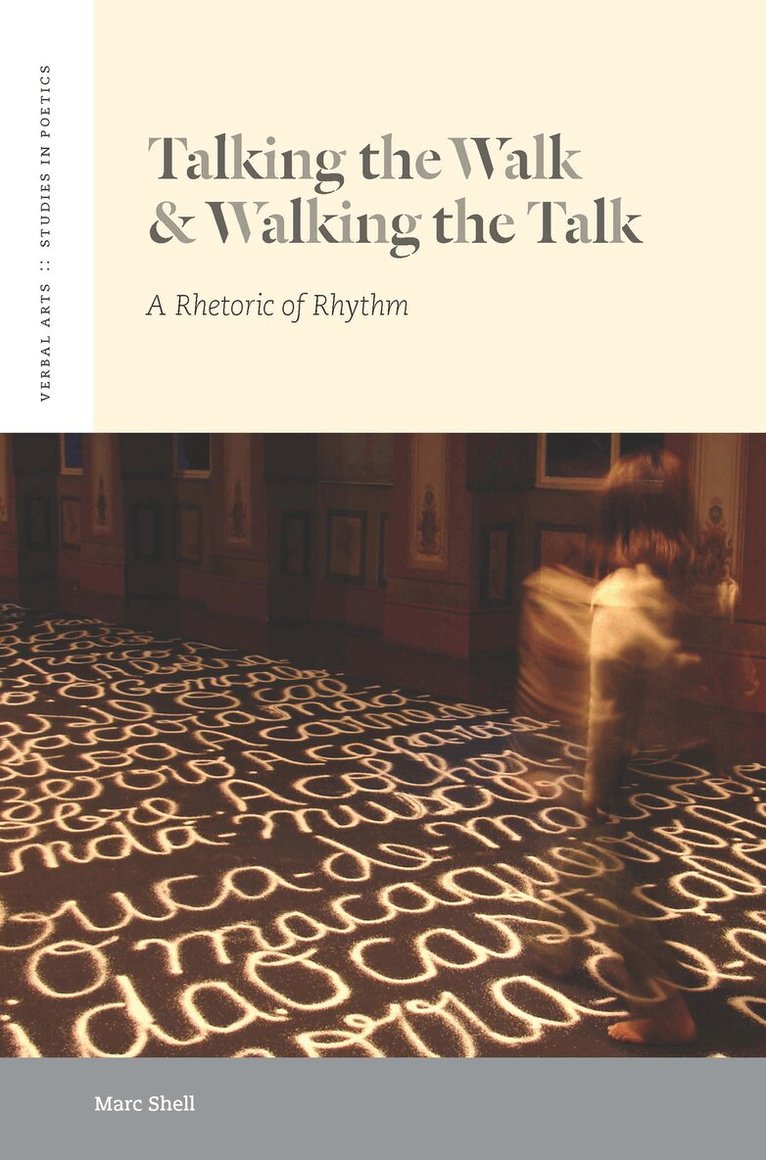
    Talking the Walk & Walking the Talk

    A Rhetoric of Rhythm

    AvMarc Shell

    Häftad, Engelska, 2015

    Del i serien Verbal Arts: Studies in Poetics

    391 kr

    Beställningsvara. Skickas inom 10-15 vardagar. Fri frakt över 249 kr.

    Fler format och utgåvor

    Inbunden

    1 206 kr

    Beskrivning

    This book argues that we should regard walking and talking in a single rhythmic vision. In doing so, it contributes to the theory of prosody, our understanding of respiration and looking, and, in sum, to the particular links, across the board, between the human characteristics of bipedal walking and meaningful talk.The author first introduces the philosophical, neurological, anthropological, and aesthetic aspects of the subject in historical perspective, then focuses on rhetoric and introduces a tension between the small and large issues of rhythm. He thereupon turns his attention to the roles of breathing in poetry—as a life-and-death matter, with attention to beats and walking poems. This opens onto technical concepts from the classical traditions of rhetoric and philology.Turning to the relationship between prosody and motion, he considers both animals and human beings as both ostensibly able-bodied creatures and presumptively disabled ones. Finally, he looks at dancing and writing as aspects of walking and talking, with special attention to motion in Arabic and Chinese calligraphy.The final chapters of the book provide a series of interrelated representative case studies.

    Produktinformation

    • Utgivningsdatum:2015-09-01
    • Mått:152 x 229 x 11 mm
    • Vikt:306 g
    • Format:Häftad
    • Språk:Engelska
    • Serie:Verbal Arts: Studies in Poetics
    • Antal sidor:224
    • Förlag:Fordham University Press
    • ISBN:9780823256839

    Utforska kategorier

    • Litteraturvetenskap inom Skönlitteratur

    Mer om författaren

    Marc Shell, a John D. and Catherine T. MacArthur Fellow, is Irving BabbittProfessor of Comparative Literature and Professor of English and AmericanLiterature and Language at Harvard University. The most recent of his many books are Polio and Its Aftermath: The Paralysis of Culture and Stutter.

    Recensioner i media

    "A few paragraphs of Marc Shell, dip in where you will, and you know you're in the presence of one of the profession's small handful of eccentric polymaths and geniuses." -- -Paul Fry Yale University

    Innehållsförteckning

    • CHAPTER ONE: STARTING OUT 1. Prologue & Preamble 2. Talking & Walking 3. Rhythm & Meter 4. Scansion & Breathing (Caesura, Beat, Walking Poems) 5. Kinesiology & Prosody (Canine Walkies, Galloping Verse, Lame Metrics) 6. Writing & Dancing 7. Letting the Ducks Out CHAPTER TWO: WALKING VOICES 1. "And God went, 'Where are you'?" in the Bible's In The Beginning 2. The Walking Bass in Monteverdi's My Foot Slips Again [1624] 3. "I can Scarcely Move or Draw my Breath" in Purcell's King Arthur [1691] CHAPTER THREE: TRIPS OF THE TONGUE IN HAMLET [1600] 1. Crawl 2. Pause 3. Mobility 4. Claudication 5. Will he Nill he 6. Triplex CHAPTER FOUR: TALKING CURES 1. "Walking and Talking at the Same Time": Wordsworth's Dilation (Pedestrianism, Bumming, Hopping & Ambling) 2. "Slips of the Tongue": Freud's Hinking (Hysterical Narratives, Limping Iambics) CHAPTER FIVE: WALKIE TALKIES 1. Tin Man's "Can Can Can" in The Wizard of Oz [1939] 2. Foghorn Leghorn's "Walkie Talkie" in Walky Talky Hawky [1946] 3. Lina Lamont's "Pipes and Stems" in Singin' in the Rain [1952] 4. L.B. Jeffries' "Totter" in Rear Window [1954] CHAPTER SIX: MARCHING & HEILING IN THE GREAT DICTATOR [1940] 1. Powerful Crowds 2. Goose Steps 3. Macaronic Speeches 4. Anatine Quacks 5. Mind the Music CHAPTER SEVEN: SIGN LANGUAGES 1. Ma Bell's "Let your Fingers do the Walking" in The Yellow Pages [1962] 2. Dorothy Miles' Body-Sign Language in Gestures [1976] CHAPTER EIGHT: POSTAMBLE & EPILOGUE 1. Reduplication 2. Talking the Walk & Walking the Talk 3. The Finish Line 4. A Walking Solution BACK MATTER 1. Illustrations (List) 2. Abbreviations